School of Public Health and Social Work& Institute of Health and Biomedical Innovation, Queensland University of Technology, Kelvin Grove, Brisbane, Australia.
Environ Health. 2013 Feb 1;12:12. doi: 10.1186/1476-069X-12-12.
Hot and cold temperatures have been associated with childhood asthma. However, the relationship between daily temperature variation and childhood asthma is not well understood. This study aimed to examine the relationship between diurnal temperature range (DTR) and childhood asthma.
A Poisson generalized linear model combined with a distributed lag non-linear model was used to examine the relationship between DTR and emergency department admissions for childhood asthma in Brisbane, from January 1st 2003 to December 31st 2009.
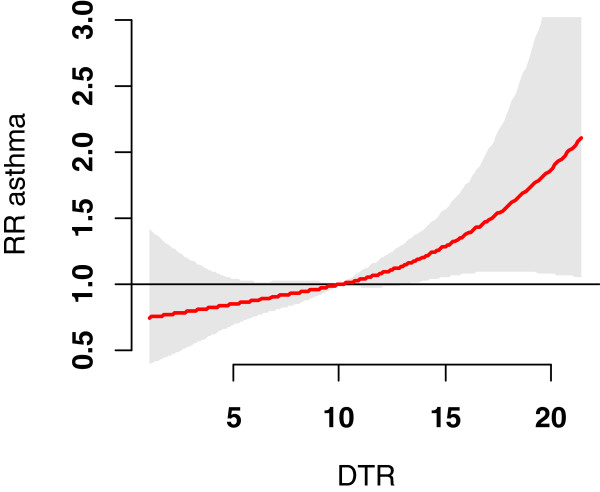
There was a statistically significant relationship between DTR and childhood asthma. The DTR effect on childhood asthma increased above a DTR of 10°C. The effect of DTR on childhood asthma was the greatest for lag 0-9 days, with a 31% (95% confidence interval: 11% - 58%) increase of emergency department admissions per 5°C increment of DTR. Male children and children aged 5-9 years appeared to be more vulnerable to the DTR effect than others.
Large DTR may trigger childhood asthma. Future measures to control and prevent childhood asthma should include taking temperature variability into account. More protective measures should be taken after a day of DTR above 10°C.
热和冷的温度与儿童哮喘有关。然而,日温差(DTR)与儿童哮喘之间的关系尚不清楚。本研究旨在探讨 DTR 与儿童哮喘急诊就诊之间的关系。
采用泊松广义线性模型结合分布式滞后非线性模型,分析 2003 年 1 月 1 日至 2009 年 12 月 31 日布里斯班儿童哮喘急诊就诊与 DTR 之间的关系。
DTR 与儿童哮喘之间存在统计学显著关系。DTR 对儿童哮喘的影响在 DTR 超过 10°C 时增加。DTR 对儿童哮喘的影响在滞后 0-9 天最大,DTR 每增加 5°C,急诊就诊增加 31%(95%置信区间:11%-58%)。男童和 5-9 岁儿童似乎比其他儿童更容易受到 DTR 影响。
大的 DTR 可能会引发儿童哮喘。未来控制和预防儿童哮喘的措施应考虑温度变异性。在 DTR 超过 10°C 的一天后,应采取更多的保护措施。