Department of Immunology, St. Jude Children's Research Hospital, Memphis, TN 38105, USA.
Semin Immunol. 2012 Dec;24(6):421-8. doi: 10.1016/j.smim.2012.12.004. Epub 2013 Feb 1.
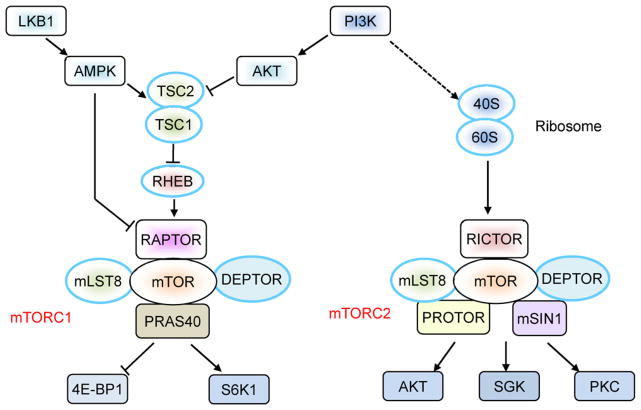
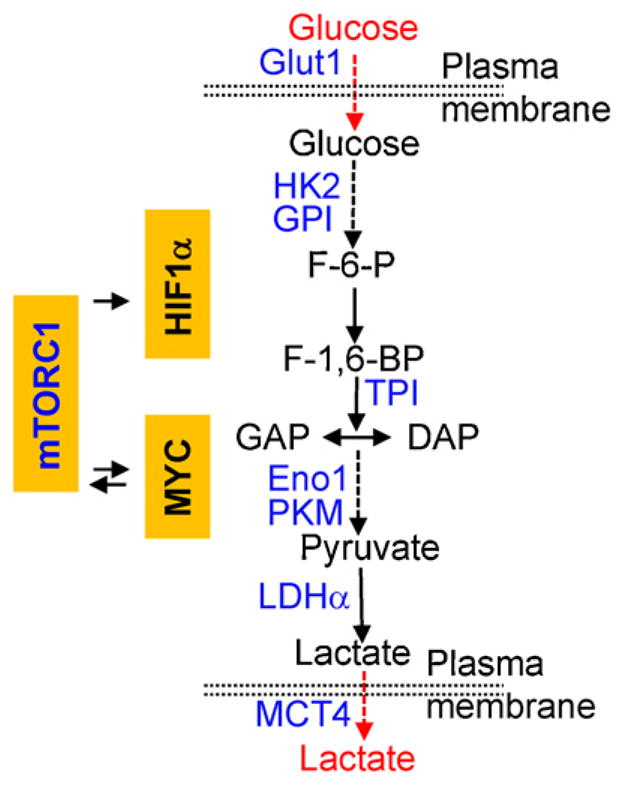
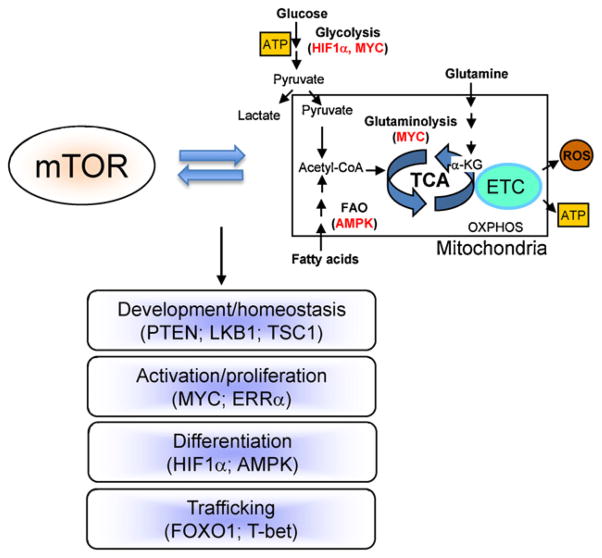
The mechanistic target of rapamycin (mTOR), an evolutionally conserved serine and threonine kinase, plays a critical role in the promotion of cell growth and proliferation via integration of cellular and environmental cues. In adaptive immunity, the mTOR pathway orchestrates multiple physiological processes including the development and homeostasis of T cells under steady state, and their subsequent activation and differentiation upon antigen recognition. Associated with such fate decisions is the dynamic reprogramming of T cell metabolic pathways, as naïve, activated and memory cells are defined by distinct bioenergetic and biosynthetic activities. Emerging evidence indicates that mTOR signaling intersects with T cell metabolism at two major levels to constitute a critical control mechanism of T cell fate decisions. First, as a central environmental sensor, mTOR links immune signaling and the availability of nutrients, especially amino acids. Second, mTOR activates specific metabolic pathways in T cells such as aerobic glycolysis (also known as the "Warburg effect") in a process dependent upon the induction of transcription factors MYC and HIF1α. Understanding how mTOR interplays with T cell metabolism to dictate T cell fates and functions will provide fundamental insights into the mechanism of immune responses and the development of novel therapeutics against immune-mediated diseases. In this review, we summarize the current advances on mTOR signaling and T cell metabolism in the control of development, homeostasis, activation and differentiation of T cells.
雷帕霉素靶蛋白(mTOR)是一种进化上保守的丝氨酸/苏氨酸激酶,通过整合细胞和环境信号,在促进细胞生长和增殖方面发挥着关键作用。在适应性免疫中,mTOR 途径协调了多种生理过程,包括静息状态下 T 细胞的发育和稳态,以及抗原识别后 T 细胞的激活和分化。与这些命运决定相关的是 T 细胞代谢途径的动态重编程,因为幼稚、激活和记忆细胞具有不同的能量代谢和生物合成活性。新出现的证据表明,mTOR 信号在两个主要水平上与 T 细胞代谢相交,构成了 T 细胞命运决定的关键控制机制。首先,作为中央环境传感器,mTOR 将免疫信号与营养物质(特别是氨基酸)的可用性联系起来。其次,mTOR 在 T 细胞中激活特定的代谢途径,如有氧糖酵解(也称为“Warburg 效应”),这一过程依赖于转录因子 MYC 和 HIF1α 的诱导。了解 mTOR 如何与 T 细胞代谢相互作用来决定 T 细胞的命运和功能,将为免疫反应的机制和针对免疫介导疾病的新型治疗方法的发展提供基础。在这篇综述中,我们总结了目前关于 mTOR 信号和 T 细胞代谢在控制 T 细胞发育、稳态、激活和分化方面的最新进展。