Rehberger T G, Glatz B A
Department of Food Technology, Iowa State University, Ames 50011.
Appl Environ Microbiol. 1990 Apr;56(4):864-71. doi: 10.1128/aem.56.4.864-871.1990.
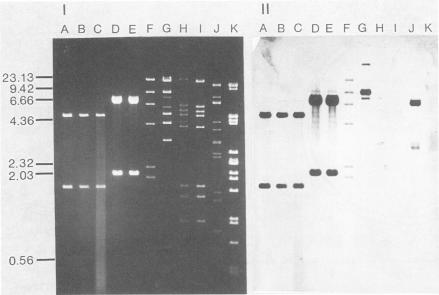
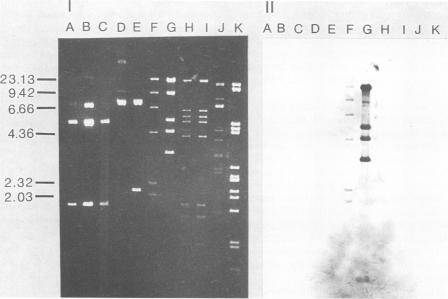
Plasmid DNAs from 15 Propionibacterium strains were characterized by using restriction endonuclease analyses, DNA-DNA hybridizations, and curing experiments. Restriction endonuclease analysis identified seven distinct plasmids (pRGO1 through pRGO7). Detailed restriction maps were constructed for four of these plasmids. DNA-DNA hybridization analysis revealed that plasmids pRGO1 and pRGO2 had extensive sequence homology and that both were homologous to pRGO7 and to similar sequences of pRGO5. Plasmids pRGO4 and pRGO6 did not have any significant sequence homology with any of the other plasmids. Plasmid pRGO3 had partial sequence homology only with pRGO7. Curing of plasmids pRGO1, pRGO2, and pRGO5 was achieved by treatment with acriflavin, but we failed to identify any plasmid-encoded bacteriocin production, carbohydrate fermentation, or antibiotic resistance. However, physical evidence was obtained that tentatively linked the clumping phenotype of Propionibacterium jensenii P38 with plasmid pRGO5.
通过限制性内切酶分析、DNA-DNA杂交和消除实验对15株丙酸杆菌的质粒DNA进行了表征。限制性内切酶分析鉴定出7种不同的质粒(pRGO1至pRGO7)。为其中4种质粒构建了详细的限制性图谱。DNA-DNA杂交分析表明,质粒pRGO1和pRGO2具有广泛的序列同源性,并且两者均与pRGO7以及pRGO5的相似序列同源。质粒pRGO4和pRGO6与其他任何质粒均无明显的序列同源性。质粒pRGO3仅与pRGO7具有部分序列同源性。通过吖啶黄素处理实现了质粒pRGO1、pRGO2和pRGO5的消除,但我们未能鉴定出任何由质粒编码的细菌素产生、碳水化合物发酵或抗生素抗性。然而,获得了初步将詹氏丙酸杆菌P38的聚集表型与质粒pRGO5联系起来的物理证据。