Department of Cardiology, Beijing Anzhen Hospital of Capital Medical University, No, 2 Anzhen Road, Chaoyang district, Beijing, China.
Cardiovasc Diabetol. 2013 Feb 11;12:33. doi: 10.1186/1475-2840-12-33.
Acute phase hyperglycemia has been associated with increased mortality in patients with acute myocardial infarction (AMI). However, the predictive value of glycemic excursion for adverse outcome in elderly AMI patients is not clear. The aim of this study is to investigate the prognostic value of early in-hospital glycemic excursion and hemoglobin A1c (HbA1c) for one-year major adverse cardiac event (MACE) in elderly patients with AMI.
We studied 186 elderly AMI patients, whose clinical data were collected and the Global Registry of Acute Coronary Events (GRACE) risk score were calculated on admission. The fluctuations of blood glucose in patients were measured by a continuous glucose monitoring system (CGMS) for 72 hours. Participants were grouped into tertiles of mean amplitude of glycemic excursions (MAGE) and grouped into HbA1c levels (as ≥6.5% or <6.5%). The MACE of patients, including new-onset myocardial infarction, acute heart failure and cardiac death, was documented during one year follow-up. The relationship of MAGE and HbA1c to the incidence of MACE in elderly AMI patients was analyzed.
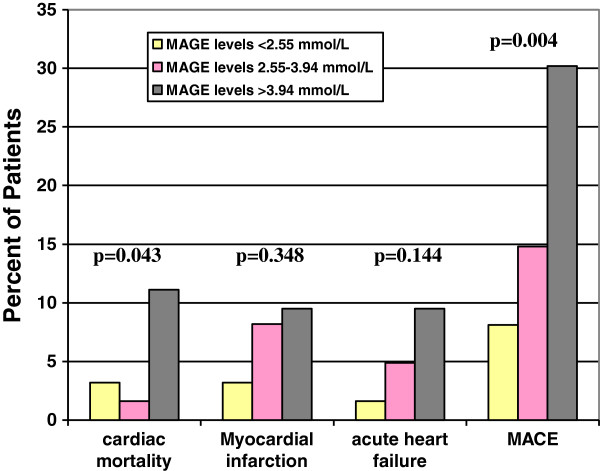
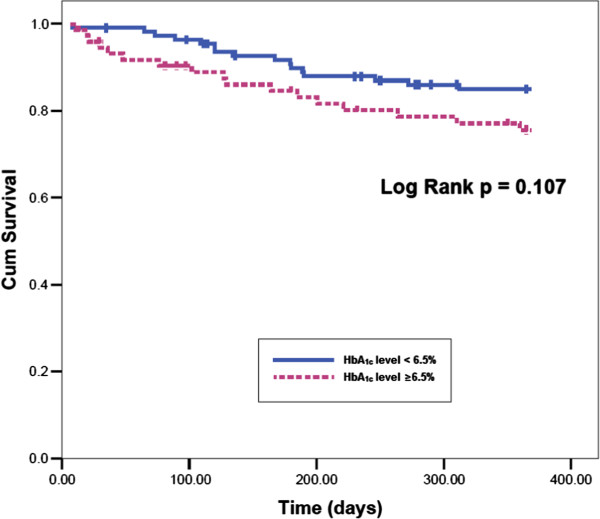
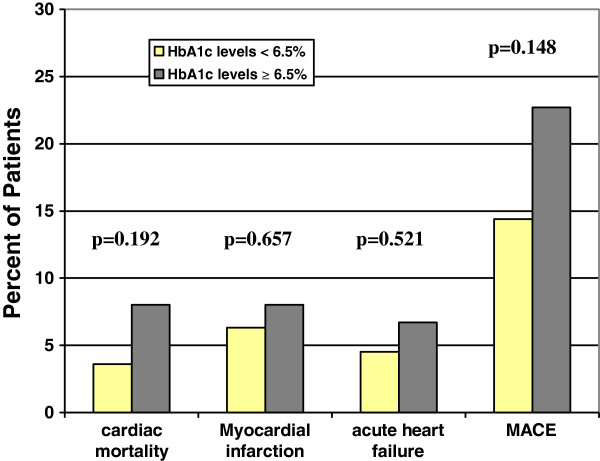
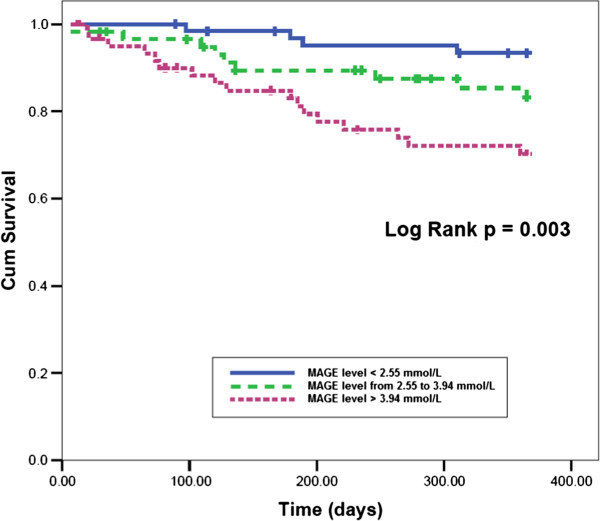
In all participants, a higher MAGE level was associated with the higher GRACE score (r = 0.335, p < 0.001). The rate of MACE by MAGE tertiles (>3.94 mmol/L, 2.55-3.94 mmol/L or <2.55 mmol/L) was 30.2% vs. 14.8% vs. 8.1%, respectively (p = 0.004); by HbA1c category (≥6.5% vs. <6.5%) was 22.7% vs. 14.4%, respectively (p = 0.148). Elderly AMI patients with a higher MAGE level had a significantly higher cardiac mortality. In multivariable analysis, high MAGE level was significantly associated with incidence of MACE (HR 3.107, 95% CI 1.190-8.117, p = 0.021) even after adjusting for GRACE risk score, but HbA1c was not.
The early in-hospital intraday glycemic excursion may be an important predictor of mortality and MACE even stronger than HbA1c in elderly patients after AMI.
急性心肌梗死(AMI)患者的急性期高血糖与死亡率增加有关。然而,血糖波动对老年 AMI 患者不良预后的预测价值尚不清楚。本研究旨在探讨老年 AMI 患者入院后早期血糖波动和糖化血红蛋白(HbA1c)对一年主要不良心脏事件(MACE)的预测价值。
我们研究了 186 名老年 AMI 患者,收集了他们的临床数据,并在入院时计算了全球急性冠状动脉事件登记处(GRACE)风险评分。通过连续血糖监测系统(CGMS)测量患者的血糖波动 72 小时。参与者根据平均血糖波动幅度(MAGE)的三分位数分组,并根据 HbA1c 水平(≥6.5%或<6.5%)分组。在 1 年随访期间记录患者的 MACE,包括新发心肌梗死、急性心力衰竭和心脏死亡。分析 MAGE 和 HbA1c 与老年 AMI 患者 MACE 发生率的关系。
在所有参与者中,较高的 MAGE 水平与较高的 GRACE 评分相关(r=0.335,p<0.001)。根据 MAGE 三分位数(>3.94mmol/L、2.55-3.94mmol/L 或<2.55mmol/L),MACE 的发生率分别为 30.2%、14.8%和 8.1%(p=0.004);根据 HbA1c 类别(≥6.5%或<6.5%),发生率分别为 22.7%和 14.4%(p=0.148)。MAGE 水平较高的老年 AMI 患者的心脏死亡率明显较高。多变量分析显示,高 MAGE 水平与 MACE 发生率显著相关(HR 3.107,95%CI 1.190-8.117,p=0.021),即使在调整了 GRACE 风险评分后也是如此,但 HbA1c 则不然。
即使在调整了 GRACE 风险评分后,老年 AMI 患者入院后日内血糖波动也可能是死亡率和 MACE 的重要预测指标,其预测价值甚至强于 HbA1c。