Faculty of Sport Sciences and Physical Education, University of Coimbra, Estádio Universitário, Pavilhão 3, 3040-156 Coimbra, Portugal.
Cardiovasc Diabetol. 2012 Feb 6;11:13. doi: 10.1186/1475-2840-11-13.
The aim of this study is to investigate the relationships between HbA1c and other risk factors like obesity, functional fitness, lipid profile, and inflammatory status in older adults. Epidemiological evidence suggests that HbA1c is associated with cardiovascular and ischemic heart disease risk. Excess of body weight and obesity are considered to play a central role in the development of these conditions. Age is associated with several risk factors as increased body fat and abdominal fat, deterioration of the lipid profile, diabetes, raising in inflammatory activity, or decreased functional fitness.
Data were available from 118 participants aged 65-95 years, including 72 women and 46 men. Anthropometric variables were taken, as was functional fitness, blood pressure and heart rate. Blood samples were collected after 12 h fasting, and HbA1c, hs-CRP, TG, TC, HDL-C, LDL-C, and glycaemia were calculated. Bivariate and partial correlations were performed to explore associations amongst the variables of interest. Differences between groups were explored by performing factorial analysis of variance.
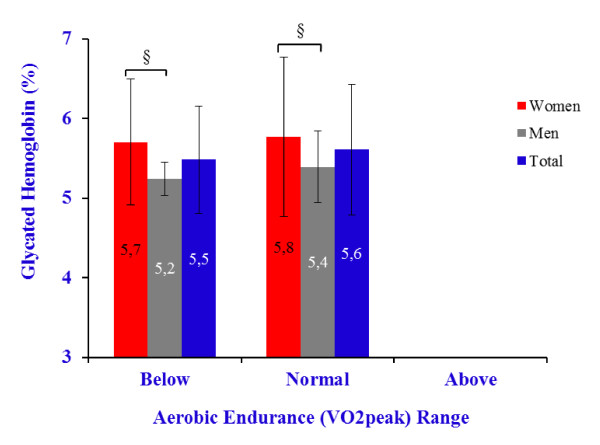
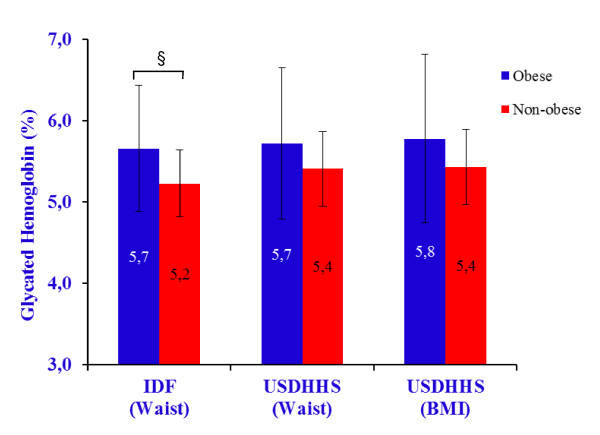
HbA1c levels ranged from 4.6%-9.4% with 93% of the cases below 6.5%. Women had higher HbA1c, glycaemia, TC, BMI, and lower and upper flexibility than men. Men had higher BW, WC, 6-min walking distance, and VO2peak than women. Age, SBP, DBP, HRrest, HRpeak, HDL-C, LDL-C, TG, TG/HDL-C ratio, Log10 hs-CRP, upper and lower strength, and agility and dynamic balance were similar in men and women. HbA1c had positive associations with glycaemia, HDL-C, TG/HDL-C, BW, WC, BMI, but not with functional fitness, TC, LDL-C, Log10 hs-CRP, PAD, or PAS. Obese participants had higher HbA1c than non-obese only when IDF and not USDHHS criteria were applied.
Older women had higher HbA1c than men, even after controlling for BMI. HbA1c associates equally with BW, BMI or WC. Population-based criteria are recommended to classify obesity and to identify higher levels of HbA1c in obese older adults. HbA1c associates with atherogenic dyslipidemia particularly with TG and TG/HDL-C ratio, but not with TC, HDL-C, or LDL-C. HbA1c is not associated with hs-CRP, and with functional fitness and aerobic endurance.
本研究旨在探讨 HbA1c 与肥胖、功能适应性、血脂谱和炎症状态等其他危险因素之间的关系,这些因素在老年人中与心血管疾病和缺血性心脏病风险相关。流行病学证据表明,HbA1c 与心血管和缺血性心脏病风险相关。超重和肥胖被认为在这些疾病的发展中起着核心作用。随着年龄的增长,身体脂肪和腹部脂肪增加、血脂谱恶化、糖尿病、炎症活动增加或功能适应性下降等多种风险因素也会随之而来。
本研究纳入了 118 名年龄在 65-95 岁的参与者,其中包括 72 名女性和 46 名男性。测量了参与者的人体测量变量、功能适应性、血压和心率。采集 12 小时禁食后的血液样本,计算 HbA1c、hs-CRP、TG、TC、HDL-C、LDL-C 和血糖。进行了双变量和偏相关分析,以探讨感兴趣变量之间的关联。通过进行方差因子分析来探讨组间差异。
HbA1c 水平范围为 4.6%-9.4%,其中 93%的病例低于 6.5%。女性的 HbA1c、血糖、TC、BMI 以及上下肢灵活性均高于男性,而男性的 BW、WC、6 分钟步行距离和 VO2peak 均高于女性。男女之间的年龄、SBP、DBP、HRrest、HRpeak、HDL-C、LDL-C、TG、TG/HDL-C 比值、Log10 hs-CRP、上下肢力量、敏捷性和动态平衡等差异无统计学意义。HbA1c 与血糖、HDL-C、TG/HDL-C、BW、WC、BMI 呈正相关,但与功能适应性、TC、LDL-C、Log10 hs-CRP、PAD 或 PAS 无相关性。仅当使用 IDF 而不是 USDHHS 标准时,肥胖参与者的 HbA1c 才高于非肥胖者。
即使在控制 BMI 后,老年女性的 HbA1c 也高于男性。HbA1c 与 BW、BMI 或 WC 呈同等相关。建议使用基于人群的标准来对肥胖进行分类,并识别肥胖老年人中 HbA1c 水平的升高。HbA1c 与致动脉粥样硬化的血脂异常相关,尤其是与 TG 和 TG/HDL-C 比值相关,但与 TC、HDL-C 或 LDL-C 无关。HbA1c 与 hs-CRP 无关,与功能适应性和有氧耐力也无关。