Department of Developmental Psychology, University of Padova, Italy.
Neuroimage. 2014 Jan 15;85 Pt 1(0 1):181-91. doi: 10.1016/j.neuroimage.2013.04.082. Epub 2013 Apr 29.
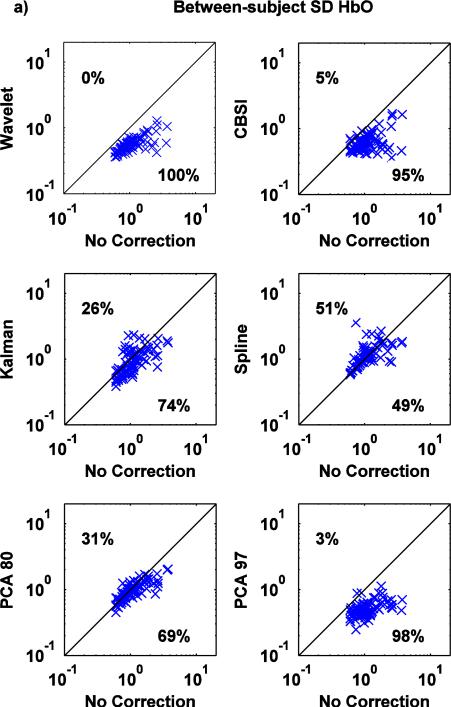
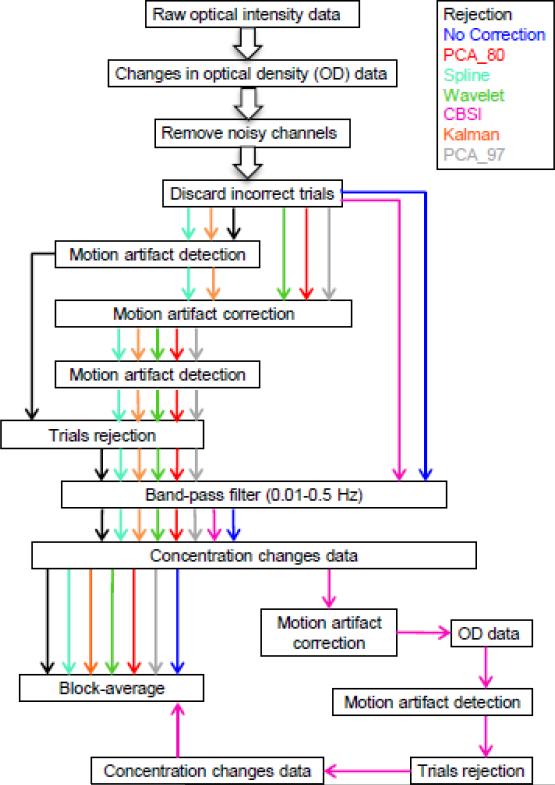
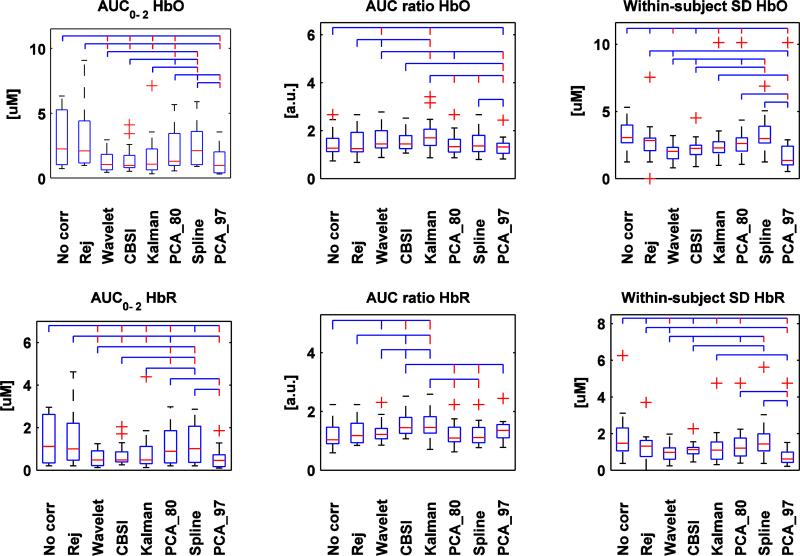
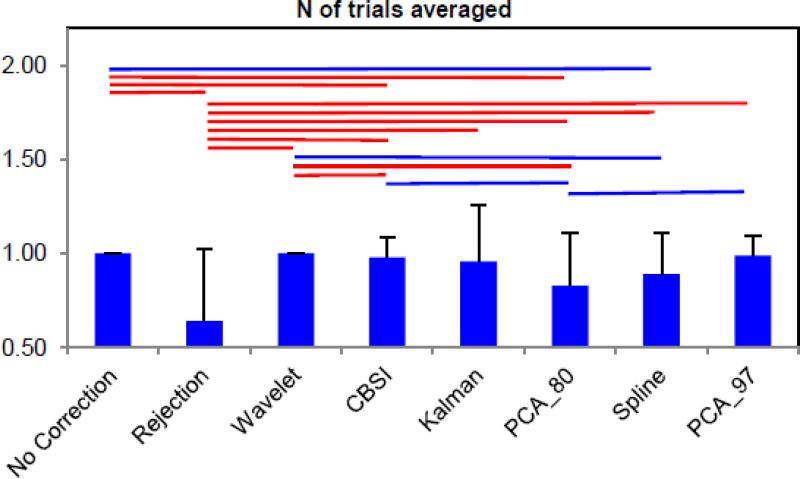
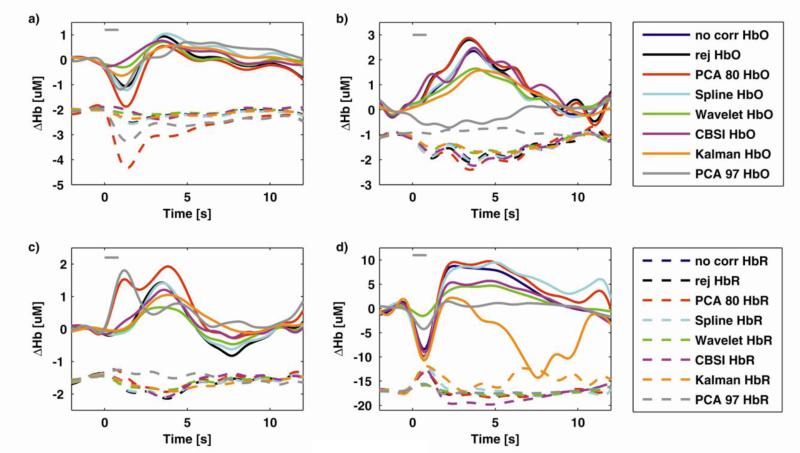
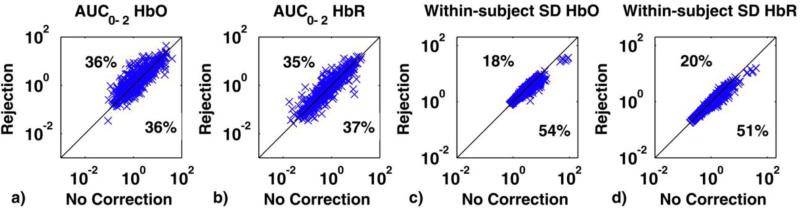
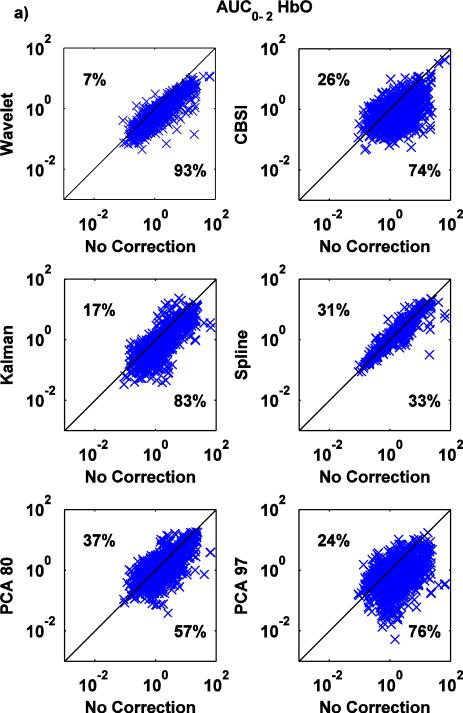
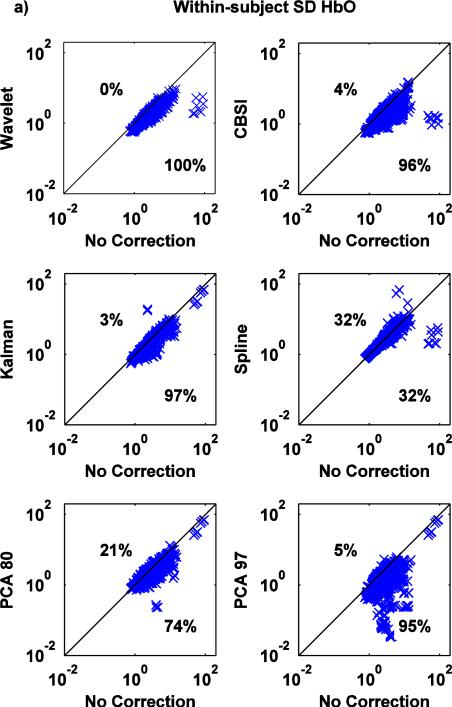
Motion artifacts are a significant source of noise in many functional near-infrared spectroscopy (fNIRS) experiments. Despite this, there is no well-established method for their removal. Instead, functional trials of fNIRS data containing a motion artifact are often rejected completely. However, in most experimental circumstances the number of trials is limited, and multiple motion artifacts are common, particularly in challenging populations. Many methods have been proposed recently to correct for motion artifacts, including principle component analysis, spline interpolation, Kalman filtering, wavelet filtering and correlation-based signal improvement. The performance of different techniques has been often compared in simulations, but only rarely has it been assessed on real functional data. Here, we compare the performance of these motion correction techniques on real functional data acquired during a cognitive task, which required the participant to speak aloud, leading to a low-frequency, low-amplitude motion artifact that is correlated with the hemodynamic response. To compare the efficacy of these methods, objective metrics related to the physiology of the hemodynamic response have been derived. Our results show that it is always better to correct for motion artifacts than reject trials, and that wavelet filtering is the most effective approach to correcting this type of artifact, reducing the area under the curve where the artifact is present in 93% of the cases. Our results therefore support previous studies that have shown wavelet filtering to be the most promising and powerful technique for the correction of motion artifacts in fNIRS data. The analyses performed here can serve as a guide for others to objectively test the impact of different motion correction algorithms and therefore select the most appropriate for the analysis of their own fNIRS experiment.
运动伪影是许多功能近红外光谱(fNIRS)实验中一个重要的噪声源。尽管如此,目前还没有一种成熟的方法可以去除它们。相反,包含运动伪影的 fNIRS 数据的功能试验通常会被完全拒绝。然而,在大多数实验情况下,试验的数量是有限的,并且多个运动伪影是常见的,尤其是在具有挑战性的人群中。最近已经提出了许多方法来校正运动伪影,包括主成分分析、样条插值、卡尔曼滤波、小波滤波和基于相关的信号改进。不同技术的性能已经在模拟中进行了比较,但很少在真实的功能数据上进行评估。在这里,我们比较了这些运动校正技术在认知任务期间采集的真实功能数据上的性能,该任务要求参与者大声说话,导致低频、低幅度的运动伪影与血液动力学反应相关。为了比较这些方法的效果,已经推导出了与血液动力学反应生理学相关的客观指标。我们的结果表明,校正运动伪影总是比拒绝试验更好,而小波滤波是校正这种伪影最有效的方法,在 93%的情况下,减少了存在伪影的曲线下面积。因此,我们的结果支持了先前的研究,表明小波滤波是校正 fNIRS 数据中运动伪影最有前途和最强大的技术。这里进行的分析可以为其他人提供指导,以便客观地测试不同运动校正算法的影响,从而为他们自己的 fNIRS 实验分析选择最合适的算法。