School of Social Work, University of Maryland, Baltimore, MD, USA.
PLoS One. 2013;8(2):e54496. doi: 10.1371/journal.pone.0054496. Epub 2013 Feb 6.
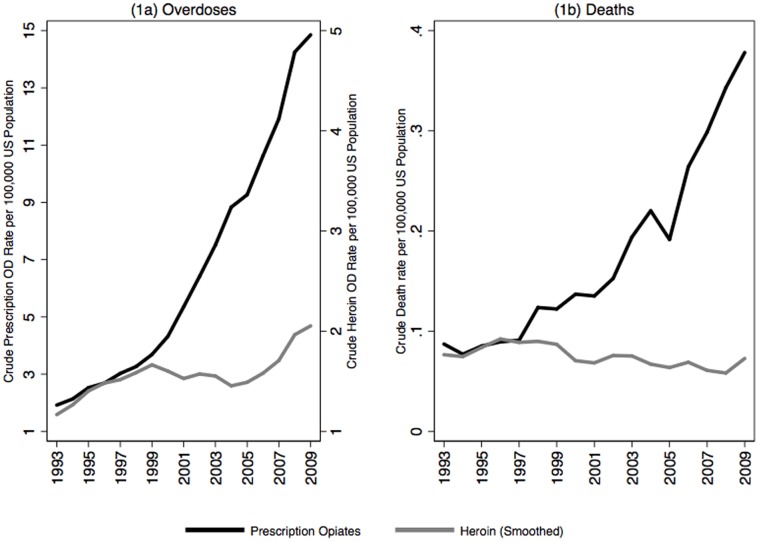
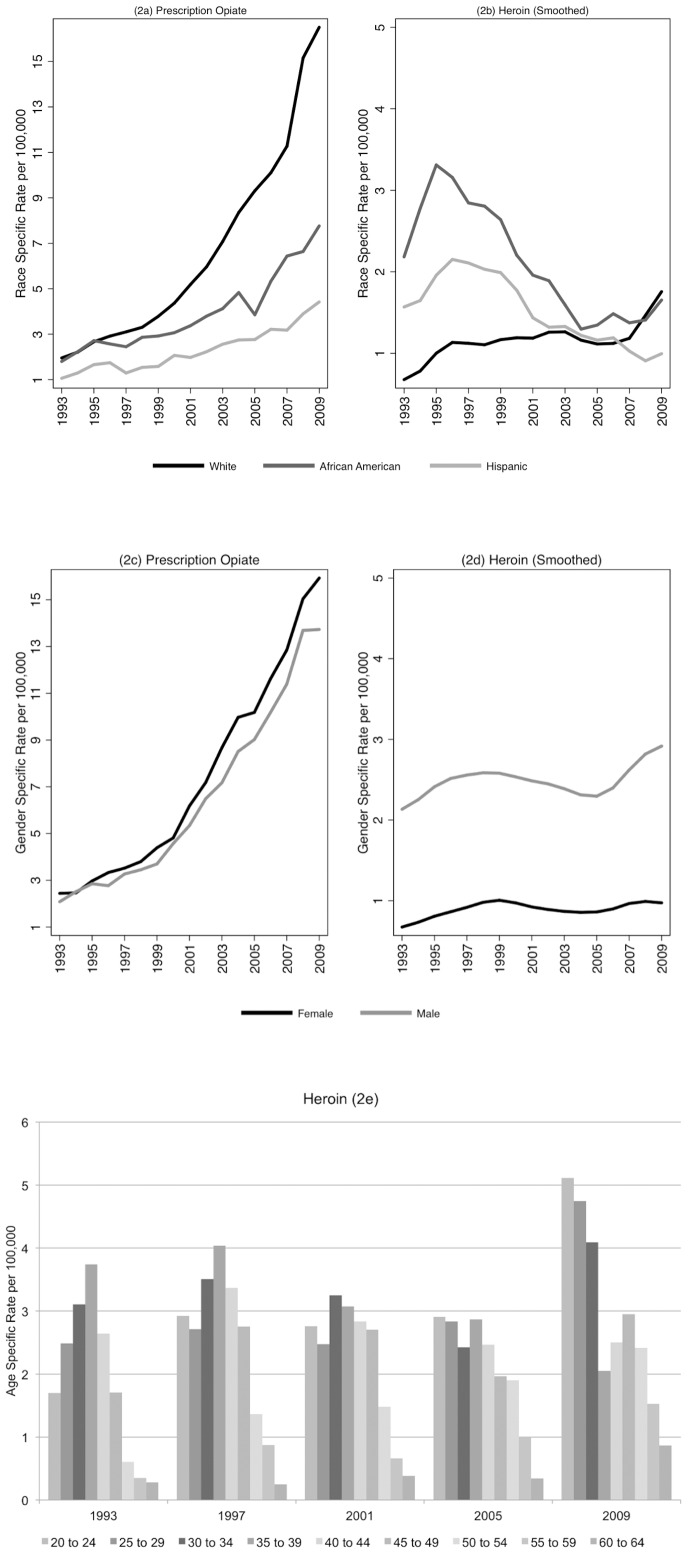
The historical patterns of opiate use show that sources and methods of access greatly influence who is at risk. Today, there is evidence that an enormous increase in the availability of prescription opiates is fuelling a rise in addiction nationally, drawing in new initiates to these drugs and changing the geography of opiate overdoses. Recent efforts at supply-based reductions in prescription opiates may reduce harm, but addicted individuals may switch to other opiates such as heroin. In this analysis, we test the hypothesis that changes in the rates of Prescription Opiate Overdoses (POD) are correlated with changes in the rate of heroin overdoses (HOD). ICD9 codes from the Nationwide Inpatient Sample and population data from the Census were used to estimate overall and demographic specific rates of POD and HOD hospital admissions between 1993 and 2009. Regression models were used to test for linear trends and lagged negative binomial regression models were used to model the interrelationship between POD and HOD hospital admissions. Findings show that whites, women, and middle-aged individuals had the largest increase in POD and HOD rates over the study period and that HOD rates have increased in since 2007. The lagged models show that increases in a hospitals POD predict an increase in the subsequent years HOD admissions by a factor of 1.26 (p<0.001) and that each increase in HOD admissions increase the subsequent years POD by a factor of 1.57 (p<0.001). Our hypothesis of fungibility between prescription opiates and heroin was supported by these analyses. These findings suggest that focusing on supply-based interventions may simply lead to a shift in use to heroin rather minimizing the reduction in harm. The alternative approach of using drug abuse prevention resources on treatment and demand-side reduction is likely to be more productive at reducing opiate abuse related harm.
阿片类药物使用的历史模式表明,来源和获取方法极大地影响了风险人群。如今,有证据表明,处方类阿片类药物供应的大幅增加正在推动全国范围内成瘾率的上升,使新的药物使用者接触到这些药物,并改变了阿片类药物过量的地域分布。最近减少处方类阿片类药物供应的做法可能会减少危害,但成瘾者可能会转而使用海洛因等其他阿片类药物。在这项分析中,我们检验了以下假设,即处方类阿片类药物过量(POD)率的变化与海洛因过量(HOD)率的变化相关。我们利用全国住院患者样本中的 ICD9 编码和人口普查中的人口数据,估算了 1993 年至 2009 年期间 POD 和 HOD 住院人数的总体和人口特定发生率。我们使用回归模型检验了线性趋势,使用滞后负二项回归模型检验了 POD 和 HOD 住院人数之间的相互关系。结果表明,在研究期间,白人、女性和中年人群的 POD 和 HOD 发生率增幅最大,且自 2007 年以来,HOD 发生率有所上升。滞后模型表明,医院 POD 发生率的增加预示着随后年份 HOD 入院人数会增加 1.26 倍(p<0.001),而 HOD 入院人数的增加会使随后年份 POD 增加 1.57 倍(p<0.001)。这些分析结果支持我们关于处方类阿片类药物和海洛因之间可替代性的假设。这些发现表明,关注供应方面的干预措施可能只会导致使用海洛因的转移,而不是最大限度地减少危害的减少。采用药物滥用预防资源进行治疗和需求方减少的替代方法,可能更有利于减少与阿片类药物滥用相关的危害。