University of Pittsburgh Medical Center Eye Center, Eye and Ear Institute, Ophthalmology and Visual Science Research Center, Department of Ophthalmology, University of Pittsburgh School of Medicine, Pittsburgh, Pennsylvania, USA.
PLoS One. 2013;8(2):e55476. doi: 10.1371/journal.pone.0055476. Epub 2013 Feb 11.
To develop a new three-dimensional (3D) spectral-domain optical coherence tomography (SD-OCT) data analysis method using a machine learning technique based on variable-size super pixel segmentation that efficiently utilizes full 3D dataset to improve the discrimination between early glaucomatous and healthy eyes.
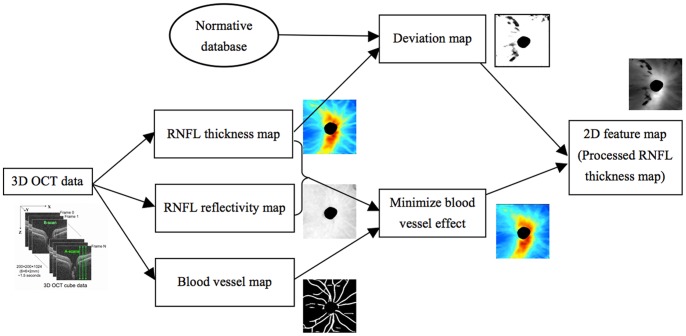
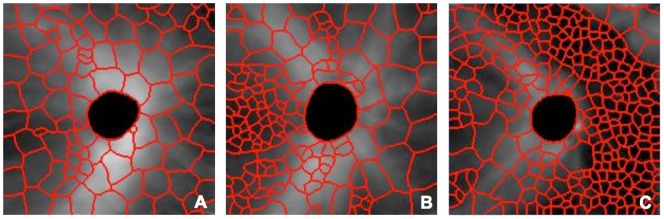
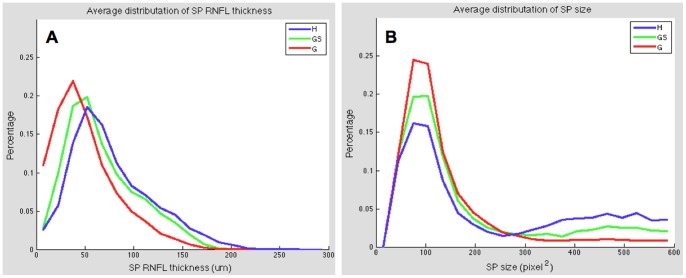
192 eyes of 96 subjects (44 healthy, 59 glaucoma suspect and 89 glaucomatous eyes) were scanned with SD-OCT. Each SD-OCT cube dataset was first converted into 2D feature map based on retinal nerve fiber layer (RNFL) segmentation and then divided into various number of super pixels. Unlike the conventional super pixel having a fixed number of points, this newly developed variable-size super pixel is defined as a cluster of homogeneous adjacent pixels with variable size, shape and number. Features of super pixel map were extracted and used as inputs to machine classifier (LogitBoost adaptive boosting) to automatically identify diseased eyes. For discriminating performance assessment, area under the curve (AUC) of the receiver operating characteristics of the machine classifier outputs were compared with the conventional circumpapillary RNFL (cpRNFL) thickness measurements.
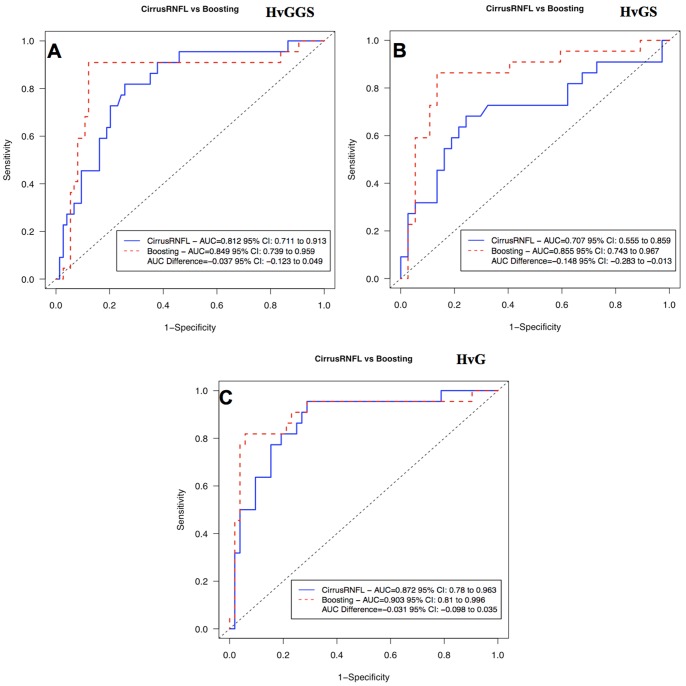
The super pixel analysis showed statistically significantly higher AUC than the cpRNFL (0.855 vs. 0.707, respectively, p = 0.031, Jackknife test) when glaucoma suspects were discriminated from healthy, while no significant difference was found when confirmed glaucoma eyes were discriminated from healthy eyes.
A novel 3D OCT analysis technique performed at least as well as the cpRNFL in glaucoma discrimination and even better at glaucoma suspect discrimination. This new method has the potential to improve early detection of glaucomatous damage.
开发一种新的基于机器的三维(3D)光谱域光相干断层扫描(SD-OCT)数据分析方法,该方法基于可变大小超像素分割的机器学习技术,有效地利用全 3D 数据集,提高早期青光眼和正常眼之间的区分能力。
对 96 名患者(44 名正常、59 名青光眼疑似和 89 名青光眼患者)的 192 只眼进行了 SD-OCT 扫描。每个 SD-OCT 立方数据集首先基于视网膜神经纤维层(RNFL)分割转换为 2D 特征图,然后分为不同数量的超像素。与传统的具有固定点数的超像素不同,新开发的可变大小超像素定义为具有可变大小、形状和数量的同质相邻像素的簇。提取超像素图的特征,并将其作为输入提供给机器分类器(LogitBoost 自适应增强),以自动识别患病眼。为了进行判别性能评估,比较了机器分类器输出的接收者操作特性曲线下的面积(AUC)与传统的周边视网膜神经纤维层(cpRNFL)厚度测量值。
超像素分析显示,在区分青光眼疑似患者和正常患者时,其 AUC 显著高于 cpRNFL(分别为 0.855 和 0.707,p=0.031,Jackknife 检验),而在区分确诊青光眼患者和正常患者时,两者之间无显著差异。
一种新的 3D OCT 分析技术在青光眼鉴别中的表现至少与 cpRNFL 一样好,甚至在青光眼疑似患者鉴别中表现更好。这种新方法有可能提高青光眼损伤的早期检测能力。