China-Sweden Associated Research Laboratory in Industrial Biotechnology, College of Chemistry, Chemical Engineering and Biotechnology, Donghua University, Shanghai, 201620, China.
Department of Chemistry, Umeå University, Umeå, SE-901 87, Sweden.
Biotechnol Biofuels. 2013 Feb 16;6(1):25. doi: 10.1186/1754-6834-6-25.
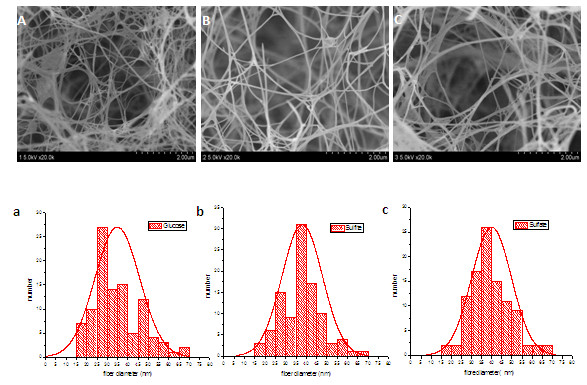
Bacterial cellulose (BC) is a highly crystalline and mechanically stable nanopolymer, which has excellent potential as a material in many novel applications, especially if it can be produced in large amounts from an inexpensive feedstock. Waste fiber sludge, a residue with little or no value, originates from pulp mills and lignocellulosic biorefineries. A high cellulose and low lignin content contributes to making the fiber sludge suitable for bioconversion, even without a thermochemical pretreatment step. In this study, the possibility to combine production of BC and hydrolytic enzymes from fiber sludge was investigated. The BC was characterized using field-emission scanning electron microscopy and X-ray diffraction analysis, and its mechanical properties were investigated.
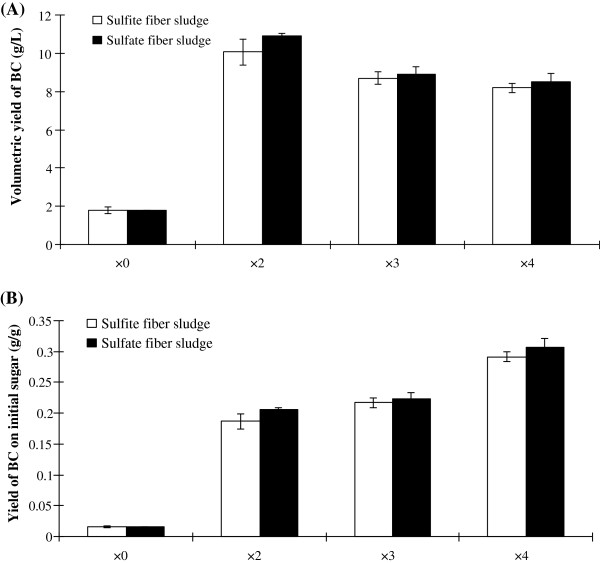
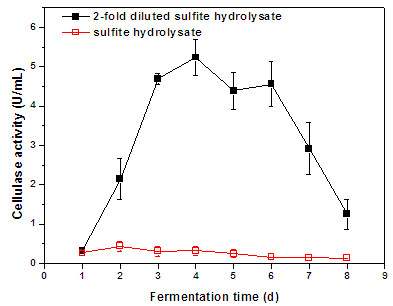
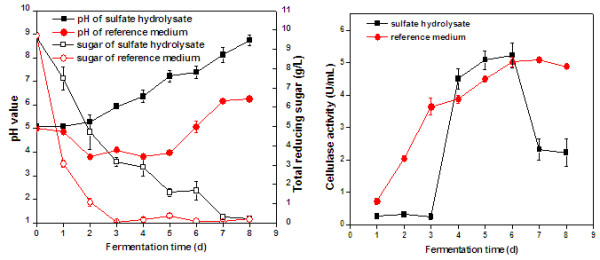
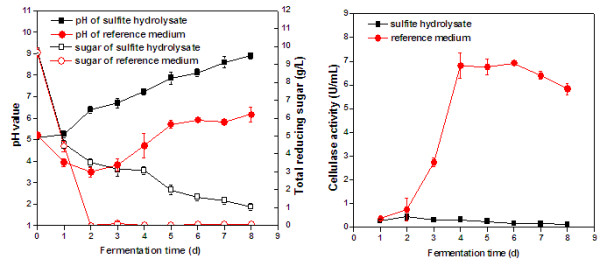
Bacterial cellulose and enzymes were produced through sequential fermentations with the bacterium Gluconacetobacter xylinus and the filamentous fungus Trichoderma reesei. Fiber sludges from sulfate (SAFS) and sulfite (SIFS) processes were hydrolyzed enzymatically without prior thermochemical pretreatment and the resulting hydrolysates were used for BC production. The highest volumetric yields of BC from SAFS and SIFS were 11 and 10 g/L (DW), respectively. The BC yield on initial sugar in hydrolysate-based medium reached 0.3 g/g after seven days of cultivation. The tensile strength of wet BC from hydrolysate medium was about 0.04 MPa compared to about 0.03 MPa for BC from a glucose-based reference medium, while the crystallinity was slightly lower for BC from hydrolysate cultures. The spent hydrolysates were used for production of cellulase with T. reesei. The cellulase activity (CMCase activity) in spent SAFS and SIFS hydrolysates reached 5.2 U/mL (87 nkat/mL), which was similar to the activity level obtained in a reference medium containing equal amounts of reducing sugar.
It was shown that waste fiber sludge is a suitable raw material for production of bacterial cellulose and enzymes through sequential fermentation. The concept studied offers efficient utilization of the various components in fiber sludge hydrolysates and affords a possibility to combine production of two high value-added products using residual streams from pulp mills and biorefineries. Cellulase produced in this manner could tentatively be used to hydrolyze fresh fiber sludge to obtain medium suitable for production of BC in the same biorefinery.
细菌纤维素(BC)是一种高度结晶和机械稳定的纳米聚合物,具有作为许多新型应用材料的巨大潜力,尤其是如果它可以从廉价的原料中大量生产。废纤维污泥是一种来自纸浆厂和木质纤维素生物精炼厂的几乎没有或没有价值的残留物。高纤维素和低木质素含量有助于使纤维污泥适合生物转化,即使没有热化学预处理步骤。在这项研究中,研究了从纤维污泥中同时生产 BC 和水解酶的可能性。使用场发射扫描电子显微镜和 X 射线衍射分析对 BC 进行了表征,并对其机械性能进行了研究。
通过使用木醋酸杆菌和里氏木霉的顺序发酵生产了细菌纤维素和酶。硫酸盐(SAFS)和亚硫酸盐(SIFS)工艺的纤维污泥未经预先的热化学预处理就进行了酶水解,所得水解产物用于生产 BC。从 SAFS 和 SIFS 获得的 BC 的最高体积产率分别为 11 和 10 g/L(DW)。在基于水解物的培养基中培养七天后,BC 对初始糖的产率达到 0.3 g/g。基于水解物的培养基中湿 BC 的拉伸强度约为 0.04 MPa,而基于葡萄糖的参考培养基中 BC 的拉伸强度约为 0.03 MPa,而水解物培养物中 BC 的结晶度略低。用过的水解物用于里氏木霉生产纤维素酶。用过的 SAFS 和 SIFS 水解物中的纤维素酶活性(CMCase 活性)达到 5.2 U/mL(87 nkat/mL),与含有等量还原糖的参考培养基中获得的活性水平相似。
结果表明,废纤维污泥是通过顺序发酵生产细菌纤维素和酶的合适原料。所研究的概念提供了纤维污泥水解物中各种成分的有效利用,并提供了一种可能,即在纸浆厂和生物精炼厂的剩余流中同时生产两种高附加值产品。以这种方式生产的纤维素酶可以暂时用于水解新鲜纤维污泥,以获得在同一生物精炼厂中生产 BC 的合适培养基。