Institute of Cognitive Neuroscience, University College London, Alexandra House, London, UK.
Cortex. 2013 Sep;49(8):2040-54. doi: 10.1016/j.cortex.2013.01.004. Epub 2013 Jan 23.
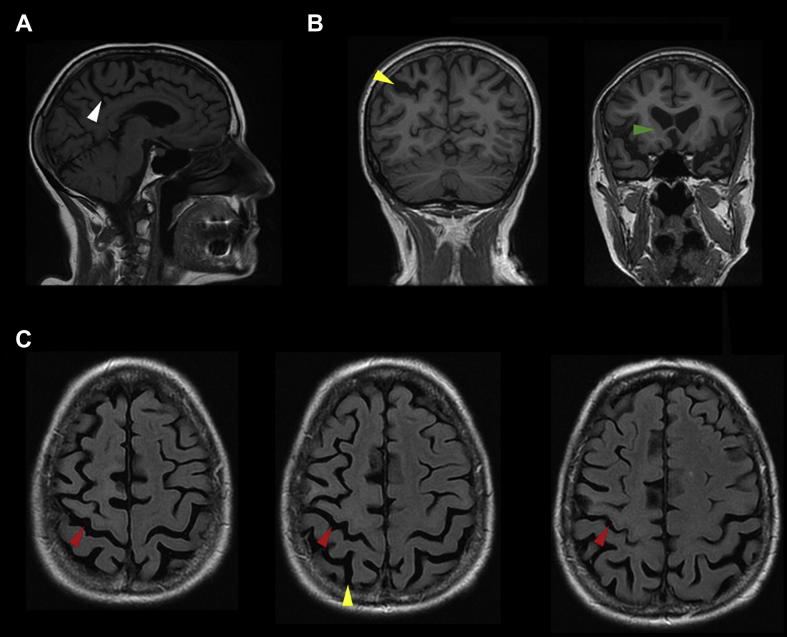
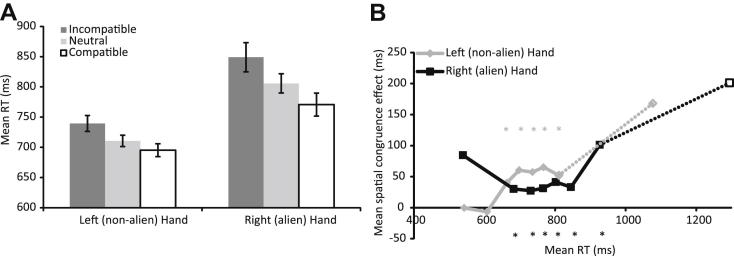
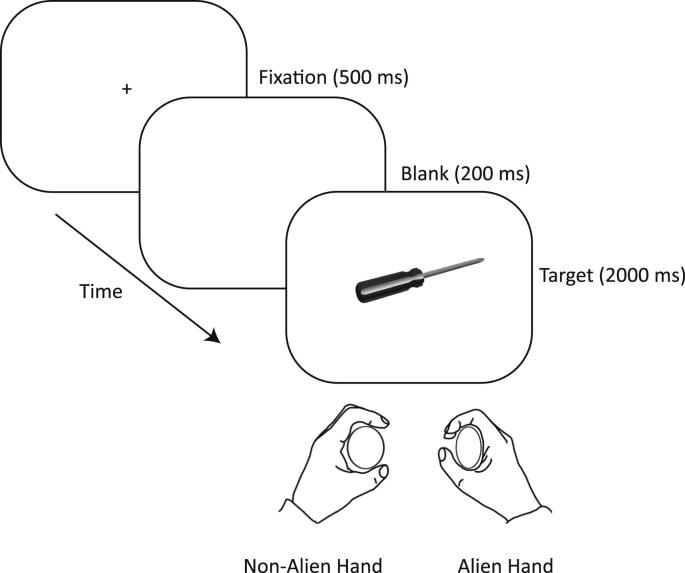
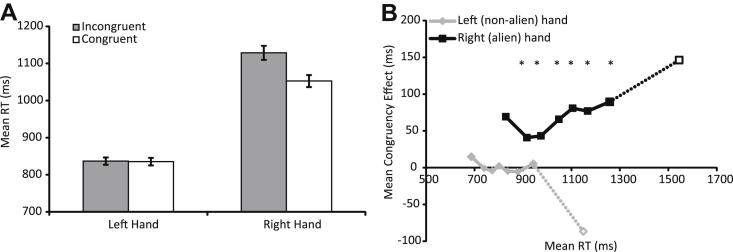
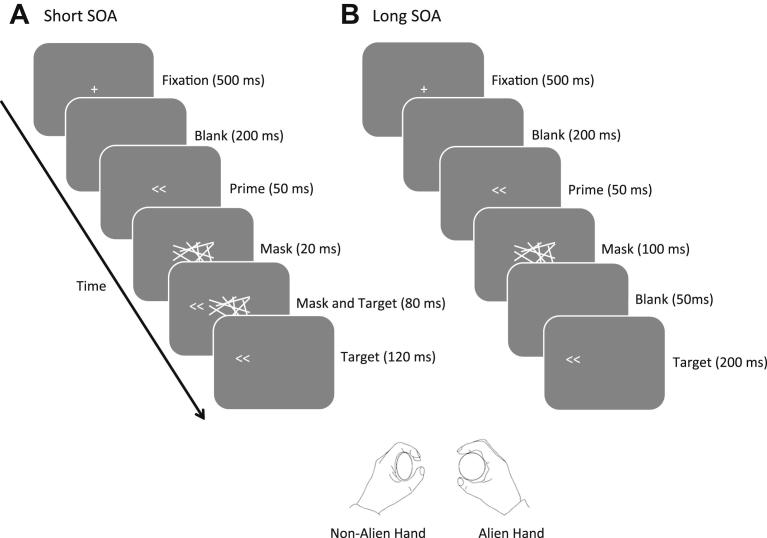
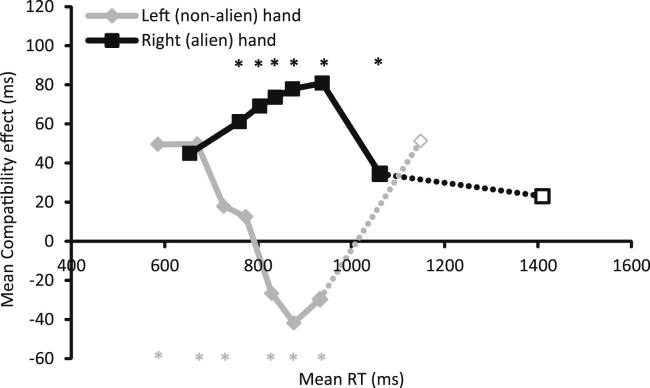
Patients with alien hand syndrome (AHS) experience making apparently deliberate and purposeful movements with their hand against their will. However, the mechanisms contributing to these involuntary actions remain poorly understood. Here, we describe two experimental investigations in a patient with corticobasal syndrome (CBS) with alien hand behaviour in her right hand. First, we show that responses with the alien hand are made significantly more quickly to images of objects which afford an action with that hand compared to objects which afford an action with the unaffected hand. This finding suggests that involuntary grasping behaviours in AHS might be due to exaggerated, automatic motor activation evoked by objects which afford actions with that limb. Second, using a backwards masked priming task, we found normal automatic inhibition of primed responses in the patient's unaffected hand, but importantly there was no evidence of such suppression in the alien limb. Taken together, these findings suggest that grasping behaviours in AHS may result from exaggerated object affordance effects, which might potentially arise from disrupted inhibition of automatically evoked responses.
患者患有异物手综合征(AHS),其手会做出明显的、蓄意的、有目的的动作,而这些动作是违背其意愿的。然而,导致这些非自愿动作的机制仍未被很好地理解。在这里,我们描述了一位患有皮质基底节综合征(CBS)且右手出现异物手行为的患者的两项实验研究。首先,我们表明,与可以用未受影响的手完成的动作的物体相比,用异物手完成的动作对该手的物体的反应速度明显更快。这一发现表明,AHS 中的无意识抓握行为可能是由于对提供该肢体动作的物体的过度、自动的运动激活所致。其次,我们使用了一种向后掩蔽启动任务,发现患者未受影响的手的启动反应存在正常的自动抑制,但重要的是,在异物手上没有发现这种抑制的证据。总之,这些发现表明,AHS 中的抓握行为可能是由于夸大的物体可供性效应所致,而这种效应可能是由于自动引发的反应抑制受到破坏所致。