Computational Radiology Laboratory, Department of Radiology, Boston Children's Hospital, Boston, MA 02115, USA.
BMC Med. 2013 Feb 27;11:54. doi: 10.1186/1741-7015-11-54.
Graph theory has been recently introduced to characterize complex brain networks, making it highly suitable to investigate altered connectivity in neurologic disorders. A current model proposes autism spectrum disorder (ASD) as a developmental disconnection syndrome, supported by converging evidence in both non-syndromic and syndromic ASD. However, the effects of abnormal connectivity on network properties have not been well studied, particularly in syndromic ASD. To close this gap, brain functional networks of electroencephalographic (EEG) connectivity were studied through graph measures in patients with Tuberous Sclerosis Complex (TSC), a disorder with a high prevalence of ASD, as well as in patients with non-syndromic ASD.
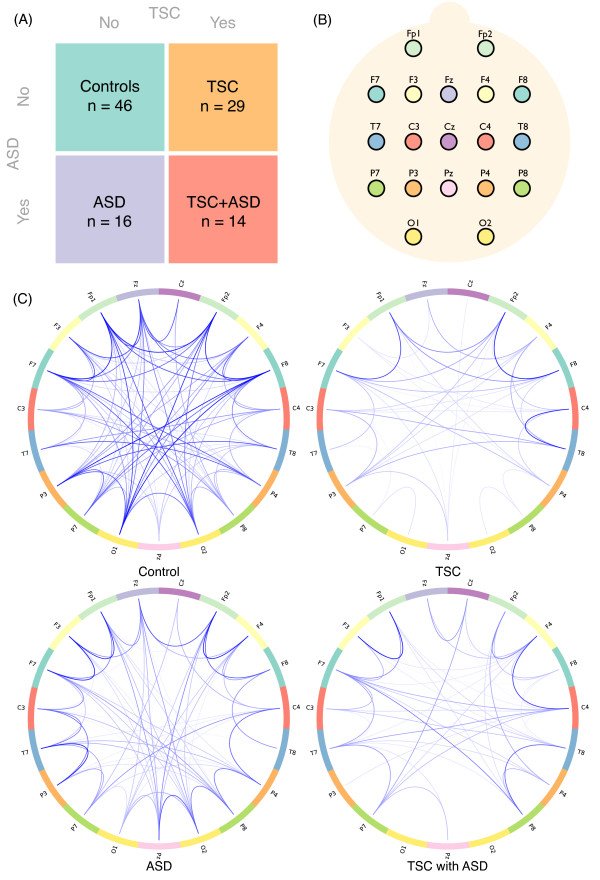
EEG data were collected from TSC patients with ASD (n = 14) and without ASD (n = 29), from patients with non-syndromic ASD (n = 16), and from controls (n = 46). First, EEG connectivity was characterized by the mean coherence, the ratio of inter- over intra-hemispheric coherence and the ratio of long- over short-range coherence. Next, graph measures of the functional networks were computed and a resilience analysis was conducted. To distinguish effects related to ASD from those related to TSC, a two-way analysis of covariance (ANCOVA) was applied, using age as a covariate.
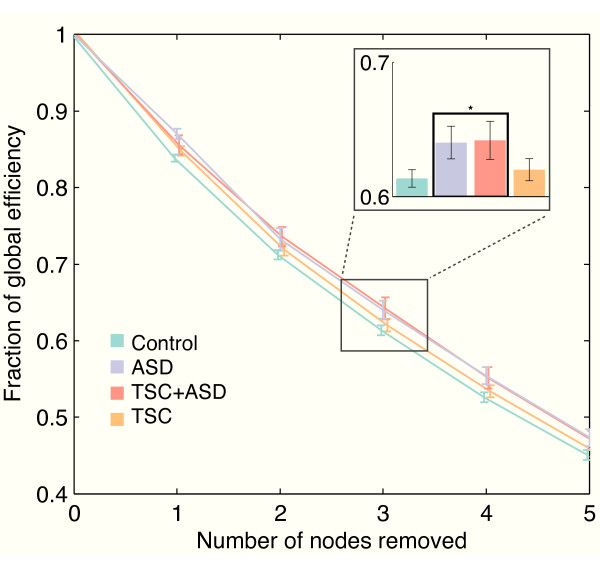
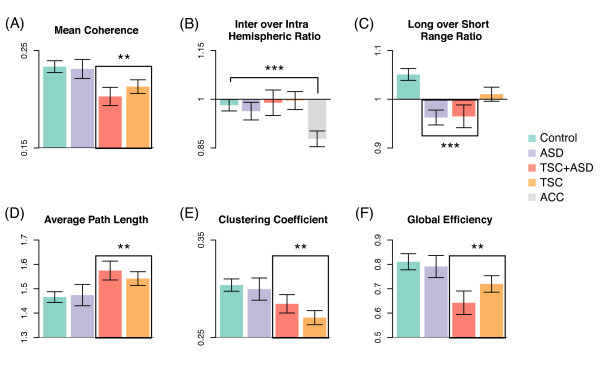
Analysis of network properties revealed differences specific to TSC and ASD, and these differences were very consistent across subgroups. In TSC, both with and without a concurrent diagnosis of ASD, mean coherence, global efficiency, and clustering coefficient were decreased and the average path length was increased. These findings indicate an altered network topology. In ASD, both with and without a concurrent diagnosis of TSC, decreased long- over short-range coherence and markedly increased network resilience were found.
The altered network topology in TSC represents a functional correlate of structural abnormalities and may play a role in the pathogenesis of neurological deficits. The increased resilience in ASD may reflect an excessively degenerate network with local overconnection and decreased functional specialization. This joint study of TSC and ASD networks provides a unique window to common neurobiological mechanisms in autism.
图论最近被引入到复杂脑网络的特征描述中,使其非常适合研究神经紊乱中连接的改变。目前的模型提出自闭症谱系障碍(ASD)是一种发育性脱节综合征,这一观点得到了非综合征性和综合征性 ASD 中汇聚证据的支持。然而,异常连接对网络属性的影响还没有得到很好的研究,特别是在综合征性 ASD 中。为了弥补这一空白,通过图论度量对脑电图(EEG)连接的脑功能网络进行了研究,研究对象为结节性硬化症(TSC)患者,这是一种 ASD 发病率很高的疾病,以及非综合征性 ASD 患者。
从患有 ASD(n = 14)和无 ASD(n = 29)的 TSC 患者、患有非综合征性 ASD(n = 16)的患者和对照组(n = 46)中收集 EEG 数据。首先,通过平均相干性、半球间相干性与半球内相干性之比以及长程相干性与短程相干性之比来描述 EEG 连接。接下来,计算了功能网络的图论度量,并进行了弹性分析。为了区分与 ASD 相关的效应和与 TSC 相关的效应,应用了协方差分析(ANCOVA),以年龄为协变量。
网络属性分析揭示了与 TSC 和 ASD 相关的特异性差异,并且这些差异在亚组中非常一致。在 TSC 中,无论是伴有还是不伴有 ASD 的诊断,平均相干性、全局效率和聚类系数降低,平均路径长度增加。这些发现表明网络拓扑发生了改变。在 ASD 中,无论是伴有还是不伴有 TSC 的诊断,都发现长程相干性与短程相干性之比降低,网络弹性明显增加。
TSC 中的网络拓扑改变代表了结构异常的功能相关物,可能在神经功能缺损的发病机制中发挥作用。ASD 中的弹性增加可能反映了过度退化的网络,具有局部过度连接和功能专业化降低的特点。对 TSC 和 ASD 网络的联合研究为自闭症的共同神经生物学机制提供了一个独特的视角。