Chemistry and Physics of Materials Unit and DST Unit on Nanoscience, Jawaharlal Nehru Centre for Advanced Scientific Research, Jakkur P.O., Bangalore 560 064, India.
Sci Rep. 2013;3:1078. doi: 10.1038/srep01078.
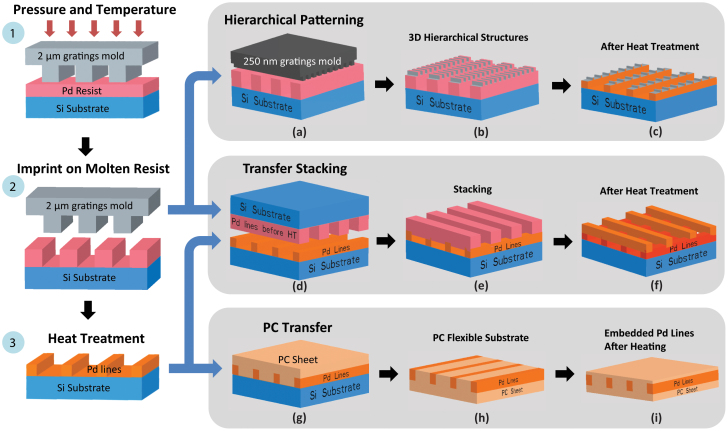
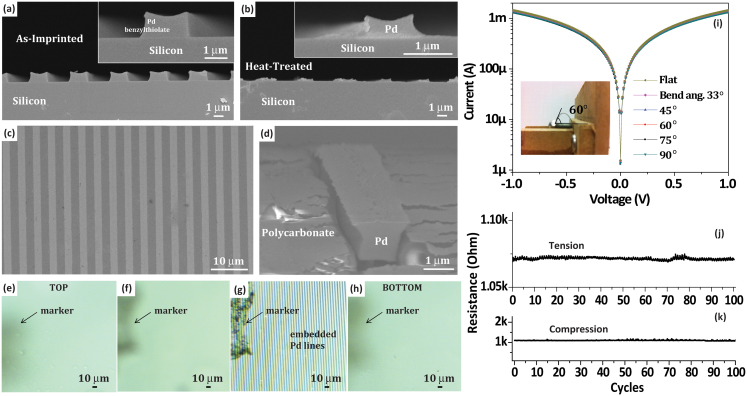
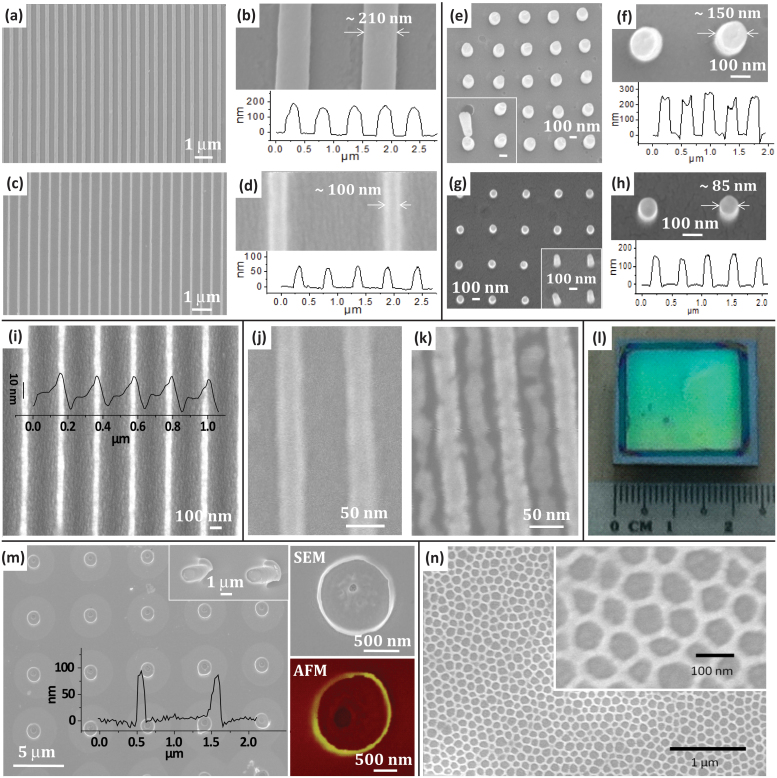
Three-dimensional hierarchical patterning of metals is of paramount importance in diverse fields involving photonics, controlling surface wettability and wearable electronics. Conventionally, this type of structuring is tedious and usually involves layer-by-layer lithographic patterning. Here, we describe a simple process of direct nanoimprint lithography using palladium benzylthiolate, a versatile metal-organic ink, which not only leads to the formation of hierarchical patterns but also is amenable to layer-by-layer stacking of the metal over large areas. The key to achieving such multi-faceted patterning is hysteretic melting of ink, enabling its shaping. It undergoes transformation to metallic palladium under gentle thermal conditions without affecting the integrity of the hierarchical patterns on micro- as well as nanoscale. A metallic rice leaf structure showing anisotropic wetting behavior and woodpile-like structures were thus fabricated. Furthermore, this method is extendable for transferring imprinted structures to a flexible substrate to make them robust enough to sustain numerous bending cycles.
三维分层图案在涉及光子学、控制表面润湿性和可穿戴电子学等多个领域都至关重要。传统上,这种结构的制造过程繁琐,通常涉及逐层光刻图案化。在这里,我们描述了一种使用钯苄硫醇的简单直接纳米压印光刻工艺,这是一种多功能的金属有机墨水,不仅可以形成分层图案,而且还可以在大面积上进行金属的逐层堆叠。实现这种多方面图案化的关键是墨水的滞后熔化,使其能够成型。它在温和的热条件下转变为金属钯,而不会影响微纳尺度上分层图案的完整性。因此,制造出了具有各向异性润湿性的金属稻叶结构和木堆状结构。此外,该方法可扩展到将压印结构转移到柔性基底上,使其足够坚固以承受多次弯曲循环。