Life Sciences Division, Lawrence Berkeley National Laboratory, Berkeley, CA 94720, USA ; Department of Psychiatry, Kaiser Permanente Medical Center, Hayward, CA 94587, USA.
Curr Genomics. 2012 Sep;13(6):489-97. doi: 10.2174/138920212802510448.
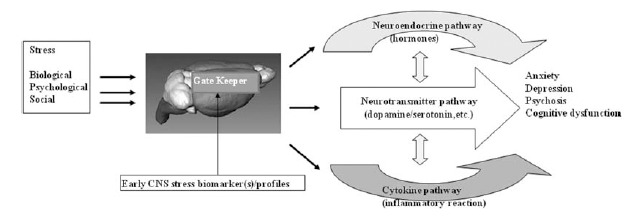
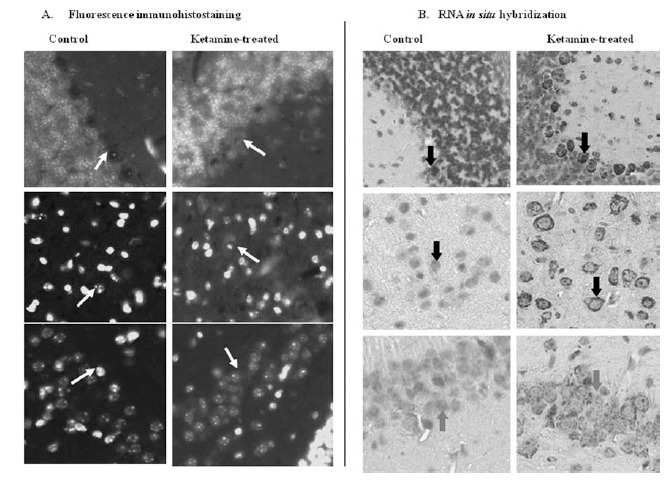
Neuropsychiatric disorders (including dementia) have high personal, family, and social costs. Although many neuropsychiatric disorders share common patterns of symptoms and treatments, there are no validated biomarkers that define the underlying molecular mechanisms in the central nervous system (CNS). We hypothesize that there are early and common molecular changes in the CNS that will serve as sensitive indicators of CNS molecular stress and that will be predictive of neuropathological changes resulted in increasing the risk for neuropsychiatric diseases. Using the rodent model, we showed that systemic exposure to three diverse CNS stressors with different mechanisms of action (ketamine, low-dose and high-dose ionizing radiation, interferon-α) induced the expression of troponin T1 (Tnnt 1) within hours in adult mouse brain tissue. Tnnt 1 expression was induced in neuronal (not glial) cells, the hippocampal zone of neurogenesis, cerebral cortex, amygdale, and choroid plexus, which are important CNS locations in behavior and mental health. We also identified nine neural signaling pathways that showed a high degree of concordance in their transcriptional response in mouse brain tissue for hours after low-dose irradiation, in the aging human brain (unirradiated), and in brain tissue from patients with Alzheimer's disease. Our studies provide new molecular information on shared mechanisms and expression profiles of diverse neuropsychiatric disorders. This knowledge will be fundamental for developing molecular signatures of early CNS stress biomarker for early diagnosis and treatment of neuropsychiatric diseases.
神经精神疾病(包括痴呆症)给个人、家庭和社会带来了沉重的负担。尽管许多神经精神疾病具有相似的症状和治疗模式,但目前还没有经过验证的生物标志物可以定义中枢神经系统(CNS)中的潜在分子机制。我们假设中枢神经系统中存在早期且普遍的分子变化,这些变化将作为中枢神经系统分子应激的敏感指标,并能预测导致神经精神疾病风险增加的神经病理变化。使用啮齿动物模型,我们发现,全身性暴露于三种作用机制不同的中枢神经系统应激源(氯胺酮、低剂量和高剂量电离辐射、干扰素-α)会在数小时内诱导成年小鼠脑组织中肌钙蛋白 T1(Tnnt1)的表达。Tnnt1 的表达被诱导在神经元(非神经胶质)细胞、海马神经发生区、大脑皮层、杏仁核和脉络丛中,这些都是行为和心理健康中重要的中枢神经系统部位。我们还鉴定了九个神经信号通路,这些通路在低剂量照射后数小时的小鼠脑组织、未受照射的衰老人类大脑和阿尔茨海默病患者的脑组织中,其转录反应具有高度的一致性。我们的研究为不同神经精神疾病的共同机制和表达谱提供了新的分子信息。这一知识将是开发早期中枢神经系统应激生物标志物的分子特征以进行神经精神疾病早期诊断和治疗的基础。