Department of Population Sciences, Telethon Institute for Child Health Research, Centre for Child Health Research, The University of Western Australia, West Perth, Western Australia.
BMJ Open. 2013 Feb 27;3(2). doi: 10.1136/bmjopen-2012-002356. Print 2013.
To describe the hospitalisation patterns in children with intellectual disability (ID) and/or autism spectrum disorder (ASD) after the first year of life and compare with those unaffected.
Prospective cohort study using data linkage between health, ID and hospitalisation population-based datasets.
Western Australia.
416 611 individuals born between 1983 and 1999 involving 1 027 962 hospital admission records. Five case categories were defined (mild/moderate ID, severe ID, biomedically caused ID, ASD with ID and ASD without ID) and compared with the remainder of children and young people.
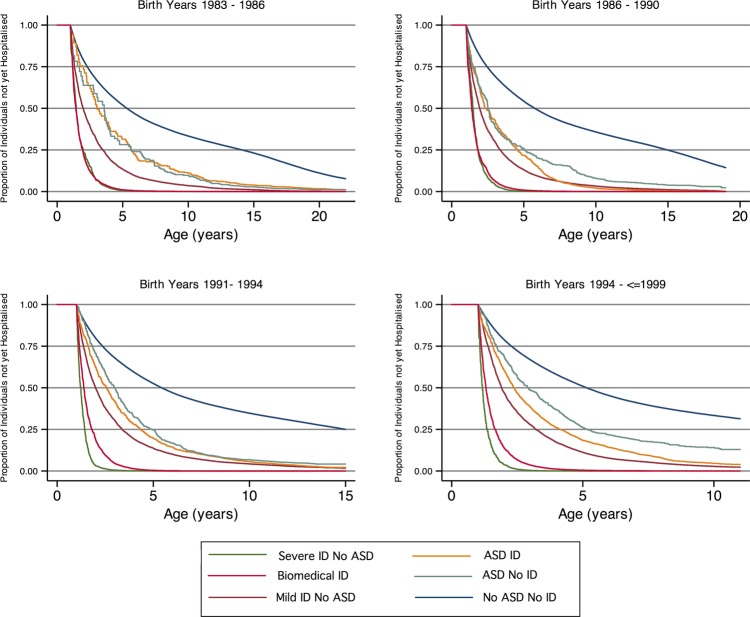
Time to event analysis was used to compare time hospitalisation and rate of hospitalisation between the different case-groups by estimating HR, accounting for birth year and preterm birth status.
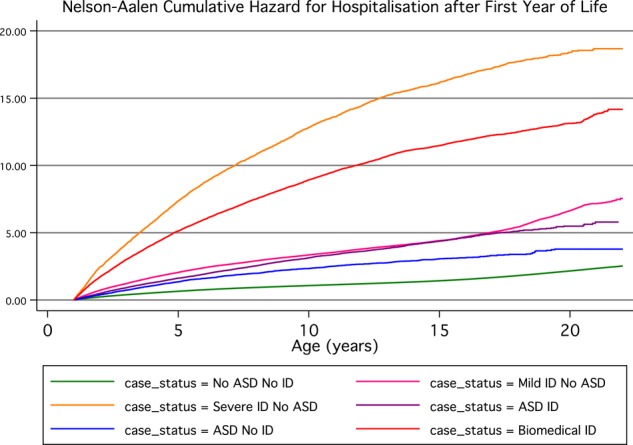
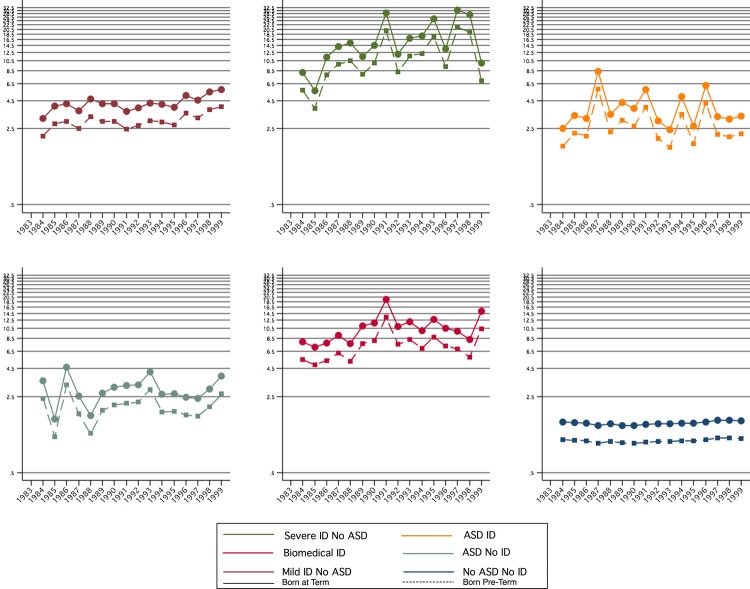
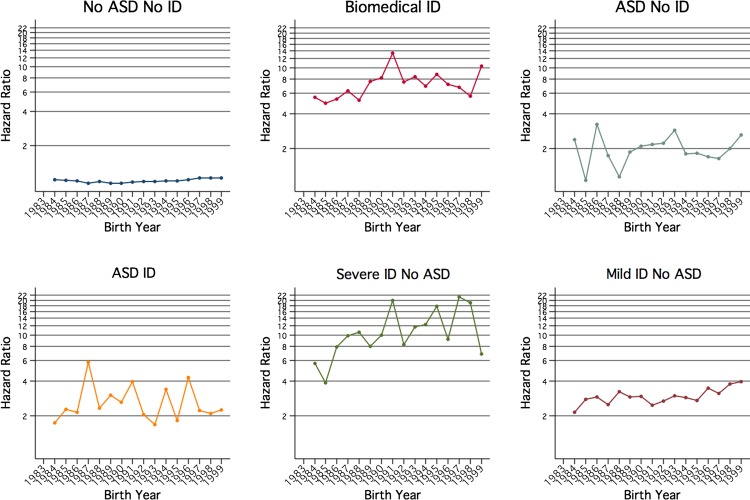
ID and/or ASD were found to be associated with an increased risk of hospitalisation compared with the remainder of the population. The increase in risk was highest in those with severe ID and no ASD (HR=10.33, 95% CI 8.66 to 12.31). For those with ID of known biomedical cause or mild ID of unknown cause, the risk of hospitalisation was lower (HR=7.36, 95% CI 6.73 to 8.07 and HR=3.08, 95% CI 2.78 to 3.40, respectively). Those with ASDs had slightly increased risk (HR=2.82, 95% CI 2.26 to 3.50 for those with ID and HR=2.09, 95% CI 1.85 to 2.36 for those without ID).
Children with an ID or ASD experience an increased risk of hospitalisation after the first year of life which varied from 2 to 10 times that of the rest of the population. Findings can inform service planning or resource allocation for these children with special needs.
描述生命第一年之后智力障碍(ID)和/或自闭症谱系障碍(ASD)患儿的住院模式,并与未受影响的患儿进行比较。
使用健康、ID 和住院人群为基础的数据集之间的数据链接进行前瞻性队列研究。
西澳大利亚。
纳入 1983 年至 1999 年出生的 416611 名个体,涉及 1027962 份住院记录。定义了 5 个病例类别(轻度/中度 ID、重度 ID、生物医学原因导致的 ID、伴有 ID 的 ASD 和不伴有 ID 的 ASD),并与其余儿童和青少年进行比较。
使用生存时间分析比较不同病例组之间的住院时间和住院率,通过估计 HR 来比较,同时考虑出生年份和早产状况。
与人群相比,ID 和/或 ASD 与住院风险增加相关。在没有 ASD 的重度 ID 患儿中,风险增加最高(HR=10.33,95%CI 8.66 至 12.31)。对于具有已知生物医学病因的 ID 或原因不明的轻度 ID 患儿,住院风险较低(HR=7.36,95%CI 6.73 至 8.07 和 HR=3.08,95%CI 2.78 至 3.40)。伴有 ASDs 的患儿风险略有增加(伴有 ID 的患儿 HR=2.82,95%CI 2.26 至 3.50;不伴有 ID 的患儿 HR=2.09,95%CI 1.85 至 2.36)。
生命第一年之后,患有 ID 或 ASD 的患儿住院风险增加,是普通人群的 2 至 10 倍。这些发现可为这些有特殊需求的患儿的服务规划或资源分配提供信息。