National Creutzfeldt–Jakob Disease Research and Surveillance Unit, University of Edinburgh, Bryan Matthews Building, Western General Hospital, Crewe Road, Edinburgh, EH4 2XU, UK.
Brain. 2013 Apr;136(Pt 4):1139-45. doi: 10.1093/brain/awt032. Epub 2013 Feb 28.
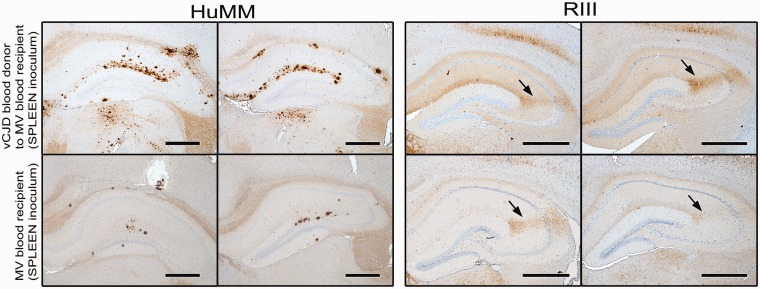
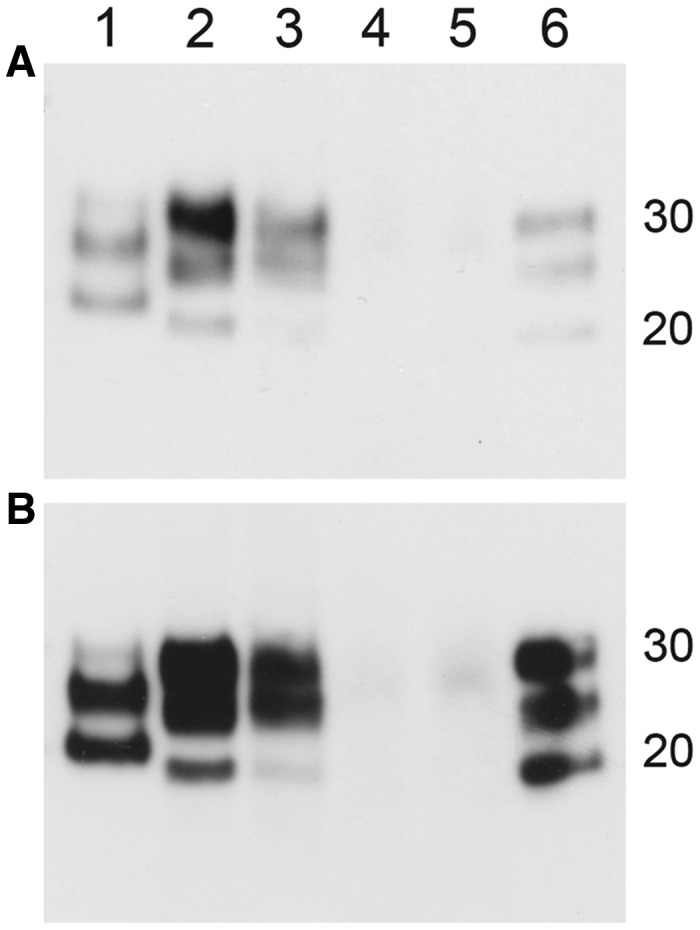
Blood transfusion has been identified as a source of human-to-human transmission of variant Creutzfeldt-Jakob disease. Three cases of variant Creutzfeldt-Jakob disease have been identified following red cell transfusions from donors who subsequently developed variant Creutzfeldt-Jakob disease and an asymptomatic red cell transfusion recipient, who did not die of variant Creutzfeldt-Jakob disease, has been identified with prion protein deposition in the spleen and a lymph node, but not the brain. This individual was heterozygous (MV) at codon 129 of the prion protein gene (PRNP), whereas all previous definite and probable cases of variant Creutzfeldt-Jakob disease have been methionine homozygotes (MM). A critical question for public health is whether the prion protein deposition reported in peripheral tissues from this MV individual correlates with infectivity. Additionally it is important to establish whether the PRNP codon 129 genotype has influenced the transmission characteristics of the infectious agent. Brain and spleen from the MV blood recipient were inoculated into murine strains that have consistently demonstrated transmission of the variant Creutzfeldt-Jakob disease agent. Mice were assessed for clinical and pathological signs of disease and transmission data were compared with other transmission studies in variant Creutzfeldt-Jakob disease, including those on the spleen and brain of the donor to the index case. Transmission of variant Creutzfeldt-Jakob disease was observed from the MV blood recipient spleen, but not from the brain, whereas there was transmission from both spleen and brain tissues from the red blood cell donor. Longer incubation times were observed for the blood donor spleen inoculum compared with the blood donor brain inoculum, suggesting lower titres of infectivity in the spleen. The distribution of vacuolar pathology and abnormal prion protein in infected mice were similar following inoculation with both donor and recipient spleen homogenates, providing initial evidence of similar transmission properties after propagation in PRNP codon 129 MV and MM individuals. These studies demonstrate that spleen tissue from a PRNP MV genotype individual can propagate the variant Creutzfeldt-Jakob disease agent and that the infectious agent can be present in the spleen without CNS involvement.
输血已被确定为人与人之间变异型克雅氏病传播的来源。在从随后发生变异型克雅氏病的供体中接受红细胞输注的 3 例变异型克雅氏病病例中,发现了一名无症状的红细胞输注受者,该受者未死于变异型克雅氏病,但在脾脏和淋巴结中发现了朊病毒蛋白沉积,但未在大脑中发现。该个体在朊病毒蛋白基因(PRNP)的密码子 129 处为杂合子(MV),而之前所有确定和可能的变异型克雅氏病病例均为蛋氨酸纯合子(MM)。对于公共卫生来说,一个关键问题是来自该 MV 个体的外周组织中报告的朊病毒蛋白沉积是否与感染性相关。此外,重要的是要确定 PRNP 密码子 129 基因型是否影响了传染性病原体的传播特征。将 MV 血液受者的大脑和脾脏接种到已一致证明可传播变异型克雅氏病病原体的鼠株中。评估了小鼠的临床和病理疾病体征,并将传播数据与其他变异型克雅氏病的传播研究进行了比较,包括对首例病例供体的大脑和脾脏的研究。从 MV 血液受者的脾脏中观察到变异型克雅氏病的传播,但从大脑中未观察到,而从红细胞供体的脾脏和大脑组织中均观察到传播。与血液供体大脑接种物相比,血液供体脾脏接种物的潜伏期更长,表明脾脏中的感染性滴度较低。在用供体和受者脾脏匀浆接种后,感染小鼠的空泡病理和异常朊病毒蛋白的分布相似,这为在 PRNP 密码子 129 MV 和 MM 个体中繁殖后具有相似的传播特性提供了初步证据。这些研究表明,来自 PRNP MV 基因型个体的脾脏组织可以繁殖变异型克雅氏病病原体,并且在没有中枢神经系统受累的情况下,病原体可能存在于脾脏中。