Pediatric Intensive Care Unit, University Hospital of Heraklion, 71110 Heraklion, Crete, Greece.
BMC Pediatr. 2013 Mar 1;13:31. doi: 10.1186/1471-2431-13-31.
Critical illness constitutes a serious derangement of metabolism. The aim of our study was to compare acute phase metabolic patterns in children with sepsis (S) or severe sepsis/septic shock (SS) to those with severe traumatic brain injury (TBI) and healthy controls (C) and to evaluate their relations to neutrophil, lymphocyte and monocyte expressions of CD64 and CD11b.
Sixty children were enrolled in the study. Forty-five children with systemic inflammatory response syndrome (SIRS) were classified into three groups: TBI (n = 15), S (n = 15), and SS (n = 15). C consisted of 15 non- SIRS patients undergoing screening tests for minor elective surgery. Blood samples were collected within 6 hours after admission for flow cytometry of neutrophil, lymphocyte and monocyte expression of CD64 and CD11b (n = 60). Procalcitonin (PCT), C-reactive protein (CRP), glucose, triglycerides (TG), total cholesterol (TC), high (HDL) or low-density-lipoproteins (LDL) were also determined in all groups, and repeated on day 2 and 3 in the 3 SIRS groups (n = 150).
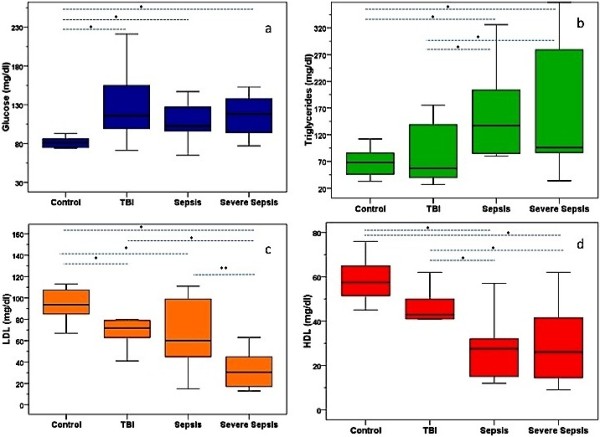
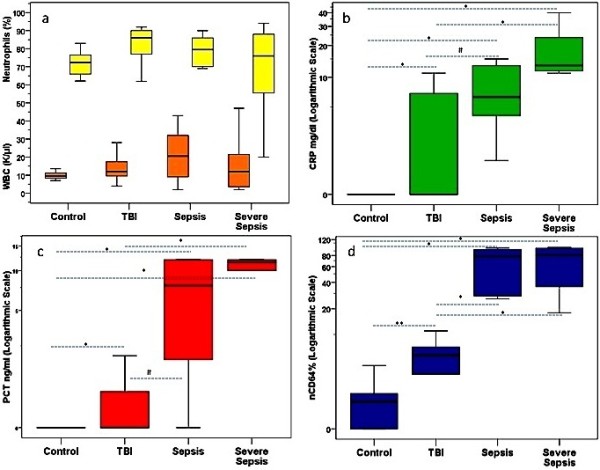
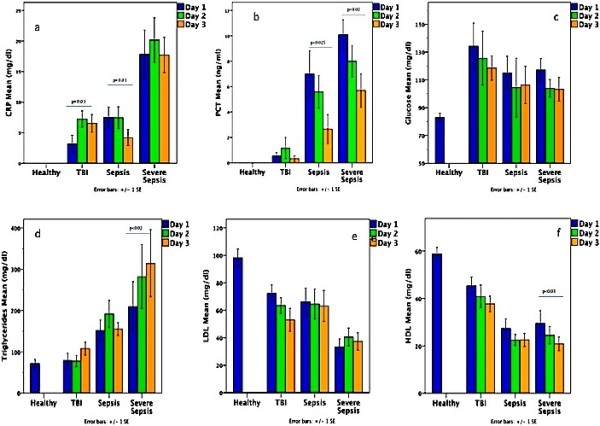
CRP, PCT and TG (p < 0.01) were significantly increased in S and SS compared to TBI and C; glucose did not differ among critically ill groups. Significantly lower were the levels of TC, LDL, and HDL in septic groups compared to C and to moderate changes in TBI (p < 0.0001) but only LDL differed between S and SS (p < 0.02). Among septic patients, PCT levels declined significantly (p < 0.02) with time, followed by parallel decrease of HDL (p < 0.03) and increase of TG (p < 0.02) in the SS group. Neutrophil CD64 (nCD64) expression was higher in patients with SS (81.2%) and S (78.8%) as compared to those with TBI (5.5%) or C (0.9%, p < 0.0001). nCD64 was positively related with CRP, PCT, glucose, and TG (p < 0.01) and negatively with TC, LDL, and HDL (p < 0.0001), but not with severity of illness, hematologic indices, length of stay or mechanical ventilation duration.
In sepsis, the early stress-metabolic pattern is characterized by a high (nCD64, glucose, TG) - low (TC, HDL, LDL) combination in contrast to the moderate pattern of TBI in which only glucose increases combined with a moderate cholesterol - lipoprotein decrease. These early metabolic patterns persist the first 3 days of acute illness and are associated with the acute phase CD64 expression on neutrophils.
危重病构成严重的代谢紊乱。我们的研究目的是比较败血症(S)或严重败血症/败血症性休克(SS)患儿与严重创伤性脑损伤(TBI)患儿和健康对照组(C)的急性期代谢模式,并评估其与中性粒细胞、淋巴细胞和单核细胞 CD64 和 CD11b 表达的关系。
共纳入 60 名患儿进行研究。45 名全身炎症反应综合征(SIRS)患儿分为三组:TBI(n=15)、S(n=15)和 SS(n=15)。C 组由 15 名接受小择期手术筛选检查的非 SIRS 患儿组成。所有患儿均在入院后 6 小时内采集血液样本,用于流式细胞术检测中性粒细胞、淋巴细胞和单核细胞 CD64 和 CD11b 的表达(n=60)。所有患儿均测定降钙素原(PCT)、C 反应蛋白(CRP)、血糖、甘油三酯(TG)、总胆固醇(TC)、高密度脂蛋白(HDL)或低密度脂蛋白(LDL),SIRS 三组患儿于第 2 天和第 3 天重复检测(n=150)。
S 和 SS 患儿的 CRP、PCT 和 TG(p<0.01)显著高于 TBI 和 C 组;危重病患儿的血糖无差异。与 C 组和 TBI 组中度变化相比,败血症组 TC、LDL 和 HDL 水平显著降低(p<0.0001),但仅 SS 组的 LDL 有差异(p<0.02)。败血症患者 PCT 水平随时间显著下降(p<0.02),随后 SS 组 HDL 平行下降(p<0.03),TG 升高(p<0.02)。SS 组(81.2%)和 S 组(78.8%)患者的中性粒细胞 CD64(nCD64)表达高于 TBI 组(5.5%)或 C 组(0.9%,p<0.0001)。nCD64 与 CRP、PCT、血糖和 TG 呈正相关(p<0.01),与 TC、LDL 和 HDL 呈负相关(p<0.0001),但与疾病严重程度、血液学指标、住院时间或机械通气时间无关。
在败血症中,早期应激代谢模式的特点是高(nCD64、血糖、TG)-低(TC、HDL、LDL)组合,而 TBI 为中度模式,仅血糖升高,同时胆固醇-脂蛋白中度降低。这些早期代谢模式在急性发病的前 3 天持续存在,并与中性粒细胞急性期 CD64 表达相关。