Division of Rheumatology, Sunnybrook Health Sciences Centre, Toronto, Canada.
BMJ Open. 2013 Mar 1;3(3):e002267. doi: 10.1136/bmjopen-2012-002267.
To examine the feasibility and potential benefits of early peer support to improve the health and quality of life of individuals with early inflammatory arthritis (EIA).
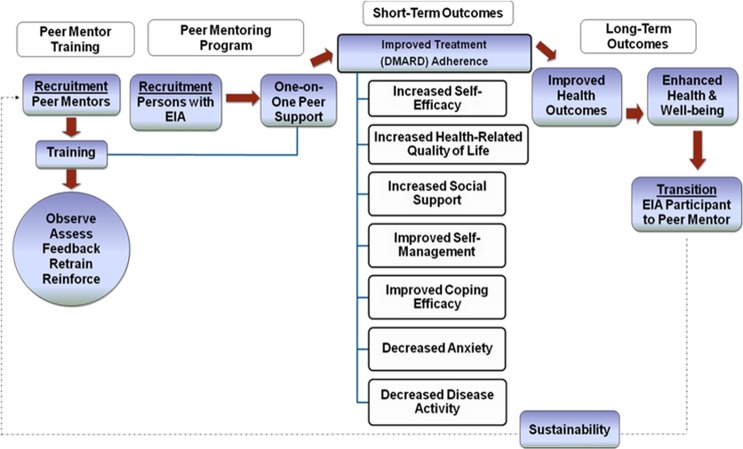
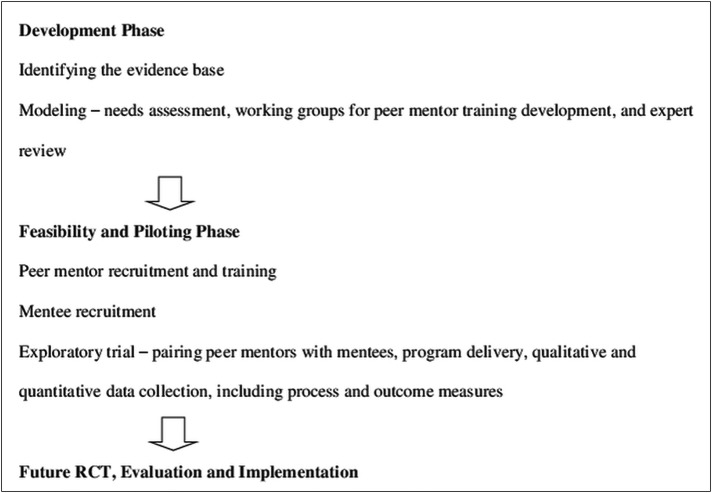
Feasibility study using the 2008 Medical Research Council framework as a theoretical basis. A literature review, environmental scan, and interviews with patients, families and healthcare providers guided the development of peer mentor training sessions and a peer-to-peer mentoring programme. Peer mentors were trained and paired with a mentee to receive (face-to-face or telephone) support over 12 weeks.
Two academic teaching hospitals in Toronto, Ontario, Canada.
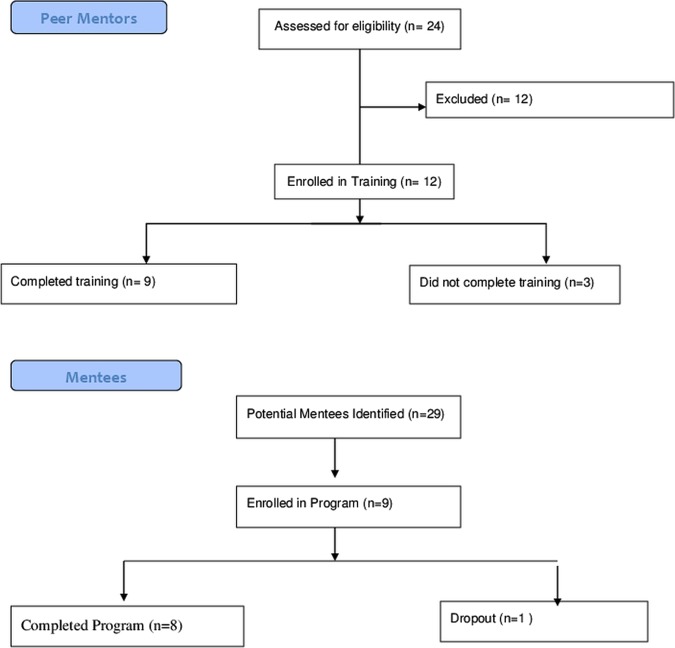
Nine pairs consisting of one peer mentor and one mentee were matched based on factors such as age and work status.
Mentee outcomes of disease modifying antirheumatic drugs (DMARDs)/biological treatment use, self-efficacy, self-management, health-related quality of life, anxiety, coping efficacy, social support and disease activity were measured using validated tools. Descriptive statistics and effect sizes were calculated to determine clinically important (>0.3) changes. Peer mentor self-efficacy was assessed using a self-efficacy scale. Interviews conducted with participants examined acceptability and feasibility of procedures and outcome measures, as well as perspectives on the value of peer support for individuals with EIA. Themes were identified through constant comparison.
Mentees experienced improvements in the overall arthritis impact on life, coping efficacy and social support (effect size >0.3). Mentees also perceived emotional, informational, appraisal and instrumental support. Mentors also reported benefits and learnt from mentees' fortitude and self-management skills. The training was well received by mentors. Their self-efficacy increased significantly after training completion. Participants' experience of peer support was informed by the unique relationship with their peer. All participants were unequivocal about the need for peer support for individuals with EIA.
The intervention was well received. Training, peer support programme and outcome measures were demonstrated to be feasible with modifications. Early peer support may augment current rheumatological care.
NCT01054963, NCT01054131.
研究早期同伴支持对改善早期炎症性关节炎(EIA)患者健康和生活质量的可行性和潜在益处。
使用 2008 年医学研究委员会框架作为理论基础的可行性研究。文献回顾、环境扫描以及对患者、家属和医疗保健提供者的访谈指导了同伴导师培训课程和同伴间指导计划的制定。同伴导师接受培训并与一名学员配对,在 12 周内通过面对面或电话接受支持。
加拿大安大略省多伦多的两所学术教学医院。
9 对参与者,包括 1 名同伴导师和 1 名学员,根据年龄和工作状态等因素进行匹配。
使用经过验证的工具测量学员的疾病修饰抗风湿药物(DMARDs)/生物治疗使用、自我效能、自我管理、健康相关生活质量、焦虑、应对效能、社会支持和疾病活动等方面的结果。计算描述性统计数据和效应大小,以确定具有临床意义(>0.3)的变化。使用自我效能量表评估同伴导师的自我效能。对参与者进行访谈,以检查程序和结果测量的可接受性和可行性,以及对 EIA 患者同伴支持价值的看法。通过不断比较确定主题。
学员在整体关节炎对生活的影响、应对效能和社会支持方面都有改善(效应大小>0.3)。学员还感受到了情感、信息、评估和工具支持。导师也报告了从学员的坚韧和自我管理技能中受益。培训得到了导师的好评。他们的自我效能在培训结束后显著提高。参与者对同伴支持的体验受到他们与同伴之间独特关系的影响。所有参与者都明确表示 EIA 患者需要同伴支持。
干预措施受到好评。培训、同伴支持计划和结果测量在经过修改后证明是可行的。早期同伴支持可能会增强当前的风湿病护理。
NCT01054963、NCT01054131。