Laboratory for Social and Neural Systems Research, Department of Economics, University of Zurich Zurich, Switzerland.
Front Psychol. 2013 Mar 12;4:118. doi: 10.3389/fpsyg.2013.00118. eCollection 2013.
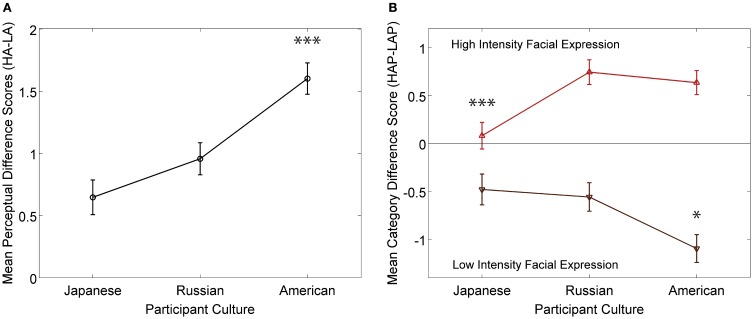
Despite consistently documented cultural differences in the perception of facial expressions of emotion, the role of culture in shaping cognitive mechanisms that are central to emotion perception has received relatively little attention in past research. We review recent developments in cross-cultural psychology that provide particular insights into the modulatory role of culture on cognitive mechanisms involved in interpretations of facial expressions of emotion through two distinct routes: display rules and cognitive styles. Investigations of emotion intensity perception have demonstrated that facial expressions with varying levels of intensity of positive affect are perceived and categorized differently across cultures. Specifically, recent findings indicating significant levels of differentiation between intensity levels of facial expressions among American participants, as well as deviations from clear categorization of high and low intensity expressions among Japanese and Russian participants, suggest that display rules shape mental representations of emotions, such as intensity levels of emotion prototypes. Furthermore, a series of recent studies using eye tracking as a proxy for overt attention during face perception have identified culture-specific cognitive styles, such as the propensity to attend to very specific features of the face. Together, these results suggest a cascade of cultural influences on cognitive mechanisms involved in interpretations of facial expressions of emotion, whereby cultures impart specific behavioral practices that shape the way individuals process information from the environment. These cultural influences lead to differences in cognitive styles due to culture-specific attentional biases and emotion prototypes, which partially account for the gradient of cultural agreements and disagreements obtained in past investigations of emotion perception.
尽管在面部表情情感感知方面存在一致记录的文化差异,但文化在塑造情感感知核心认知机制方面的作用在过去的研究中相对较少受到关注。我们回顾了跨文化心理学的最新发展,这些发展为通过两种不同途径理解文化对认知机制的调节作用提供了独特的见解:表现规则和认知风格。对面部表情情感解释的认知机制的研究表明,具有不同积极情感强度的面部表情在不同文化中被感知和分类的方式不同。具体来说,最近的研究结果表明,美国参与者对面部表情强度的感知和分类存在显著差异,而日本和俄罗斯参与者对面部表情强度的高和低分类存在偏差,这表明表现规则塑造了情感的心理表征,例如情感原型的强度水平。此外,一系列使用眼动追踪作为面孔感知期间显性注意代理的最新研究确定了特定于文化的认知风格,例如关注面孔非常特定特征的倾向。这些结果表明,文化对情感面部表情解释的认知机制存在一系列影响,文化赋予特定的行为实践,塑造了个体处理环境信息的方式。这些文化影响导致了认知风格的差异,这是由于特定于文化的注意力偏见和情感原型所致,这部分解释了过去情感感知研究中获得的文化共识和分歧的梯度。