Department of Anthropology, Josef Pilsudski University of Physical Education, Warsaw, Poland.
J Hum Kinet. 2011 Dec;30:21-8. doi: 10.2478/v10078-011-0069-y. Epub 2011 Dec 25.
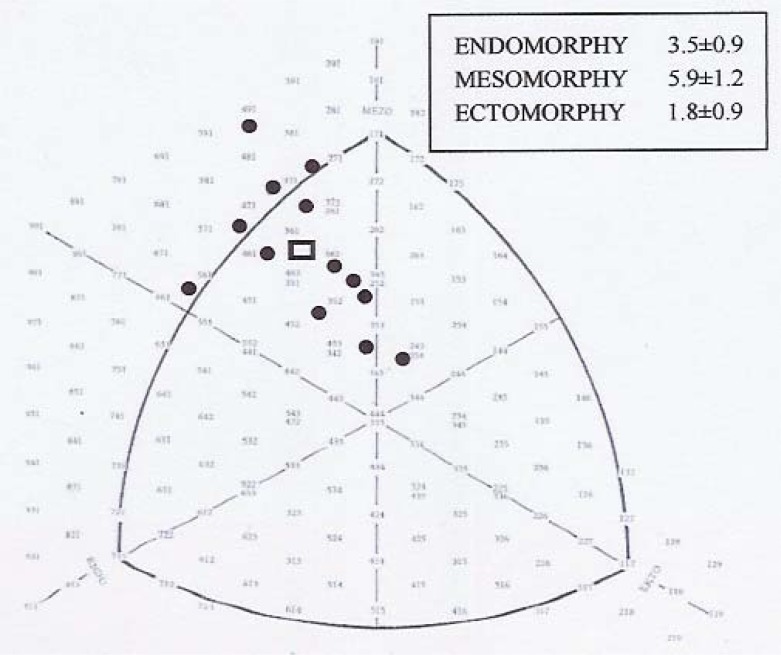
The purpose of this study was to examine the relationship between somatotype, muscle torque and power output in judoists. Thirteen judoists (age 18.4±3.1 years, body height 178.6±8.2 cm, body mass 82.3±15.9 kg) volunteered to participate in this study. Somatotype was determined using the Heath-Carter method. Maximal muscle torques of elbow, shoulder, knee, hip and trunk flexors as well as extensors were measured under static conditions. Power outputs were measured in 5 maximal cycle ergometer exercise bouts, 10 s each, at increasing external loads equal to 2.5, 5.0, 7.5, 10.0 and 12.5% of body weight. The Pearson's correlation coefficients were calculated between all parameters. The mean somatotype of judoists was: 3.5-5.9-1.8 (values for endomorphy, mesomorphy and ectomorphy, respectively). The values (mean±SD) of sum of muscle torque of ten muscle groups (TOTAL) was 3702.2±862.9 N x m. The power output ranged from 393.2±79.4 to 1077.2±275.4 W. The values of sum of muscle torque of right and left upper extremities (SUE), sum of muscle torque of right and left lower extremities (SLE), sum of muscle torque of the trunk (ST) and TOTAL were significantly correlated with the mesomorphic component (0.68, 0.80, 0.71 and 0.78, respectively). The ectomorphic component correlated significantly with values of SUE, SLE, ST and TOTAL (-0.69, -0.81, -0.71 and -0.79, respectively). Power output was also strongly correlated with both mesomorphy (positively) and ectomorphy (negatively). The results indicated that the values of mesomorphic and ectomorphic somatotype components influence muscle torque and power output, thus body build could be an important factor affecting results in judo.
本研究旨在探讨柔道运动员的体型、肌肉扭矩和功率输出之间的关系。13 名柔道运动员(年龄 18.4±3.1 岁,身高 178.6±8.2cm,体重 82.3±15.9kg)自愿参加了这项研究。体型采用 Heath-Carter 法确定。在静态条件下测量肘部、肩部、膝盖、臀部和躯干屈肌和伸肌的最大肌肉扭矩。功率输出在 5 个最大的循环测力计运动回合中测量,每个回合 10 秒,外部负荷分别等于体重的 2.5%、5.0%、7.5%、10.0%和 12.5%。计算了所有参数之间的 Pearson 相关系数。柔道运动员的平均体型为:3.5-5.9-1.8(分别为内胚层、中胚层和外胚层的数值)。十个肌肉群的肌肉扭矩总和(TOTAL)的平均值±标准差为 3702.2±862.9 N x m。功率输出范围为 393.2±79.4 至 1077.2±275.4 W。右侧和左侧上肢的肌肉扭矩总和(SUE)、右侧和左侧下肢的肌肉扭矩总和(SLE)、躯干的肌肉扭矩总和(ST)和 TOTAL 的值与中胚层成分显著相关(分别为 0.68、0.80、0.71 和 0.78)。外胚层成分与 SUE、SLE、ST 和 TOTAL 的值显著相关(分别为-0.69、-0.81、-0.71 和-0.79)。功率输出也与中胚层(正相关)和外胚层(负相关)显著相关。结果表明,中胚层和外胚层体型成分的值影响肌肉扭矩和功率输出,因此体型可能是影响柔道成绩的一个重要因素。