Andersen Catherine J, Blesso Christopher N, Lee Jiyoung, Barona Jacqueline, Shah Dharika, Thomas Michael J, Fernandez Maria Luz
Department of Nutritional Sciences, University of Connecticut, 3624 Horsebarn Road Ext., Unit 4017, Storrs, CT 06269-4017, USA.
Lipids. 2013 Jun;48(6):557-67. doi: 10.1007/s11745-013-3780-8. Epub 2013 Mar 15.
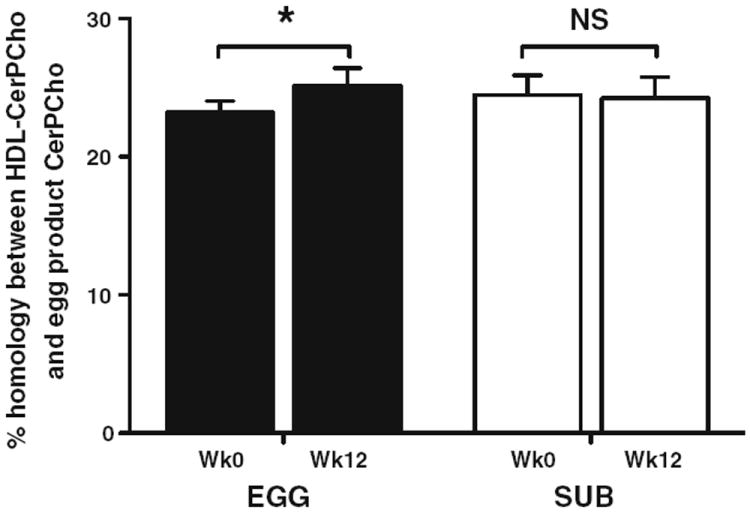
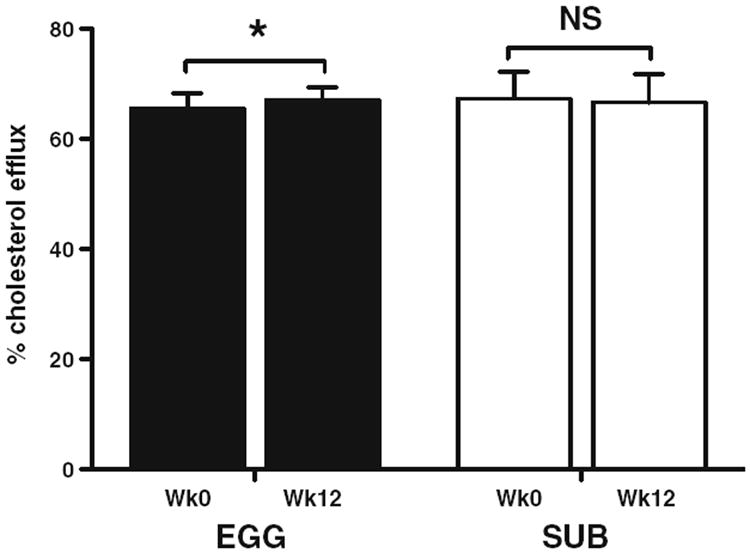
We recently demonstrated that daily whole egg consumption during moderate carbohydrate restriction leads to greater increases in plasma HDL-cholesterol (HDL-C) and improvements in HDL profiles in metabolic syndrome (MetS) when compared to intake of a yolk-free egg substitute. We further investigated the effects of this intervention on HDL composition and function, hypothesizing that the phospholipid species present in egg yolk modulate HDL lipid composition to increase the cholesterol-accepting capacity of subject serum. Men and women classified with MetS were randomly assigned to consume either three whole eggs (EGG, n = 20) per day or the equivalent amount of egg substitute (SUB, n = 17) throughout a 12-week moderate carbohydrate-restricted (25-30 % of energy) diet. Relative to other HDL lipids, HDL-cholesteryl ester content increased in all subjects, with greater increases in the SUB group. Further, HDL-triacylglycerol content was reduced in EGG group subjects with normal baseline plasma HDL-C, resulting in increases in HDL-CE/TAG ratios in both groups. Phospholipid analysis by mass spectrometry revealed that HDL became enriched in phosphatidylethanolamine in the EGG group, and that EGG group HDL better reflected sphingomyelin species present in the whole egg product at week 12 compared to baseline. Further, macrophage cholesterol efflux to EGG subject serum increased from baseline to week 12, whereas no changes were observed in the SUB group. Together, these findings suggest that daily egg consumption promotes favorable shifts in HDL lipid composition and function beyond increasing plasma HDL-C in MetS.
我们最近证明,与摄入不含蛋黄的蛋类替代品相比,在适度限制碳水化合物期间每日食用全蛋可使代谢综合征(MetS)患者的血浆高密度脂蛋白胆固醇(HDL-C)升高幅度更大,并改善HDL谱。我们进一步研究了这种干预对HDL组成和功能的影响,推测蛋黄中存在的磷脂种类可调节HDL脂质组成,以增加受试者血清的胆固醇接受能力。将被归类为MetS的男性和女性随机分配,在为期12周的适度碳水化合物限制(占能量的25%-30%)饮食期间,每天食用三个全蛋(EGG组,n = 20)或等量的蛋类替代品(SUB组,n = 17)。相对于其他HDL脂质,所有受试者的HDL胆固醇酯含量均增加,SUB组增加幅度更大。此外,EGG组中基线血浆HDL-C正常的受试者的HDL三酰甘油含量降低,导致两组的HDL-CE/TAG比值均升高。通过质谱进行的磷脂分析显示,EGG组的HDL中磷脂酰乙醇胺富集,并且与基线相比,EGG组的HDL在第12周时更好地反映了全蛋产品中存在的鞘磷脂种类。此外,从基线到第12周,巨噬细胞向EGG组受试者血清的胆固醇流出增加,而SUB组未观察到变化。总之,这些发现表明,每日食用鸡蛋除了能增加MetS患者的血浆HDL-C外,还能促进HDL脂质组成和功能的有利变化。