• 文献检索
  • 文档翻译
  • 深度研究
  • 学术资讯
  • Suppr Zotero 插件Zotero 插件
  • 邀请有礼
  • 套餐&价格
  • 历史记录
应用&插件
Suppr Zotero 插件Zotero 插件浏览器插件Mac 客户端Windows 客户端微信小程序
定价
高级版会员购买积分包购买API积分包
服务
文献检索文档翻译深度研究API 文档MCP 服务
关于我们
关于 Suppr公司介绍联系我们用户协议隐私条款
关注我们

Suppr 超能文献

核心技术专利:CN118964589B侵权必究
粤ICP备2023148730 号-1Suppr @ 2026

文献检索

告别复杂PubMed语法,用中文像聊天一样搜索,搜遍4000万医学文献。AI智能推荐,让科研检索更轻松。

立即免费搜索

文件翻译

保留排版,准确专业,支持PDF/Word/PPT等文件格式,支持 12+语言互译。

免费翻译文档

深度研究

AI帮你快速写综述,25分钟生成高质量综述,智能提取关键信息,辅助科研写作。

立即免费体验

实验感染源自大流行 H1N1 的泰国重配猪流感病毒引发了疾病。

Experimental infection with a Thai reassortant swine influenza virus of pandemic H1N1 origin induced disease.

机构信息

Department of Pathology, Faculty of Veterinary Science, Chulalongkorn University, Henri-Dunant Rd, Bangkok 10330, Thailand.

出版信息

Virol J. 2013 Mar 16;10:88. doi: 10.1186/1743-422X-10-88.

DOI:10.1186/1743-422X-10-88
PMID:23497073
原文链接:https://pmc.ncbi.nlm.nih.gov/articles/PMC3606200/
Abstract

BACKGROUND

Following the emergence of the pandemic H1N1 influenza A virus in 2009 in humans, this novel virus spread into the swine population. Pigs represent a potential host for this virus and can serve as a mixing vessel for genetic mutations of the influenza virus. Reassortant viruses eventually emerged from the 2009 pandemic and were reported in swine populations worldwide including Thailand. As a result of the discovery of this emergent disease, pathogenesis studies of this novel virus were conducted in order that future disease protection and control measures in swine and human populations could be enacted.

METHODS

The pandemic H1N1 2009 virus (pH1N1) and its reassortant virus (rH1N1) isolated from pigs in Thailand were inoculated into 2 separate cohorts of 9, 3-week-old pigs. Cohorts were consisted of one group experimentally infected with pH1N1 and one group with rH1N1. A negative control group consisting of 3 pigs was also included. Clinical signs, viral shedding and pathological lesions were investigated and compared. Later, 3 pigs from viral inoculated groups and 1 pig from the control group were necropsied at 2, 4, and 12 days post inoculation (DPI).

RESULTS

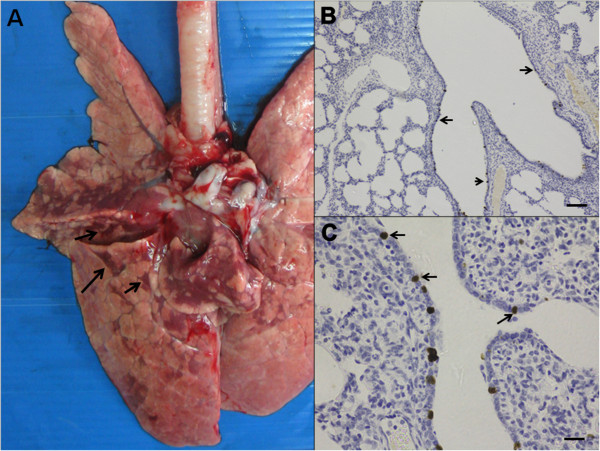
The results indicated that pigs infected with both viruses demonstrated typical flu-like clinical signs and histopathological lesions of varying severity. Influenza infected-pigs of both groups had mild to moderate pulmonary signs on 1-4 DPI. Interestingly, pigs in both groups demonstrated viral RNA detection in the nasal swabs until the end of the experiment (12 DPI).

CONCLUSION

The present study demonstrated that both the pH1N1 and rH1N1 influenza viruses, isolated from naturally infected pigs, induced acute respiratory disease in experimentally inoculated nursery pigs. Although animals in the rH1N1-infected cohort demonstrated more severe clinical signs, had higher numbers of pigs shedding the virus, were noted to have increased histopathological severity of lung lesions and increased viral antigen in lung tissue, the findings were not statistically significant in comparison with the pH1N1-infected group. Interestingly, viral genetic material of both viruses could be detected from the nasal swabs until the end of the experiment. Similar to other swine influenza viruses, the clinical signs and pathological lesions in both rH1N1 and pH1N1 were limited to the respiratory tract.

摘要

背景

2009 年大流行 H1N1 流感病毒在人类中出现后,这种新型病毒传播到猪群中。猪是这种病毒的潜在宿主,并且可以作为流感病毒遗传突变的混合容器。重组病毒最终从 2009 年大流行中出现,并在包括泰国在内的全球猪群中报告。由于发现了这种新出现的疾病,因此对这种新型病毒进行了发病机制研究,以便可以对猪和人群实施未来的疾病预防和控制措施。

方法

从泰国猪中分离出的大流行 H1N1 2009 病毒(pH1N1)和其重组病毒(rH1N1)分别接种到两组 9 只,3 周龄的猪中。两组分别包括一组用 pH1N1 感染的实验组和一组用 rH1N1 感染的实验组。还包括一组由 3 只猪组成的阴性对照组。对临床症状,病毒脱落和病理损伤进行了调查和比较。之后,在接种病毒后的两组中各有 3 只猪和对照组中的 1 只猪在接种后 2、4 和 12 天(DPI)进行剖检。

结果

结果表明,感染两种病毒的猪均表现出典型的流感样临床症状和不同严重程度的组织病理学病变。两组感染流感的猪在 1-4 DPI 时出现轻度至中度肺部症状。有趣的是,两组猪在实验结束时(12 DPI)均在鼻拭子中检测到病毒 RNA。

结论

本研究表明,从自然感染的猪中分离出的 pH1N1 和 rH1N1 流感病毒均在实验接种的仔猪中引起急性呼吸道疾病。尽管 rH1N1 感染组的动物表现出更严重的临床症状,有更多的猪排出病毒,肺部病变的组织病理学严重程度更高,肺部组织中的病毒抗原增加,但与 pH1N1 感染组相比,这些发现没有统计学意义。有趣的是,两种病毒的病毒遗传物质均可从鼻拭子中检测到,直到实验结束。与其他猪流感病毒一样,rH1N1 和 pH1N1 的临床症状和病理损伤仅限于呼吸道。
https://cdn.ncbi.nlm.nih.gov/pmc/blobs/ed44/3606200/0e5934012c07/1743-422X-10-88-1.jpg

相似文献

1
Experimental infection with a Thai reassortant swine influenza virus of pandemic H1N1 origin induced disease.实验感染源自大流行 H1N1 的泰国重配猪流感病毒引发了疾病。
Virol J. 2013 Mar 16;10:88. doi: 10.1186/1743-422X-10-88.
2
Brief report: Molecular characterization of a novel reassorted pandemic H1N1 2009 in Thai pigs.简短报告:泰国猪群中新型重配2009年大流行性H1N1的分子特征
Virus Genes. 2011 Aug;43(1):1-5. doi: 10.1007/s11262-011-0597-5. Epub 2011 Mar 26.
3
Genetic characterization of Thai swine influenza viruses after the introduction of pandemic H1N1 2009.2009年甲型H1N1流感大流行后泰国猪流感病毒的基因特征
Virus Genes. 2013 Aug;47(1):75-85. doi: 10.1007/s11262-013-0927-x. Epub 2013 Jun 6.
4
Pathogenicity of novel reassortant Eurasian avian-like H1N1 influenza virus in pigs.新型欧亚禽源样 H1N1 流感病毒在猪中的致病性。
Virology. 2021 Sep;561:28-35. doi: 10.1016/j.virol.2021.06.001. Epub 2021 Jun 6.
5
Pre-infection of pigs with Mycoplasma hyopneumoniae modifies outcomes of infection with European swine influenza virus of H1N1, but not H1N2, subtype.猪支原体肺炎的预先感染会改变 H1N1 欧洲猪流感病毒而不是 H1N2 亚型的感染结果。
Vet Microbiol. 2012 May 25;157(1-2):96-105. doi: 10.1016/j.vetmic.2011.12.027. Epub 2011 Dec 29.
6
Pathogenesis of swine influenza virus (Thai isolates) in weanling pigs: an experimental trial.泰国分离株猪流感病毒在断奶仔猪中的发病机制:一项实验性试验。
Virol J. 2009 Mar 25;6:34. doi: 10.1186/1743-422X-6-34.
7
Pathogenicity and transmissibility of novel reassortant H3N2 influenza viruses with 2009 pandemic H1N1 genes in pigs.具有2009年大流行H1N1基因的新型重配H3N2流感病毒在猪中的致病性和传播性
J Virol. 2015 Mar;89(5):2831-41. doi: 10.1128/JVI.03355-14. Epub 2014 Dec 24.
8
North American triple reassortant and Eurasian H1N1 swine influenza viruses do not readily reassort to generate a 2009 pandemic H1N1-like virus.北美三重组和欧亚 H1N1 猪流感病毒不易重组产生类似于 2009 年大流行的 H1N1 病毒。
mBio. 2014 Mar 11;5(2):e00919-13. doi: 10.1128/mBio.00919-13.
9
Pathogenesis of pandemic influenza A (H1N1) and triple-reassortant swine influenza A (H1) viruses in mice.大流行性甲型流感(H1N1)病毒和三重重配猪甲型流感(H1)病毒在小鼠中的发病机制。
J Virol. 2010 May;84(9):4194-203. doi: 10.1128/JVI.02742-09. Epub 2010 Feb 24.
10
Genetic and biological characterisation of an avian-like H1N2 swine influenza virus generated by reassortment of circulating avian-like H1N1 and H3N2 subtypes in Denmark.丹麦通过对流行的禽源H1N1和H3N2亚型病毒进行重配产生的一种禽源H1N2猪流感病毒的基因和生物学特性分析
Virol J. 2013 Sep 18;10:290. doi: 10.1186/1743-422X-10-290.

引用本文的文献

1
Reduction in Mortality of Calves with Bovine Respiratory Disease in Detection with Influenza C and D Virus.丙型和丁型流感病毒检测中患牛呼吸道疾病犊牛死亡率的降低
Animals (Basel). 2022 Nov 23;12(23):3252. doi: 10.3390/ani12233252.
2
Coupled CRC 2D and ALI 3D Cultures Express Receptors of Emerging Viruses and Are More Suitable for the Study of Viral Infections Compared to Conventional Cell Lines.联合的CRC 2D和ALI 3D培养物表达新兴病毒的受体,并且与传统细胞系相比更适合用于病毒感染研究。
Stem Cells Int. 2020 Jul 9;2020:2421689. doi: 10.1155/2020/2421689. eCollection 2020.
3
Control of a Reassortant Pandemic 2009 H1N1 Influenza Virus Outbreak in an Intensive Swine Breeding Farm: Effect of Vaccination and Enhanced Farm Management Practices.

本文引用的文献

1
Molecular and antigenic characterization of reassortant H3N2 viruses from turkeys with a unique constellation of pandemic H1N1 internal genes.从具有独特大流行 H1N1 内部基因组合的火鸡中分离出的重配 H3N2 病毒的分子和抗原特征。
PLoS One. 2012;7(3):e32858. doi: 10.1371/journal.pone.0032858. Epub 2012 Mar 21.
2
Multiple reassortment between pandemic (H1N1) 2009 and endemic influenza viruses in pigs, United States.美国猪群中季节性流感病毒和大流行(H1N1)2009 流感病毒之间的多次重配。
Emerg Infect Dis. 2011 Sep;17(9):1624-9. doi: 10.3201/eid1709.110338.
3
Novel reassortment of Eurasian avian-like and pandemic/2009 influenza viruses in swine: infectious potential for humans.
集约化养猪场2009年甲型H1N1流感病毒重配株大流行疫情的控制:疫苗接种和强化养殖场管理措施的效果
PLoS Curr. 2015 Apr 13;7:ecurrents.outbreaks.4211b8d6cedd8c870db723455409c0f8. doi: 10.1371/currents.outbreaks.4211b8d6cedd8c870db723455409c0f8.
4
Genetic characterization of Thai swine influenza viruses after the introduction of pandemic H1N1 2009.2009年甲型H1N1流感大流行后泰国猪流感病毒的基因特征
Virus Genes. 2013 Aug;47(1):75-85. doi: 10.1007/s11262-013-0927-x. Epub 2013 Jun 6.
新型欧亚类禽源性和大流行性/2009 流感病毒在猪中的重配:对人类的感染潜力。
J Virol. 2011 Oct;85(20):10432-9. doi: 10.1128/JVI.05352-11. Epub 2011 Aug 17.
4
Brief report: Molecular characterization of a novel reassorted pandemic H1N1 2009 in Thai pigs.简短报告:泰国猪群中新型重配2009年大流行性H1N1的分子特征
Virus Genes. 2011 Aug;43(1):1-5. doi: 10.1007/s11262-011-0597-5. Epub 2011 Mar 26.
5
Reassorted pandemic (H1N1) 2009 influenza A virus discovered from pigs in Germany.德国从猪体内发现的重配大流行(H1N1)2009 流感 A 病毒。
J Gen Virol. 2011 May;92(Pt 5):1184-1188. doi: 10.1099/vir.0.028662-0. Epub 2011 Feb 9.
6
Novel H1N2 swine influenza reassortant strain in pigs derived from the pandemic H1N1/2009 virus.新型 H1N2 猪流感重组病毒源自大流行 H1N1/2009 病毒。
Vet Microbiol. 2011 May 5;149(3-4):472-7. doi: 10.1016/j.vetmic.2010.12.011. Epub 2010 Dec 14.
7
Serological evidence of pig-to-human influenza virus transmission on Thai swine farms.泰国养猪场中猪流感病毒向人类传播的血清学证据。
Vet Microbiol. 2011 Mar 24;148(2-4):413-8. doi: 10.1016/j.vetmic.2010.09.019. Epub 2010 Sep 29.
8
Pandemic (H1N1) 2009 virus on commercial swine farm, Thailand.泰国商业猪场中的 2009 年甲型 H1N1 流感病毒。
Emerg Infect Dis. 2010 Oct;16(10):1587-90. doi: 10.3201/eid1610.100665.
9
First Pandemic H1N1 Outbreak from a Pig Farm in Italy.意大利一家养猪场爆发首例甲型H1N1流感大流行疫情。
Open Virol J. 2010 May 5;4:52-6. doi: 10.2174/1874357901004010052.
10
Evidence of human-to-swine transmission of the pandemic (H1N1) 2009 influenza virus in South Korea.韩国出现人感染猪流感(H1N1)2009 病毒的证据。
J Clin Microbiol. 2010 Sep;48(9):3204-11. doi: 10.1128/JCM.00053-10. Epub 2010 Jul 7.