Schoster Angelika, Arroyo Luis Guillermo, Staempfli Henry Rolf, Weese Jeffrey Scott
Department of Clinical Studies, Ontario Veterinary College, University of Guelph, Guelph, Canada.
BMC Res Notes. 2013 Mar 12;6:91. doi: 10.1186/1756-0500-6-91.
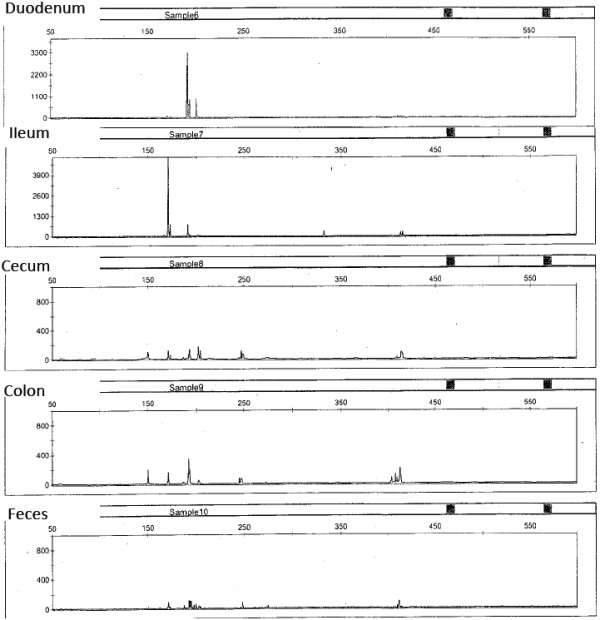
The composition of the microbiota of the equine intestinal tract is complex. Determining whether the microbial composition of fecal samples is representative of proximal compartments of the digestive tract could greatly simplify future studies. The objectives of this study were to compare the microbial populations of the duodenum, ileum, cecum, colon and rectum (feces) within and between healthy horses, and to determine whether rectal (fecal) samples are representative of proximal segments of the gastrointestinal tract. Intestinal samples were collected from ten euthanized horses. 16S rRNA gene PCR-based TRFLP was used to investigate microbiota richness in various segments of the gastrointestinal tract, and dice similarity indices were calculated to compare the samples.
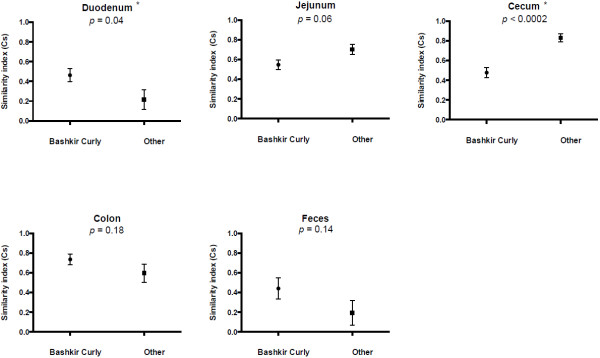
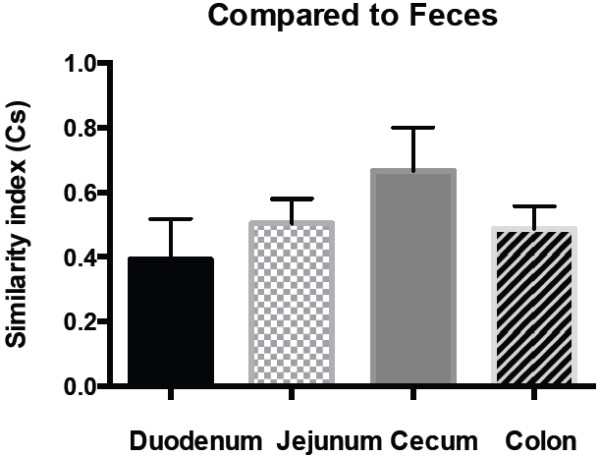
Within horses large variations of microbial populations along the gastrointestinal tract were seen. The microbiota in rectal samples was only partially representative of other intestinal compartments. The highest similarity was obtained when feces were compared to the cecum. Large compartmental variations were also seen when microbial populations were compared between six horses with similar dietary and housing management.
Rectal samples were not entirely representative of intestinal compartments in the small or large intestine. This should be taken into account when designing studies using fecal sampling to assess other intestinal compartments. Similarity between horses with similar dietary and husbandry management was also limited, suggesting that parts of the intestinal microbiota were unique to each animal in this study.
马肠道微生物群的组成复杂。确定粪便样本的微生物组成是否代表消化道近端部分可极大地简化未来的研究。本研究的目的是比较健康马匹体内以及不同健康马匹之间十二指肠、回肠、盲肠、结肠和直肠(粪便)的微生物种群,并确定直肠(粪便)样本是否代表胃肠道近端部分。从十匹安乐死的马身上采集肠道样本。基于16S rRNA基因PCR的末端限制性片段长度多态性分析(TRFLP)用于研究胃肠道不同节段的微生物丰富度,并计算骰子相似性指数以比较样本。
在马匹体内,沿胃肠道观察到微生物种群的巨大差异。直肠样本中的微生物群仅部分代表其他肠道部分。将粪便与盲肠进行比较时获得了最高的相似性。在比较六匹具有相似饮食和饲养管理的马匹的微生物种群时,也观察到了较大的节段差异。
直肠样本并不完全代表小肠或大肠的肠道部分。在设计使用粪便采样评估其他肠道部分的研究时应考虑到这一点。具有相似饮食和饲养管理的马匹之间的相似性也很有限,这表明在本研究中部分肠道微生物群是每只动物所特有的。