Renal Division, Department of Medicine, Peking University First Hospital; Institute of Nephrology, Peking University; Key laboratory of Renal Disease, Ministry of Health of China; Key Laboratory of Chronic Kidney Disease Prevention and Treatment, Ministry of Education of China, Beijing 100034, Peoples' Republic of China.
BMC Nephrol. 2013 Mar 19;14:63. doi: 10.1186/1471-2369-14-63.
Lupus nephritis is considered to be a principal cause of morbidity and mortality in SLE. Few studies focus on the association between anti-C1q antibodies in circulation and renal C1q deposition in human lupus nephritis. In this study, we detected the serum levels of C1q, presence of anti-C1q antibodies in circulation, renal C1q deposition and further analyzed their associations with clinical and pathological activity in a large cohort of Chinese lupus nephritis patients.
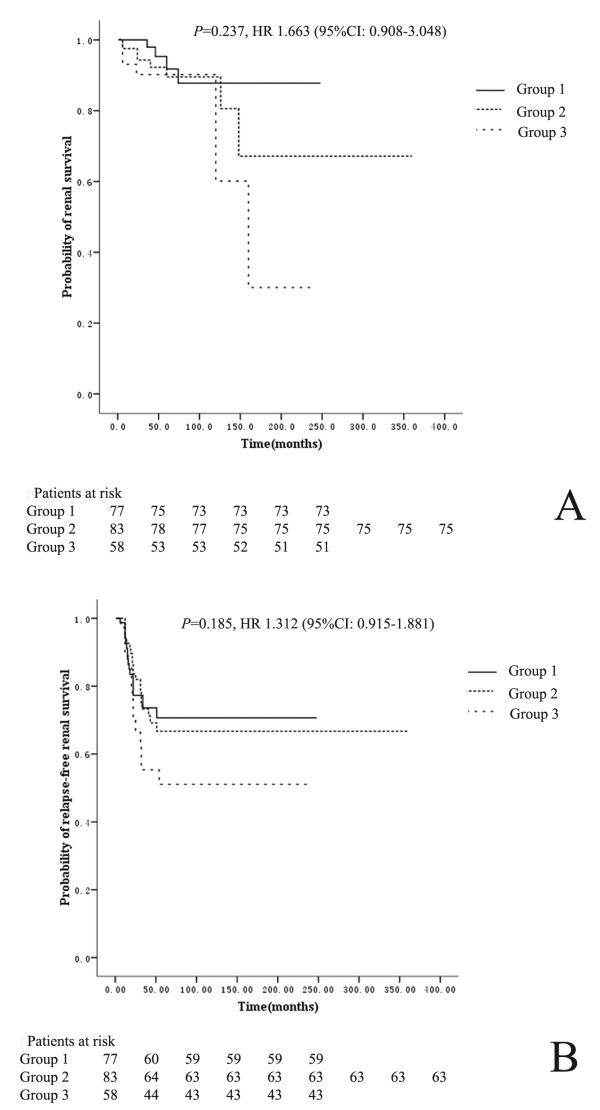
Sera and renal biopsies from 218 consecutive patients with lupus nephritis with long-term follow up data were studied. Sera were tested for levels of C1q and anti-C1q autoantibodies. Associations of levels of C1q, anti-C1q autoantibodies with renal deposition of C1q, clinical and histopathological data and renal outcome were further investigated.
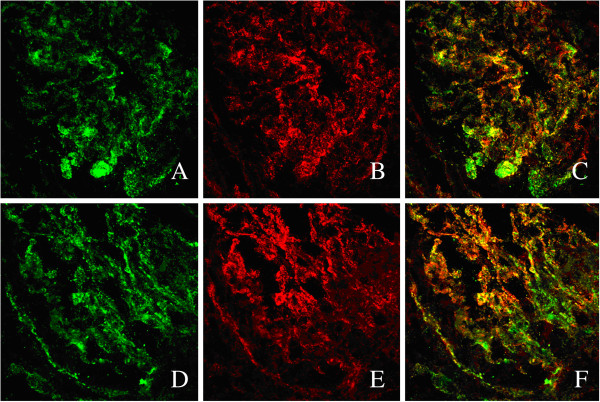
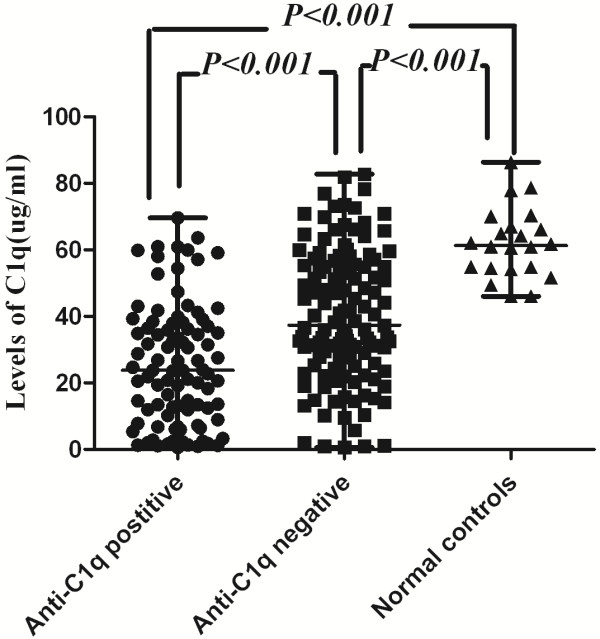
The levels of serum C1q were significantly lower in lupus nephritis than that in normal controls [33.81 ± 20.36 v.s. 61.97 ± 10.50 μg/ml (P < 0.001)]. The prevalence of anti-C1q antibodies, ratios of glomerular and vascular deposition of C1q in patients with lupus nephritis were 42.7% (93/218), 71.6% (156/218) and 86.2% (188/218), respectively. The serum C1q levels and anti-C1q antibodies were associated with SLEDAI scores (P < 0.001, P = 0.012, respectively), renal total activity indices scores (P < 0.001, P < 0.001, respectively). Granular positive staining of C1q and IgG by immunofluorescence was co-localized almost completely along the glomerular capillary wall and mesangial areas. Patients with anti-C1q antibodies presented with significantly lower serum C1q levels than those without it (23.82 [0.60, 69.62] μg/ml v.s. 37.36 [0.64, 82.83] μg/ml, P < 0.001). The presence of anti-C1q antibodies was associated with the presence of glomerular C1q deposition (P < 0.001), but not with the presence of renal vascular C1q deposition (P = 0.203).
Anti-C1q autoantibodies were closely associated with serum levels of C1q and glomerular deposition of C1q. Kidney is at least one of the target organs of anti-C1q autoantibodies.
狼疮肾炎被认为是系统性红斑狼疮患者发病率和死亡率的主要原因。很少有研究关注循环中的抗 C1q 抗体与人类狼疮肾炎中肾脏 C1q 沉积之间的关系。在这项研究中,我们检测了大量中国狼疮肾炎患者的血清 C1q 水平、循环中存在的抗 C1q 抗体、肾脏 C1q 沉积,并进一步分析了它们与临床和病理活动的相关性。
研究了 218 例连续狼疮肾炎患者的血清和肾活检标本,这些患者具有长期随访数据。检测血清 C1q 水平和抗 C1q 自身抗体。进一步研究了 C1q 水平、抗 C1q 自身抗体与肾脏 C1q 沉积、临床和组织病理学数据以及肾脏预后的关系。
狼疮肾炎患者血清 C1q 水平明显低于正常对照组[33.81±20.36 比 61.97±10.50μg/ml(P<0.001)]。狼疮肾炎患者抗 C1q 抗体、肾小球和血管 C1q 沉积的患病率分别为 42.7%(93/218)、71.6%(156/218)和 86.2%(188/218)。血清 C1q 水平和抗 C1q 抗体与 SLEDAI 评分(P<0.001,P=0.012)、肾脏总活动指数评分(P<0.001,P<0.001)相关。免疫荧光染色显示,肾小球毛细血管壁和系膜区几乎完全存在 C1q 和 IgG 的颗粒阳性染色。抗 C1q 抗体阳性患者的血清 C1q 水平明显低于阴性患者(23.82[0.60,69.62]μg/ml 比 37.36[0.64,82.83]μg/ml,P<0.001)。抗 C1q 抗体的存在与肾小球 C1q 沉积有关(P<0.001),但与肾脏血管 C1q 沉积无关(P=0.203)。
抗 C1q 自身抗体与血清 C1q 水平和肾小球 C1q 沉积密切相关。肾脏至少是抗 C1q 自身抗体的靶器官之一。