Department of Chemistry, University of Washington, Seattle, Washington, United States of America.
PLoS One. 2013;8(3):e59086. doi: 10.1371/journal.pone.0059086. Epub 2013 Mar 14.
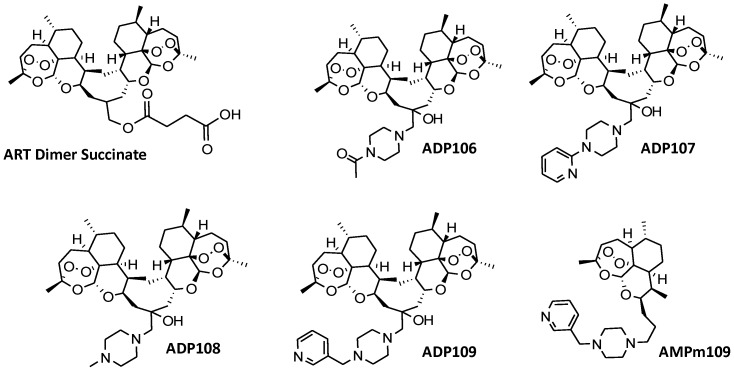
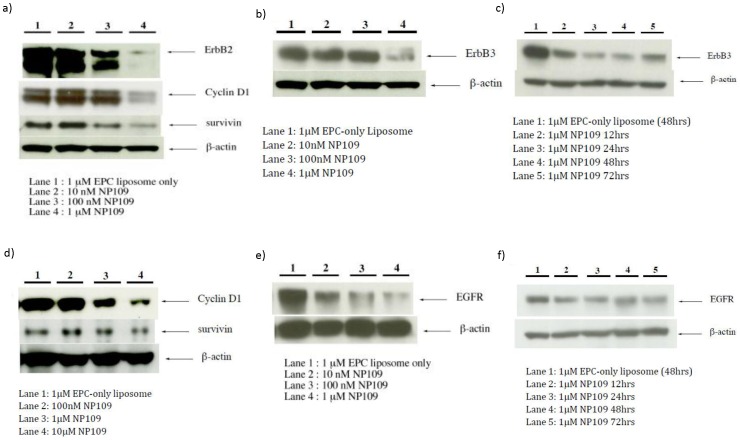
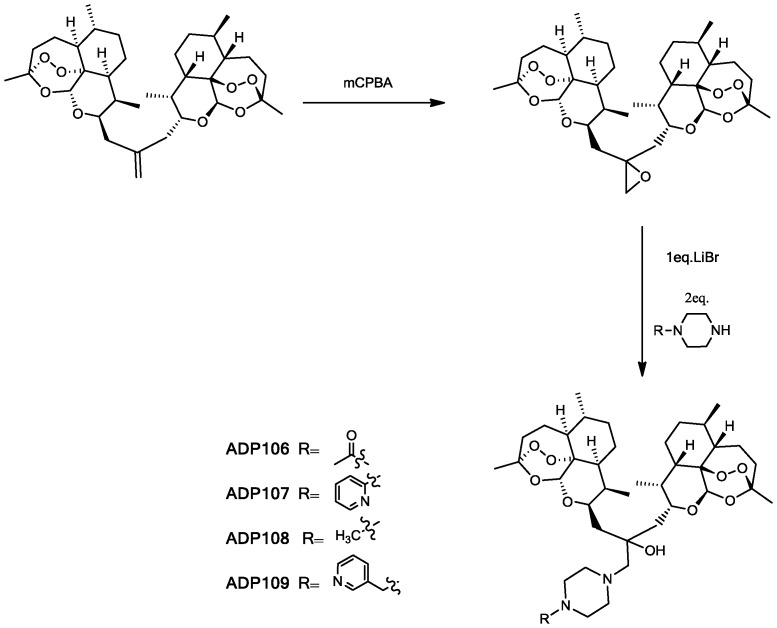
Artemisinin (ART) dimers show potent anti-proliferative activities against breast cancer cells. To facilitate their clinical development, novel pH-responsive artemisinin dimers were synthesized for liposomal nanoparticle formulations. A new ART dimer was designed to become increasingly water-soluble as pH declines. The new artemisinin dimer piperazine derivatives (ADPs) remained tightly associated with liposomal nanoparticles (NPs) at neutral pH but were efficiently released at acidic pH's that are known to exist within solid tumors and organelles such as endosomes and lysosomes. ADPs incorporated into nanoparticles down regulated the anti-apoptotic protein, survivin, and cyclin D1 when incubated at low concentrations with breast cancer cell lines. We demonstrate for the first time, for any ART derivative, that ADP NPs can down regulate the oncogenic protein HER2, and its counterpart, HER3 in a HER2+ cell line. We also show that the wild type epidermal growth factor receptor (EGFR or HER1) declines in a triple negative breast cancer (TNBC) cell line in response to ADP NPs. The declines in these proteins are achieved at concentrations of NP109 at or below 1 µM. Furthermore, the new artemisinin derivatives showed improved cell-proliferation inhibition effects compared to known dimer derivatives.
青蒿素 (ART) 二聚体对乳腺癌细胞表现出很强的抗增殖活性。为了促进它们的临床发展,合成了新型 pH 响应型青蒿素二聚体用于脂质体纳米颗粒制剂。设计了一种新的青蒿素二聚体哌嗪衍生物 (ADP),使其在 pH 下降时水溶性逐渐增加。新的青蒿素二聚体哌嗪衍生物 (ADP) 在中性 pH 时与脂质体纳米颗粒 (NPs) 紧密结合,但在酸性 pH 时会被有效释放,酸性 pH 存在于实体瘤和内体、溶酶体等细胞器中。当以低浓度与乳腺癌细胞系孵育时,ADP 被纳入纳米颗粒中会下调抗凋亡蛋白 survivin 和 cyclin D1。我们首次证明,对于任何 ART 衍生物,ADP NPs 都可以下调 HER2+细胞系中的致癌蛋白 HER2 和其对应物 HER3。我们还表明,野生型表皮生长因子受体 (EGFR 或 HER1) 在三阴性乳腺癌 (TNBC) 细胞系中对 ADP NPs 做出反应而下降。这些蛋白的下降是在 NP109 浓度达到或低于 1 µM 时实现的。此外,与已知的二聚体衍生物相比,新型青蒿素衍生物显示出更好的细胞增殖抑制作用。