Department of Entomology, Cornell University, Ithaca, NY 14853-2601, USA.
Microb Ecol. 2013 Apr;65(3):753-62. doi: 10.1007/s00248-013-0218-z. Epub 2013 Mar 27.
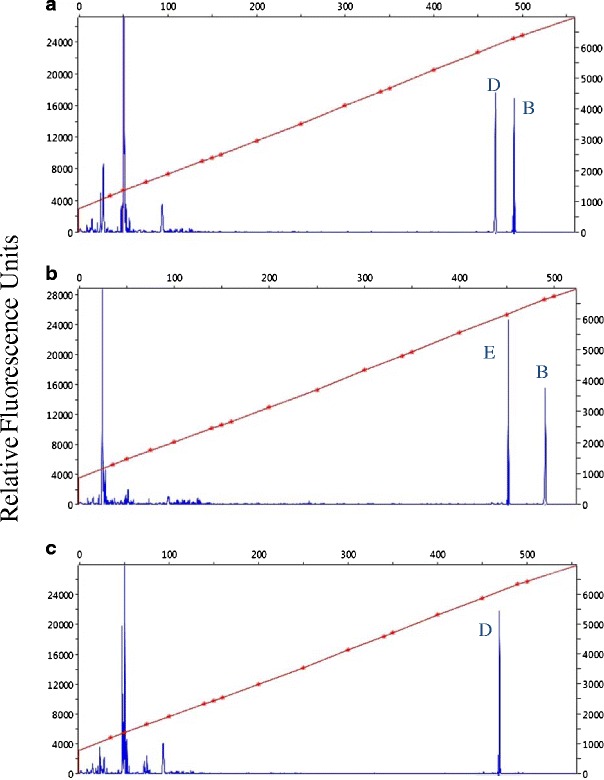
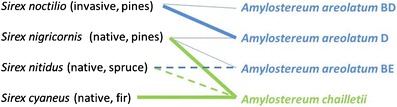
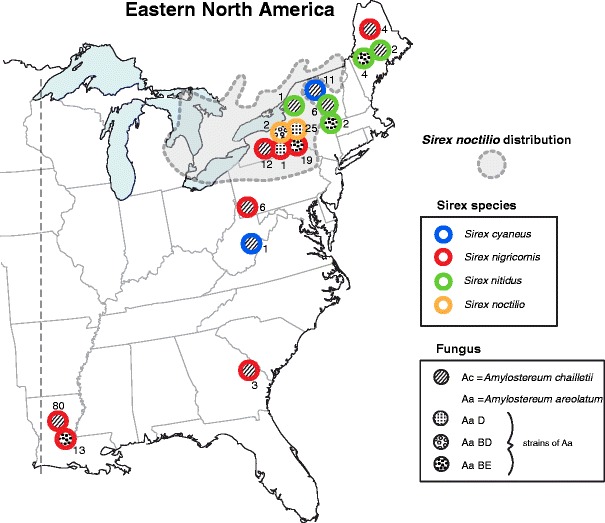
We report that associations between mutualistic fungi and their economically and ecologically important woodwasp hosts are not always specific as was previously assumed. Woodwasps in the genus Sirex engage in obligate nutritional ectosymbioses with two species of Amylostereum, a homobasid\iomycete genus of white rot fungi. In the present study, the Amylostereum species and genotypes associated with three species of Sirex native to eastern North America and one relatively recent invasive Sirex from Europe were investigated by comparing intergenic spacer regions (IGS). Sirex spp. were sampled over 6 years from 23 sites in six US states, ranging from Maine in the northeast to Louisiana in the southeast, to obtain samples of Amylostereum from mycangia of adult females. Two of the native Sirex species (Sirex nigricornis and Sirex nitidus) were associated with either Amylostereum chailletii or Amylostereum areolatum, refuting the hypothesis of strict species-specific relationships. However, the invasive Sirex noctilio and the native Sirex cyaneus were each collected with only A. areolatum or A. chailletii, respectively, although S. noctilio was associated with two different IGS genotypes of A. areolatum and S. cyaneus occurs sympatrically with the other native Sirex. In Pinus, the preferred host tree of S. nigricornis and S. noctilio, these species co-occurred in 25.9 % of trees sampled, and horizontal transmission of fungal strains from S. noctilio to S. nigricornis was documented, although only in one tree. The extent that further spread and establishment of S. noctilio will alter the composition of symbionts carried by native Sirex is unknown but will depend in part on the degree of flexibility in these host-symbiont associations.
我们报告称,互惠共生真菌与其具有经济和生态重要性的木质黄蜂宿主之间的关联并不像之前假设的那样总是具有特异性。 Sirex 属木质黄蜂与两种 Amylostereum 物种(一种白腐真菌的 homobasid\iomycete 属)进行专性营养外共生。在本研究中,通过比较种间间隔区(IGS),研究了与原产于北美东部的三种 Sirex 物种和一种来自欧洲的相对较新的入侵 Sirex 相关的 Amylostereum 物种和基因型。在 6 年的时间里,从美国 6 个州的 23 个地点采集了 Sirex spp.样本,范围从东北部的缅因州到东南部的路易斯安那州,以从成年雌性的菌囊中获取 Amylostereum 样本。两种本地 Sirex 物种(Sirex nigricornis 和 Sirex nitidus)分别与 Amylostereum chailletii 或 Amylostereum areolatum 相关,这驳斥了严格的物种特异性关系假说。然而,入侵的 Sirex noctilio 和本地的 Sirex cyaneus 分别仅与 A. areolatum 或 A. chailletii 相关,尽管 S. noctilio 与 A. areolatum 的两种不同 IGS 基因型相关联,并且 S. cyaneus 与其他本地 Sirex 发生同域分布。在 S. nigricornis 和 S. noctilio 的首选宿主树 Pinus 中,这两个物种在 25.9%的采样树木中共存,并且记录了 S. noctilio 木质黄蜂的真菌菌株向 S. nigricornis 的水平传播,尽管仅在一棵树上。S. noctilio 的进一步传播和建立将在何种程度上改变本地 Sirex 携带的共生体组成尚不清楚,但这在一定程度上取决于这些宿主共生体关联的灵活性程度。