Emmy Noether-Group for Stem Cell Biology, Department of Molecular Embryology, Institute of Anatomy and Cell Biology, University of Freiburg, Freiburg, D-79104, Germany.
Biochem J. 2013 Apr 15;451(2):135-43. doi: 10.1042/BJ20121627.
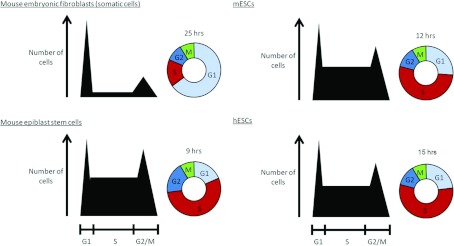
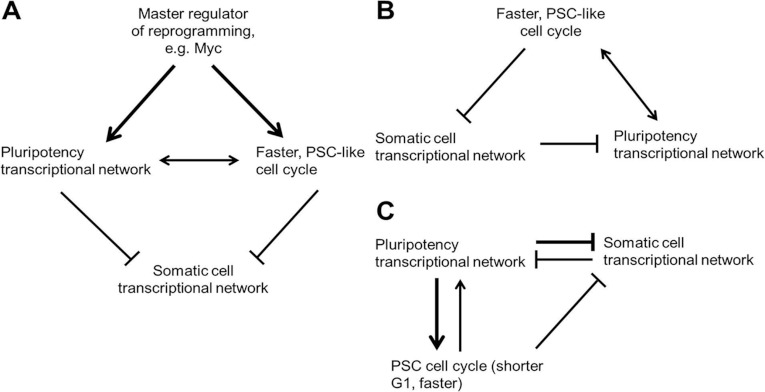
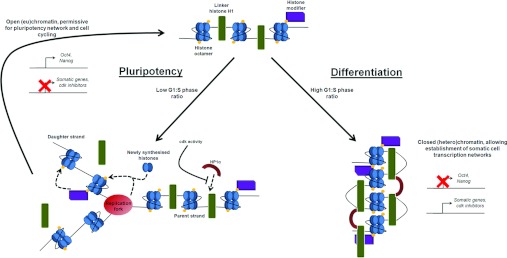
PSCs (pluripotent stem cells) possess two key properties that have made them the focus of global research efforts in regenerative medicine: they have unlimited expansion potential under conditions which favour their preservation as PSCs and they have the ability to generate all somatic cell types upon differentiation (pluripotency). Conditions have been defined in vitro in which pluripotency is maintained, or else differentiation is favoured and is directed towards specific somatic cell types. However, an unanswered question is whether or not the core cell cycle machinery directly regulates the pluripotency and differentiation properties of PSCs. If so, then manipulation of the cell cycle may represent an additional tool by which in vitro maintenance or differentiation of PSCs may be controlled in regenerative medicine. The present review aims to summarize our current understanding of links between the core cell cycle machinery and the maintenance of pluripotency in ESCs (embryonic stem cells) and iPSCs (induced PSCs).
多能干细胞(PSCs)具有两个关键特性,使其成为再生医学领域全球研究重点:在有利于其作为 PSCs 保存的条件下,它们具有无限的扩增潜力,并且在分化时具有生成所有体细胞类型的能力(多能性)。已经在体外定义了维持多能性的条件,或者有利于分化并指导特定的体细胞类型。然而,一个悬而未决的问题是核心细胞周期机制是否直接调节 PSCs 的多能性和分化特性。如果是这样,那么对细胞周期的操纵可能代表另一种工具,通过该工具可以控制再生医学中 PSCs 的体外维持或分化。本综述旨在总结我们目前对核心细胞周期机制与胚胎干细胞(ESCs)和诱导多能干细胞(iPSCs)中多能性维持之间联系的理解。