Department of Chemistry and Biotechnology, School of Engineering, The University of Tokyo, 7-3-1 Hongo, Bunkyo-ku, Tokyo, 113-8656, Japan.
BMC Biotechnol. 2013 Mar 28;13:31. doi: 10.1186/1472-6750-13-31.
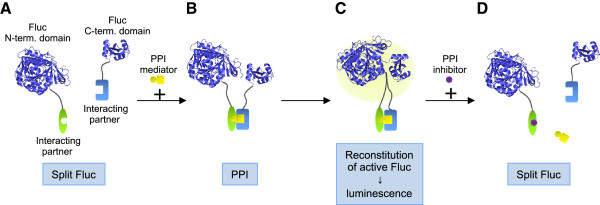
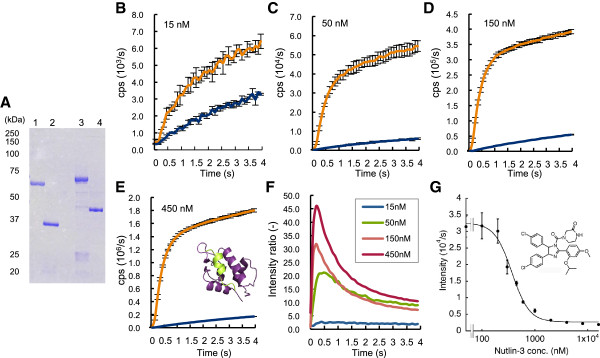
Human interactome is predicted to contain 150,000 to 300,000 protein-protein interactions, (PPIs). Protein-fragment complementation assay (PCA) is one of the most widely used methods to detect PPI, as well as Förster resonance energy transfer (FRET). To date, successful applications of firefly luciferase (Fluc)-based PCA have been reported in vivo, in cultured cells and in cell-free lysate, owing to its high sensitivity, high signal-to-background (S/B) ratio, and reversible response. Here we show the assay also works with purified proteins with unexpectedly rapid kinetics.
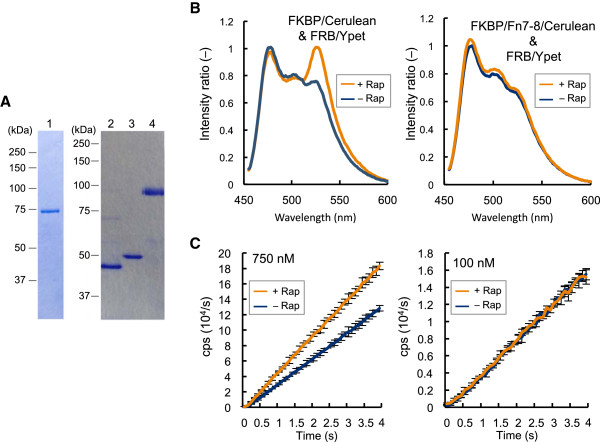
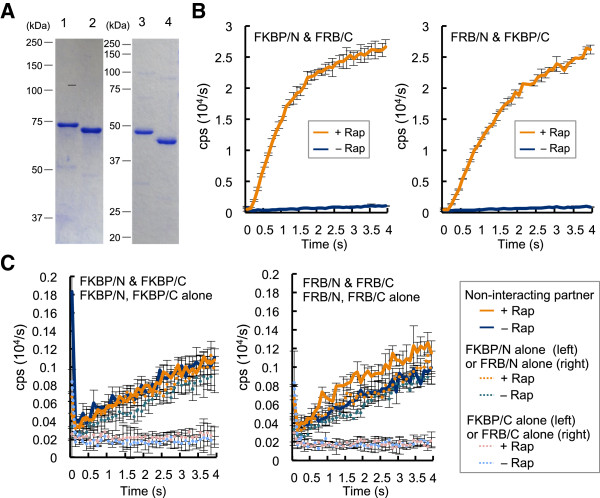
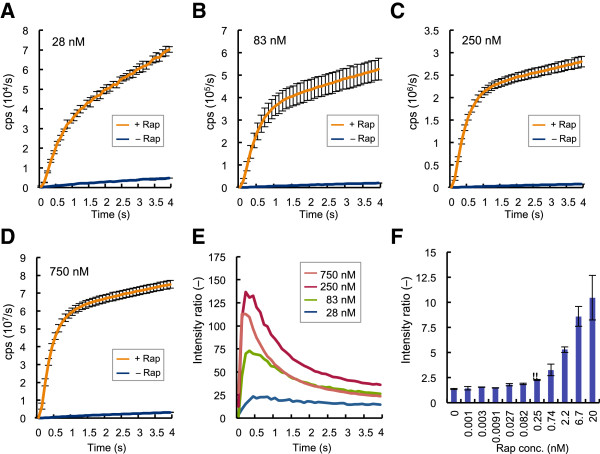
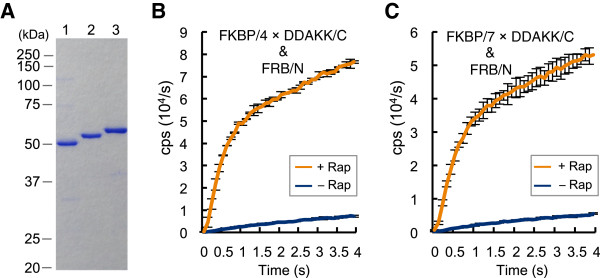
Split Fluc fragments both fused with a rapamycin-dependently interacting protein pair were made and expressed in E. coli system, and purified to homogeneity. When the proteins were used for PCA to detect rapamycin-dependent PPI, they enabled a rapid detection (~1 s) of PPI with high S/B ratio. When Fn7-8 domains (7 nm in length) that was shown to abrogate GFP mutant-based FRET was inserted between split Fluc and FKBP12 as a rigid linker, it still showed some response, suggesting less limitation in interacting partner's size. Finally, the stability of the probe was investigated. Preincubation of the probes at 37 degree C up to 1 h showed marked decrease of the luminescent signal to 1.5%, showing the limited stability of this system.
Fluc PCA using purified components will enable a rapid and handy detection of PPIs with high S/B ratio, avoiding the effects of concomitant components. Although the system might not be suitable for large-scale screening due to its limited stability, it can detect an interaction over larger distance than by FRET. This would be the first demonstration of Fluc PCA in vitro, which has a distinct advantage over other PPI assays. Our system enables detection of direct PPIs without risk of perturbation by PPI mediators in the complex cellular milieu.
人类相互作用组预计包含 150000 到 300000 个蛋白质-蛋白质相互作用(PPIs)。蛋白质片段互补测定(PCA)是检测 PPI 的最广泛使用的方法之一,以及Förster 共振能量转移(FRET)。迄今为止,萤火虫荧光素酶(Fluc)基于 PCA 的成功应用已经在体内、培养细胞和无细胞裂解物中得到了报道,这是由于其高灵敏度、高信号背景比(S/B)和可逆反应。在这里,我们展示了该测定法也可用于纯化蛋白,具有出人意料的快速动力学。
将与雷帕霉素相互作用的蛋白质对融合的 Fluc 片段进行构建并在大肠杆菌系统中表达,并进行了纯化至均一性。当这些蛋白质用于 PCA 检测雷帕霉素依赖性 PPI 时,它们能够以高 S/B 比快速检测 PPI(~1 s)。当将插入 Fluc 和 FKBP12 之间的作为刚性接头的 Fn7-8 结构域(7nm 长)插入到裂分 Fluc 中时,它仍然显示出一些反应,表明相互作用伙伴的大小限制较小。最后,研究了探针的稳定性。探针在 37°C 下预孵育 1 小时,发光信号明显下降到 1.5%,表明该系统的稳定性有限。
使用纯化组件的 Fluc PCA 将能够快速便捷地检测高 S/B 比的 PPI,避免了伴随成分的影响。尽管由于其有限的稳定性,该系统可能不适合大规模筛选,但它可以检测比 FRET 更大距离的相互作用。这将是 Fluc PCA 的首次体外演示,与其他 PPI 测定法相比具有明显的优势。我们的系统能够在复杂的细胞环境中无需担心 PPI 介质的干扰的情况下直接检测 PPI。