Autonomic Dysfunction Center, Vanderbilt University School of Medicine, Nashville, TN, USA; Department of Neurology, Vanderbilt University School of Medicine, Nashville, TN, USA.
Auton Neurosci. 2013 Oct;177(2):260-5. doi: 10.1016/j.autneu.2013.02.021. Epub 2013 Mar 26.
Patients with postural tachycardia syndrome (POTS) commonly complain of fatigue, unrefreshing sleep, daytime sleepiness and diminished quality of life. The study objective was to assess sleep quality in POTS patients using wrist actigraphy.
Prospective study with control group.
Patients with POTS (n = 36) and healthy subjects (n = 36) completed a detailed sleep log and actigraphy for 7 days.
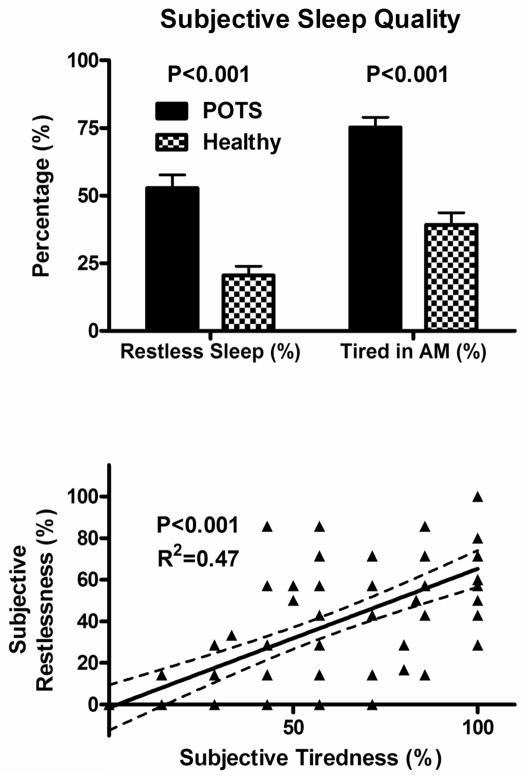
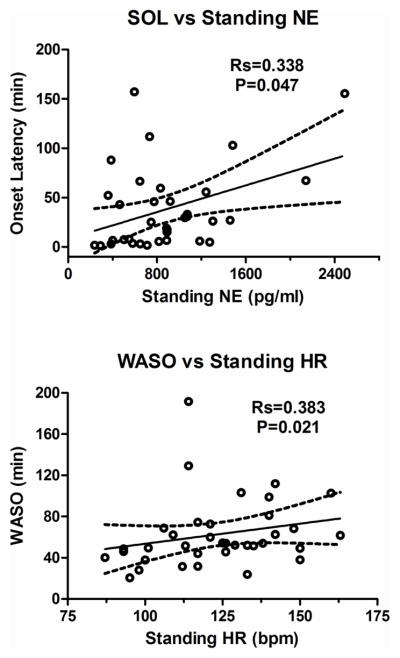
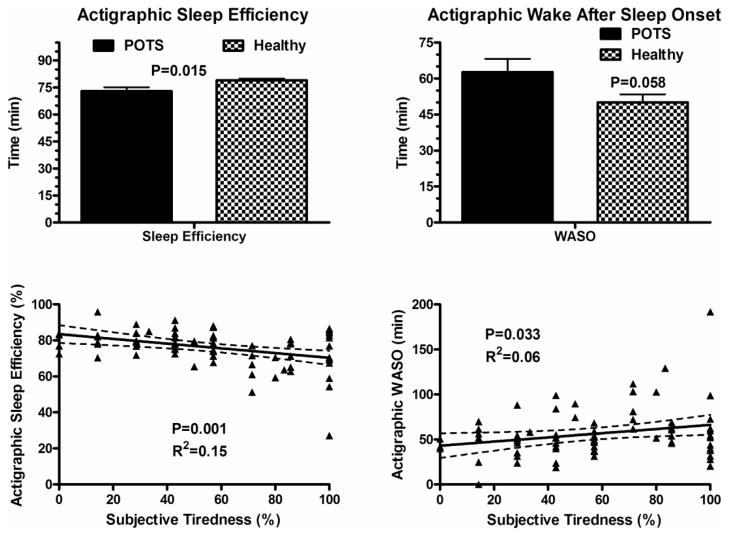
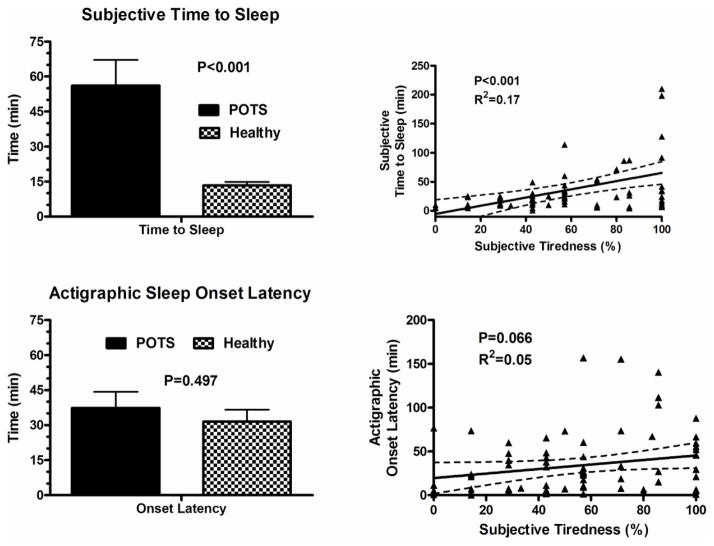
Compared with healthy subjects, POTS patients have more self-reported problems including days with restless sleep (53 ± 30% vs. 21 ± 20%; P<0.001) and tiredness (75 ± 23% vs. 39 ± 27%; P<0.001). Using actigraphy, POTS patients have lower sleep efficiency (73 ± 13% vs. 79 ± 6%; P = 0.01). Actigraphy determined sleep onset latency (SOL) did not vary significantly in the two groups, but subjective SOL was higher in POTS patient (56 ± 66 min vs. 1 3 ± 9 min; P = 0.001). In POTS patients, there was a significant correlation between subjective complaints of tiredness and actigraphic sleep efficiency (Rs = -0.36; R(2) = 0.15; P = 0.01), significant correlations between actigraphic SOL and upright norepinephrine levels (P = 0.040), and between wake after sleep onset and standing heart rate (P = 0.02).
POTS patients have more sleep-related symptoms and poor sleep efficiency. The pattern of subjective vs. objective SOL mismatch is suggestive of sleep-state misperception. High norepinephrine correlated with actigraphic SOL, and this activation of the stress system may contribute significantly to a hyperarousal state with consequent insomnia, poor mental and physical health in POTS patients.
体位性心动过速综合征(POTS)患者常主诉疲劳、睡眠质量差、日间嗜睡和生活质量下降。本研究旨在使用腕动图评估 POTS 患者的睡眠质量。
前瞻性对照研究。
POTS 患者(n=36)和健康对照组(n=36)完成 7 天详细睡眠日志和腕动图记录。
与健康对照组相比,POTS 患者报告的睡眠问题更多,包括睡眠不安(53±30% vs. 21±20%;P<0.001)和疲倦(75±23% vs. 39±27%;P<0.001)。使用腕动图,POTS 患者的睡眠效率更低(73±13% vs. 79±6%;P=0.01)。两组的腕动图确定的睡眠潜伏期(SOL)无显著差异,但 POTS 患者的主观 SOL 更高(56±66 min vs. 13±9 min;P=0.001)。在 POTS 患者中,主观疲劳与腕动图睡眠效率之间存在显著相关性(Rs=-0.36;R(2)=0.15;P=0.01),腕动图 SOL 与直立位去甲肾上腺素水平之间存在显著相关性(P=0.040),以及睡眠起始后觉醒与站立心率之间存在显著相关性(P=0.02)。
POTS 患者睡眠相关症状更多,睡眠效率更低。主观与客观 SOL 不匹配的模式提示睡眠状态感知错误。较高的去甲肾上腺素与腕动图 SOL 相关,这种应激系统的激活可能显著导致过度觉醒状态,继而导致 POTS 患者失眠、心理健康和身体健康下降。