Moodnet Research Group, Psychiatric Division, Haukeland University Hospital, Bergen, Norway.
BMC Psychiatry. 2013 Apr 4;13:105. doi: 10.1186/1471-244X-13-105.
The literature on the neuropsychological profiles in Bipolar disorder (BD) depression is sparse. The aims of the study were to assess the neurocognitive profiles in treatment-resistant, acutely admitted BD depression inpatients, to compare the neurocognitive functioning in patients with BD I and II, and to identify the demographic and clinical illness characteristics associated with cognitive functioning.
Acutely admitted BD I (n = 19) and BD II (n = 32) inpatients who fulfilled the DSM-IV-TR criteria for a major depressive episode were tested with the MATRICS Consensus Cognitive Battery (MCCB), the Wechsler Abbreviated Scale of Intelligence, the National Adult Reading Test, and a battery of clinical measures.
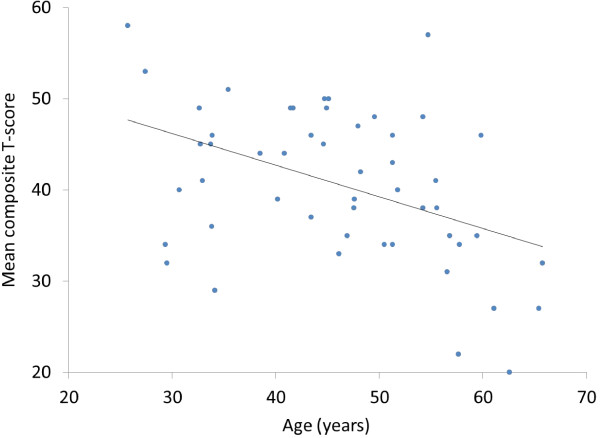
Neurocognitive impairments were evident in the BD I and BD II depression inpatients within all MCCB domains. The numerical scores on all MCCB-measures were lower in the BD I group than in the BD II group, with a significant difference on one of the measures, category fluency. 68.4% of the BD I patients had clinically significant impairment (>1.5 SD below normal mean) in two or more domains compared to 37.5% of the BD II patients (p = 0.045). A significant reduction in IQ from the premorbid to the current level was seen in BD I but not BD II patients. Higher age was associated with greater neurocognitive deficits compared to age-adjusted published norms.
A high proportion of patients with therapy-resistant BD I or II depression exhibited global neurocognitive impairments with clinically significant severity. The cognitive impairments were more common in BD I compared to BD II patients, particularly processing speed. These findings suggest that clinicians should be aware of the severe neurocognitive dysfunction in treatment-resistant bipolar depression, particularly in BD I.
NCT00664976.
双相障碍(BD)抑郁的神经心理学特征的文献很少。本研究的目的是评估治疗抵抗、急性入院的 BD 抑郁住院患者的神经认知特征,比较 BD I 和 II 型患者的神经认知功能,并确定与认知功能相关的人口统计学和临床疾病特征。
符合 DSM-IV-TR 重性抑郁发作标准的急性入院的 BD I(n = 19)和 BD II(n = 32)住院患者接受了 MATRICS 共识认知电池(MCCB)、韦氏简明智力量表、全国成人阅读测试和一系列临床测量的测试。
BD I 和 BD II 抑郁住院患者在所有 MCCB 领域都存在神经认知障碍。BD I 组的所有 MCCB 测量数值得分均低于 BD II 组,其中一项测量的类别流畅性得分差异显著。与 BD II 患者(37.5%)相比,68.4%的 BD I 患者有两个或更多领域的临床显著损伤(低于正常均值 1.5 个标准差)(p = 0.045)。与 BD I 患者相比,BD II 患者的智商从发病前到当前水平都有显著下降。与年龄调整后的发表标准相比,年龄较高与神经认知缺陷较大相关。
治疗抵抗的 BD I 或 II 型抑郁患者中有很大一部分表现出严重的神经认知障碍。与 BD II 患者相比,BD I 患者的认知障碍更为常见,尤其是在处理速度方面。这些发现表明,临床医生应该意识到治疗抵抗性双相抑郁中严重的神经认知功能障碍,特别是在 BD I 中。
NCT00664976。