Rugbjerg Peter, Naesby Michael, Mortensen Uffe H, Frandsen Rasmus J N
Microb Cell Fact. 2013 Apr 4;12:31. doi: 10.1186/1475-2859-12-31.
Fungal polyketides include commercially important pharmaceuticals and food additives, e.g. the cholesterol-lowering statins and the red and orange monascus pigments. Presently, production relies on isolation of the compounds from the natural producers, and systems for heterologous production in easily fermentable and genetically engineerable organisms, such as Saccharomyces cerevisiae and Escherichia coli are desirable. Rubrofusarin is an orange polyketide pigment that is a common intermediate in many different fungal biosynthetic pathways.
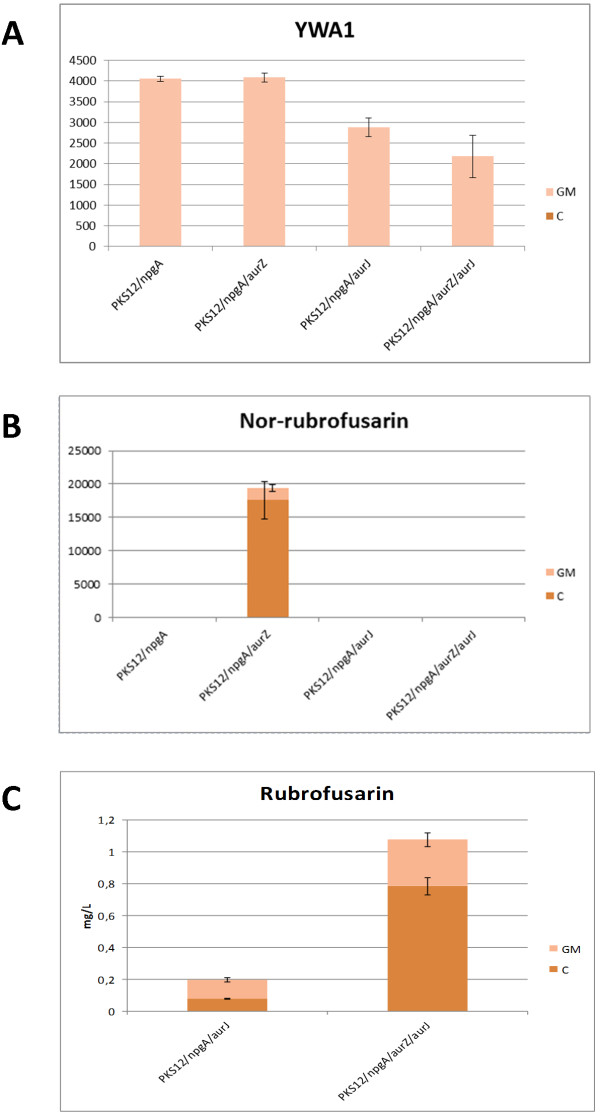
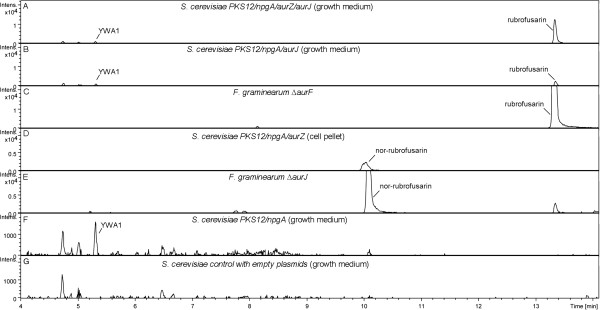
In this study, we established a biosynthetic pathway for rubrofusarin in S. cerevisiae. First, the Fusarium graminearum gene encoding polyketide synthase 12 (PKS12) was heterologously co-expressed with the Aspergillus fumigatus gene encoding phosphopantetheinyl transferase (npgA) resulting in production of YWA1. This aromatic heptaketide intermediate was converted into nor-rubrofusarin upon expression of the dehydratase gene aurZ from the aurofusarin gene cluster of F. graminearum. Final conversion into rubrofusarin was achieved by expression of the O-methyltransferase encoding gene aurJ, also obtained from the aurofusarin gene cluster, resulting in a titer of 1.1 mg/L. Reduced levels of rubrofusarin were detected when expressing PKS12, npgA, and aurJ alone, presumably due to spontaneous conversion of YWA1 to nor-rubrofusarin. However, the co-expression of aurZ resulted in an approx. six-fold increase in rubrofusarin production.
The reconstructed pathway for rubrofusarin in S. cerevisiae allows the production of a core scaffold molecule with a branch-point role in several fungal polyketide pathways, thus paving the way for production of further natural pigments and bioactive molecules. Furthermore, the reconstruction verifies the suggested pathway, and as such, it is the first example of utilizing a synthetic biological "bottom up" approach for the validation of a complex fungal polyketide pathway.
真菌聚酮化合物包括具有重要商业价值的药物和食品添加剂,例如降胆固醇的他汀类药物以及红色和橙色的红曲色素。目前,其生产依赖于从天然生产者中分离化合物,因此需要在易于发酵且可进行基因工程改造的生物体(如酿酒酵母和大肠杆菌)中建立异源生产系统。红镰孢菌素是一种橙色聚酮色素,是许多不同真菌生物合成途径中的常见中间体。
在本研究中,我们在酿酒酵母中建立了红镰孢菌素的生物合成途径。首先,将禾谷镰刀菌编码聚酮合酶12(PKS12)的基因与烟曲霉编码磷酸泛酰巯基乙胺基转移酶(npgA)的基因进行异源共表达,从而产生YWA1。在表达来自禾谷镰刀菌金褐霉素基因簇的脱水酶基因aurZ后,这种芳香族七酮中间体被转化为去甲基红镰孢菌素。通过表达同样来自金褐霉素基因簇的编码O-甲基转移酶的基因aurJ,最终将其转化为红镰孢菌素,产量达到1.1 mg/L。单独表达PKS12、npgA和aurJ时,检测到红镰孢菌素水平降低,推测这是由于YWA1自发转化为去甲基红镰孢菌素所致。然而,aurZ的共表达使红镰孢菌素产量增加了约六倍。
在酿酒酵母中重建的红镰孢菌素途径能够生产一种在几种真菌聚酮途径中起分支点作用的核心支架分子,从而为进一步生产天然色素和生物活性分子铺平了道路。此外,该重建验证了所提出的途径,因此,它是利用合成生物学“自下而上”方法验证复杂真菌聚酮途径的首个实例。