Department of Family Medicine, China Medical University Hospital, Taichung, Taiwan.
BMC Public Health. 2013 Apr 9;13:318. doi: 10.1186/1471-2458-13-318.
The prevalence of type 2 diabetes has rapidly increased in the Taiwanese population with the increasing prevalence of a sedentary lifestyle and high-calorie dietary intake. This study aims to determine the annual trends of the prevalence and incidence of diagnosed type 2 diabetes among adults in Taiwan from 2000 to 2007.
A population-based study of all residents aged 20 years and over (12,191,076 in 2000 and 18,772,180 in 2007) enrolled in the National Health Insurance (NHI) program, the database of which was used to identify patients diagnosed with type 2 diabetes. The annual prevalence and incidence of diagnosed type 2 diabetes were estimated using the International Classification of Diseases, 9th Revision, Clinical Modification diagnostic codes based on age, gender, insurance premium, and urbanization degree. Logistic regression was used to estimate the odds ratios (OR) of risk factors, as well as to examine the trend in the annual prevalence or incidence of diagnosed type 2 diabetes from 2000 to 2007.
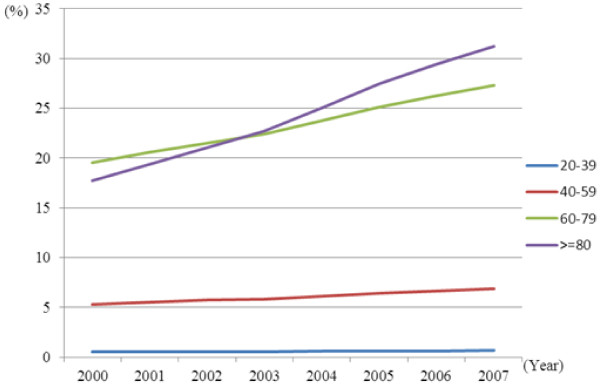
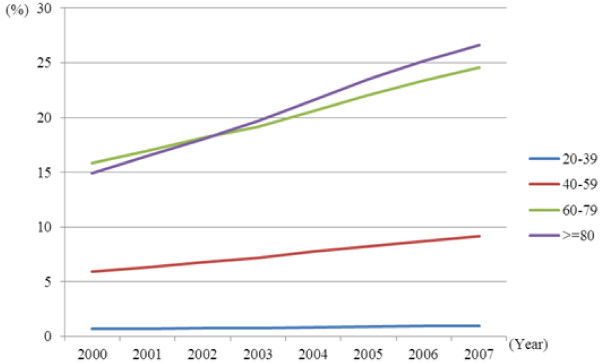
The crude annual prevalence of diagnosed type 2 diabetes increased significantly from 5.79% in 2000 to 8.30% in 2007. The increase was highest in 2007, among men, individuals aged ≥ 80 years, and individuals residing in aging society areas [OR (95% CI): 1.416 (1.412-1.420), 1.033 (1.032-1.034), 31.810 (31.690-31.931), and 1.090 (1.085-1.094), respectively]. The crude incidence fluctuated throughout the study period, ranging from 7.72 per 1,000 in 2006 to 8.98 per 1,000 in 2000. The decrease was highest in 2006, among individuals with an insurance premium ≥ median value [0.933 (0.925-0.942) and 0.810 (0.805-0.815), respectively]. The greatest increase was among men, individuals aged 60 to 79 years, and individuals residing in aging society areas [1.150 (1.145-1.155), 15.452 (15.329-15.576), and 1.127 (1.113-1.142), respectively].
This study demonstrated the substantial increase in annual prevalence of diagnosed type 2 diabetes among adults in Taiwan from 2000 to 2007. The incidence fluctuated between 2000 and 2007.
随着生活方式久坐不动和高热量饮食的普及,台湾人群 2 型糖尿病的患病率迅速增加。本研究旨在确定 2000 年至 2007 年期间台湾成年人中确诊 2 型糖尿病的患病率和发病率的年度趋势。
对参加全民健康保险计划的所有 20 岁及以上居民(2000 年为 1219.1076 人,2007 年为 18772180 人)进行了一项基于人群的研究,该数据库用于确定被诊断患有 2 型糖尿病的患者。根据年龄、性别、保险费和城市化程度,使用国际疾病分类第 9 版临床修正诊断代码估算确诊 2 型糖尿病的年患病率和发病率。使用 logistic 回归估计风险因素的比值比(OR),并检查 2000 年至 2007 年期间确诊 2 型糖尿病的年患病率或发病率的趋势。
未经调整的确诊 2 型糖尿病年患病率从 2000 年的 5.79%显著上升至 2007 年的 8.30%。2007 年增幅最高,男性、≥80 岁人群和老龄化社会地区人群增幅最大[OR(95%CI):1.416(1.412-1.420)、1.033(1.032-1.034)、31.810(31.690-31.931)和 1.090(1.085-1.094)]。整个研究期间,未经调整的发病率波动不定,2006 年为每 1000 人 7.72 例,2000 年为每 1000 人 8.98 例。2006 年降幅最大,保险费≥中位数的人群降幅最大[0.933(0.925-0.942)和 0.810(0.805-0.815)]。增幅最大的是男性、60 至 79 岁人群和老龄化社会地区人群[1.150(1.145-1.155)、15.452(15.329-15.576)和 1.127(1.113-1.142)]。
本研究表明,2000 年至 2007 年期间,台湾成年人中确诊 2 型糖尿病的年患病率显著增加。发病率在 2000 年至 2007 年之间波动。