Department of Internal Medicine, Division of Endocrinology and Metabolism, American University of Beirut-Medical Center, 3 Dag Hammarskjold Plaza, 8th floor, New York, NY 10017, USA.
Int J Endocrinol. 2013;2013:148673. doi: 10.1155/2013/148673. Epub 2013 Mar 13.
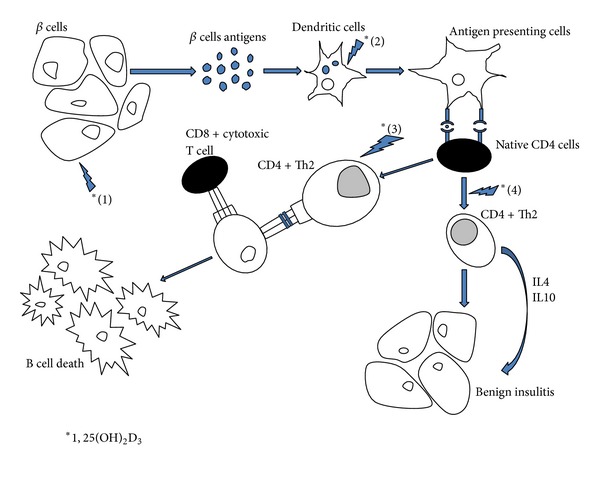
The "nonclassic" role of 1,25-dihydroxyvitamin D3 (1,25(OH)2D3) has been recently widely recognized. In type 1 diabetes mellitus (T1D), it plays an immunomodulatory role through the vitamin D receptor (VDR) present on pancreatic and immune cells. Specific VDR allelic variants have been associated with T1D in many countries. Furthermore, vitamin D deficiency has been prevalent in T1D, and the seasonal and latitude variability in the incidence of T1D can be partly explained by the related variability in vitamin D level. In fact, retrospective studies of vitamin D supplementation during pregnancy or infancy showed a lower incidence of T1D. We will review the different mechanisms of the vitamin D protective effect against insulitis and present the available data on the role of vitamin D deficiency in the control, progression, and complications of T1D.
1,25-二羟维生素 D3(1,25(OH)2D3)的“非经典”作用最近得到了广泛的认可。在 1 型糖尿病(T1D)中,它通过存在于胰腺和免疫细胞上的维生素 D 受体(VDR)发挥免疫调节作用。在许多国家,特定的 VDR 等位基因变体与 T1D 相关。此外,T1D 患者中维生素 D 缺乏症很常见,T1D 的发病率在季节和纬度上存在差异,这可以部分解释为维生素 D 水平的相关变化。事实上,对妊娠或婴儿期补充维生素 D 的回顾性研究表明,T1D 的发病率较低。我们将回顾维生素 D 对胰岛炎的保护作用的不同机制,并介绍维生素 D 缺乏在 T1D 的控制、进展和并发症中的作用的现有数据。