Microarray Laboratory, National Center for Genetic Engineering and Biotechnology, Khlong Luang, Pathum Thani, Thailand.
PLoS One. 2013;8(4):e60802. doi: 10.1371/journal.pone.0060802. Epub 2013 Apr 5.
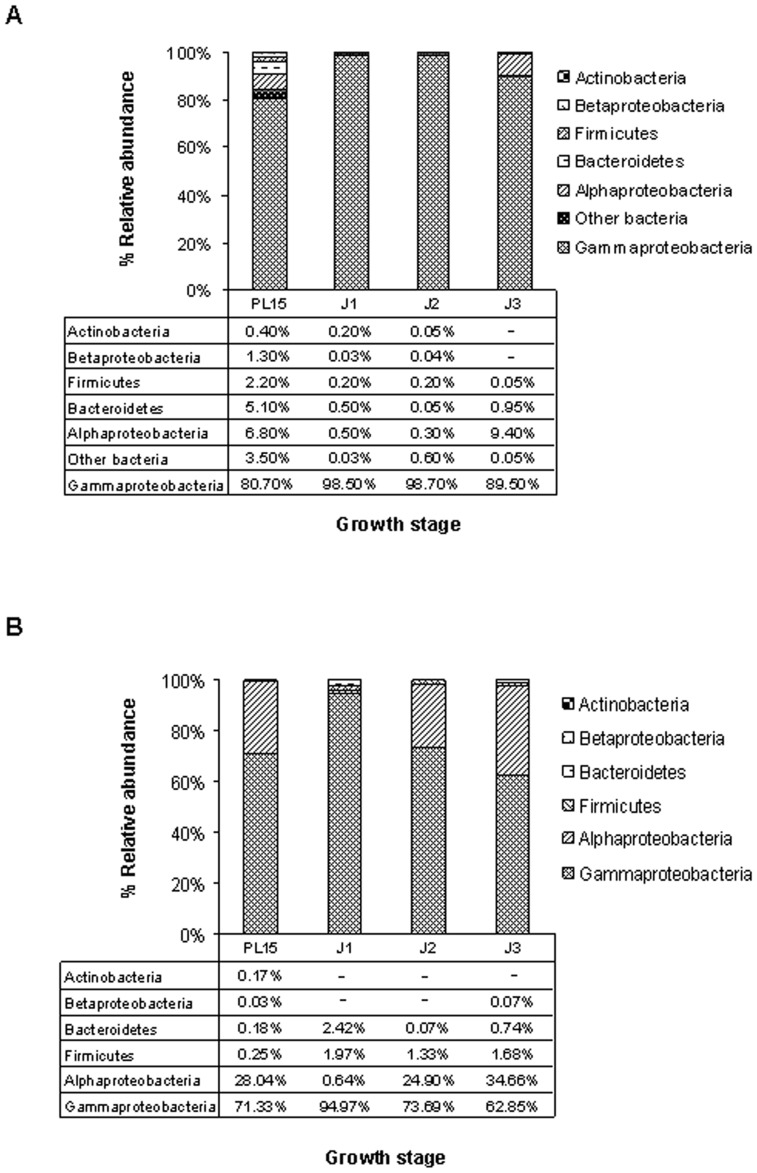
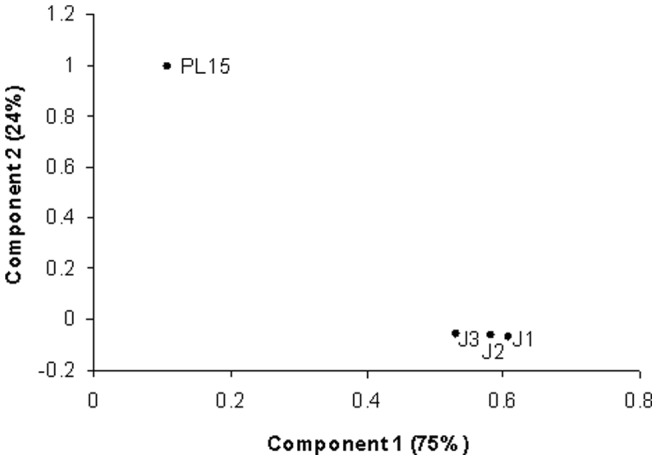
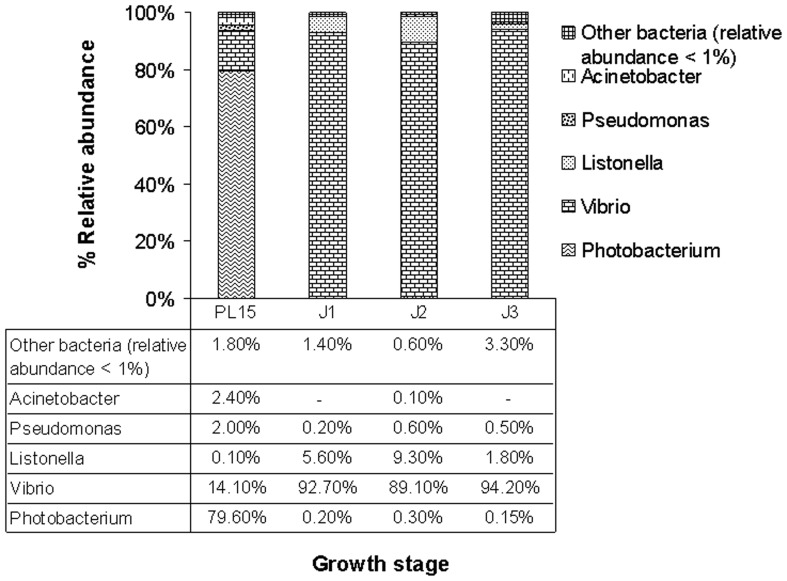
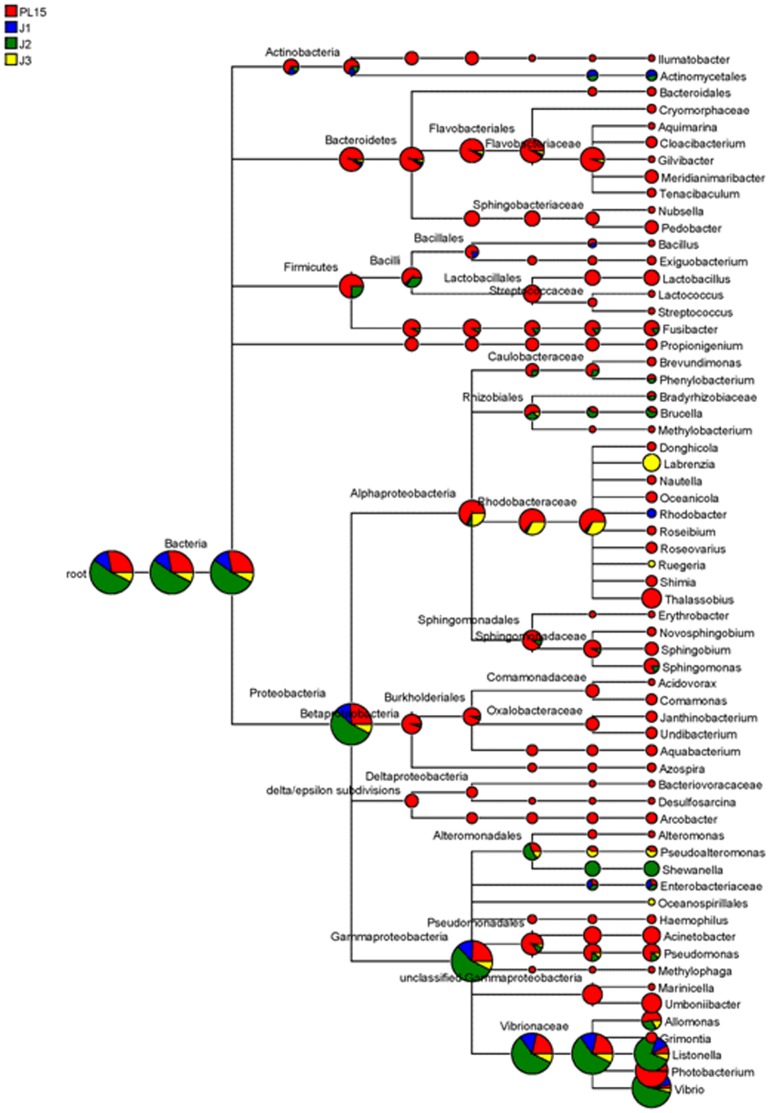
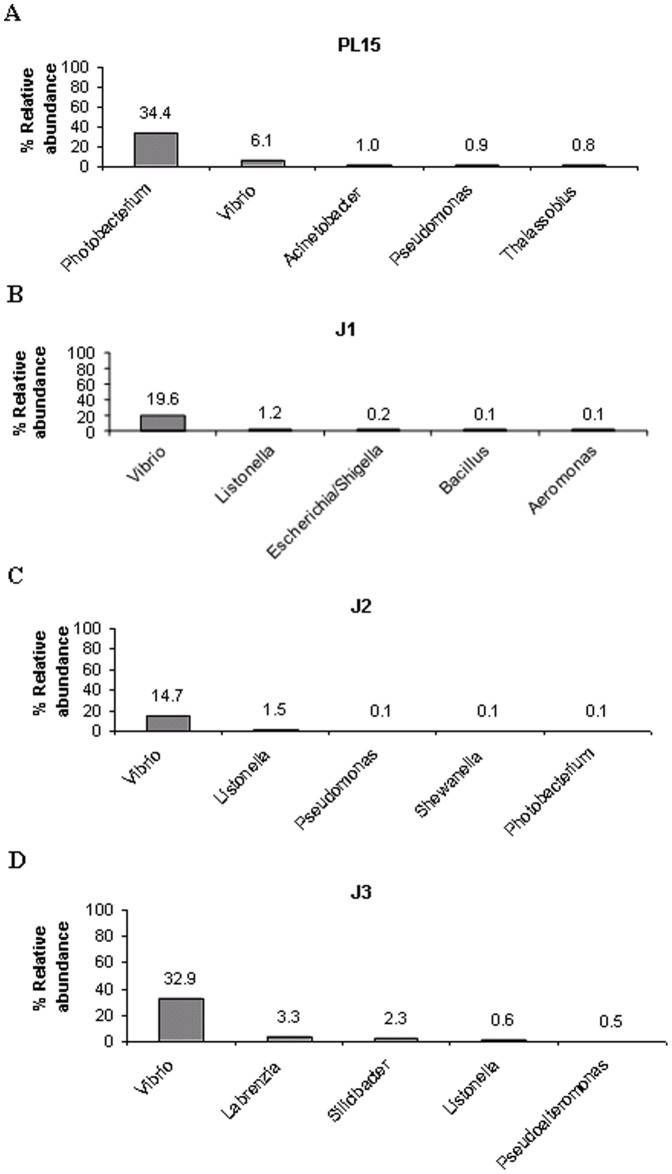
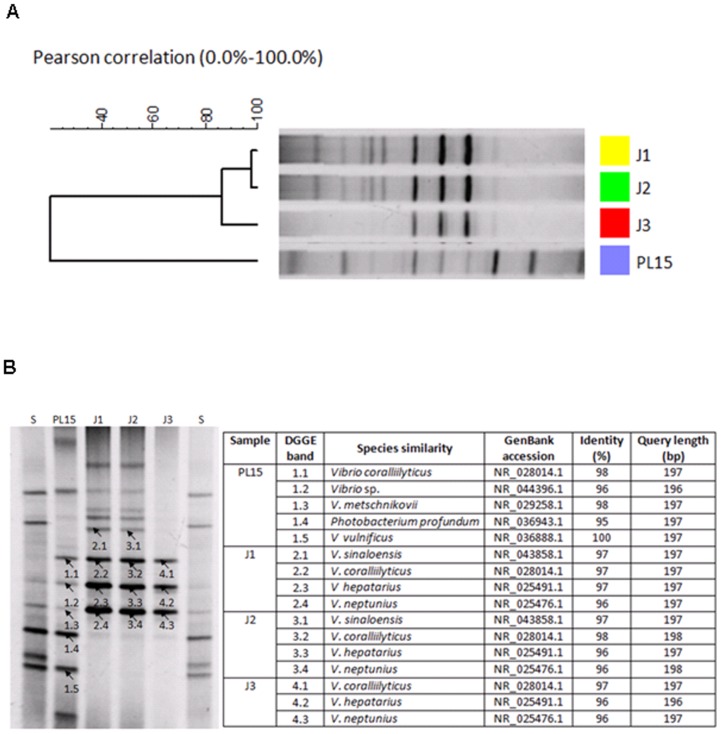
Intestinal bacterial communities in aquaculture have been drawn to attention due to potential benefit to their hosts. To identify core intestinal bacteria in the black tiger shrimp (Penaeus monodon), bacterial populations of disease-free shrimp were characterized from intestines of four developmental stages (15-day-old post larvae (PL15), 1- (J1), 2- (J2), and 3-month-old (J3) juveniles) using pyrosequencing, real-time PCR and denaturing gradient gel electrophoresis (DGGE) approaches. A total of 25,121 pyrosequencing reads (reading length = 442±24 bases) were obtained, which were categorized by barcode for PL15 (7,045 sequences), J1 (3,055 sequences), J2 (13,130 sequences) and J3 (1,890 sequences). Bacteria in the phyla Bacteroides, Firmicutes and Proteobacteria were found in intestines at all four growth stages. There were 88, 14, 27, and 20 bacterial genera associated with the intestinal tract of PL15, J1, J2 and J3, respectively. Pyrosequencing analysis revealed that Proteobacteria (class Gammaproteobacteria) was a dominant bacteria group with a relative abundance of 89% for PL15 and 99% for J1, J2 and J3. Real-time PCR assay also confirmed that Gammaproteobacteria had the highest relative abundance in intestines from all growth stages. Intestinal bacterial communities from the three juvenile stages were more similar to each other than that of the PL shrimp based on PCA analyses of pyrosequencing results and their DGGE profiles. This study provides descriptive bacterial communities associated to the black tiger shrimp intestines during these growth development stages in rearing facilities.
养殖水产中的肠道细菌群落由于对宿主具有潜在益处而受到关注。为了确定黑虎虾(Penaeus monodon)肠道中的核心肠道细菌,采用焦磷酸测序、实时 PCR 和变性梯度凝胶电泳(DGGE)方法,从四个发育阶段(15 日龄幼虾(PL15)、1-(J1)、2-(J2)和 3 月龄(J3)幼虾)的无病虾肠道中描述了细菌种群。获得了总计 25,121 个焦磷酸测序读数(读长=442±24 个碱基),这些读数通过条形码分类为 PL15(7,045 个序列)、J1(3,055 个序列)、J2(13,130 个序列)和 J3(1,890 个序列)。在所有四个生长阶段的肠道中都发现了厚壁菌门、Firmicutes 和 Proteobacteria 门的细菌。与 PL15、J1、J2 和 J3 的肠道相关的细菌分别有 88、14、27 和 20 个属。焦磷酸测序分析显示,变形菌门(Gamma-Proteobacteria 类)是一个优势菌群,PL15 的相对丰度为 89%,J1、J2 和 J3 的相对丰度为 99%。实时 PCR 分析也证实,Gamma-Proteobacteria 在所有生长阶段的肠道中具有最高的相对丰度。基于焦磷酸测序结果和 DGGE 图谱的 PCA 分析,三个幼虾阶段的肠道细菌群落彼此之间比 PL 虾更相似。本研究提供了在养殖设施中这些生长发育阶段与黑虎虾肠道相关的描述性细菌群落。