U.S. Department of Agriculture-Agricultural Research Service, U.S. Vegetable Laboratory, Charleston, SC 29414, USA.
Virol J. 2013 Apr 12;10:117. doi: 10.1186/1743-422X-10-117.
Pepino mosaic, once an emerging disease a decade ago, has become endemic on greenhouse tomatoes worldwide in recent years. Three distinct genotypes of Pepino mosaic virus (PepMV), including EU, US1 and CH2 have been recognized. Our earlier study conducted in 2006-2007 demonstrated a predominant EU genotype in Canada and United States. The objective of the present study was to monitor the dynamic of PepMV genetic composition and its current status in North America.
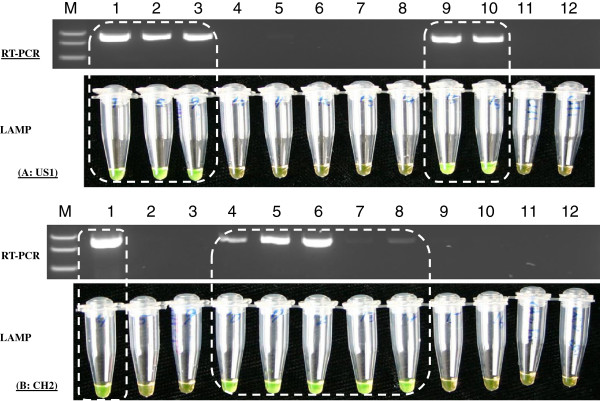
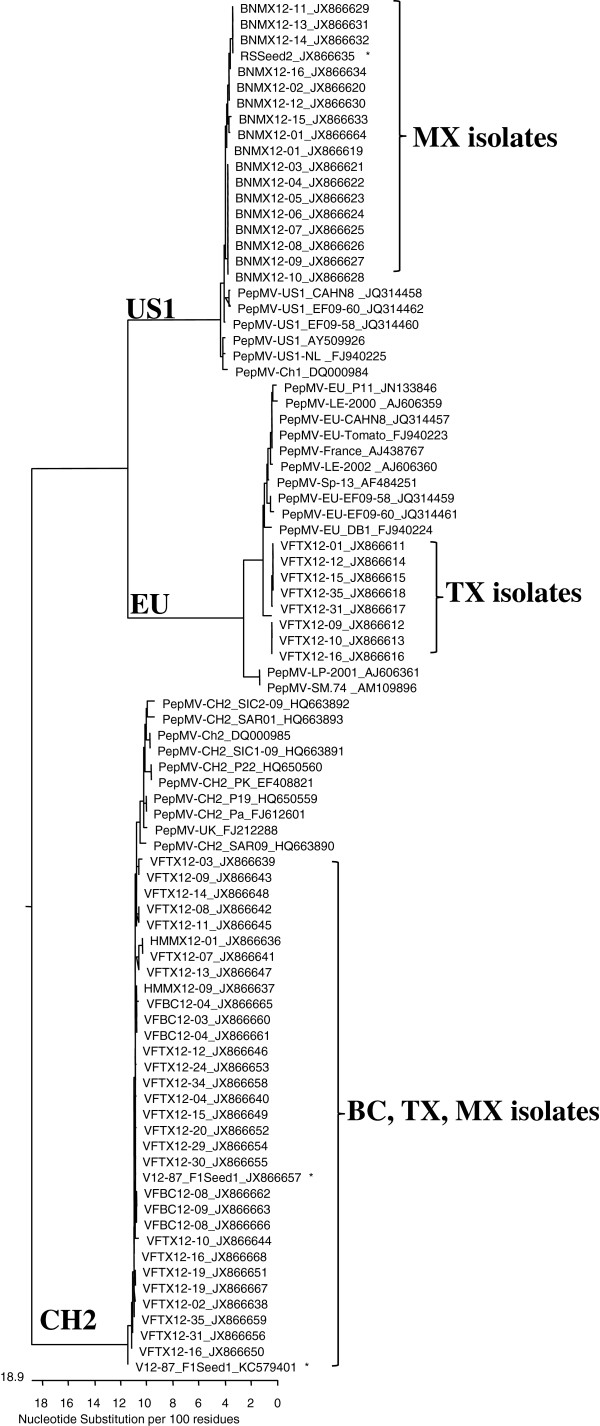
Through yearly monitoring efforts in 2009-2012, we detected a dramatic shift in the prevalent genotype of PepMV from the genotype EU to CH2 in North America since early 2010, with another shift from CH2 to US1 occurring in Mexico only two years later. Through genetic diversity analysis using the coat protein gene, such genotype shifting of PepMV in North America was linked to the positive identification of similar sequence variants in two different commercial tomato seed sources used for scion and rootstock, respectively. To allow for a quick identification, a reverse transcription loop-mediated isothermal amplification (RT-LAMP) system was developed and demonstrated to achieve a rapid identification for each of the three genotypes of PepMV, EU, US1 and CH2.
Through systemic yearly monitoring and genetic diversity analysis, we identified a linkage between the field epidemic isolates and those from commercial tomato seed lots as the likely sources of initial PepMV inoculum that resulted in genetic shifting as observed on greenhouse tomatoes in North America. Application of the genotype-specific RT-LAMP system would allow growers to efficiently determine the genetic diversity on their crops.
十年前曾是新出现疾病的 Pepino 花叶病毒(PepMV),近年来已在全世界温室番茄上成为地方病。已确认存在三种不同的 PepMV 基因型,包括 EU、US1 和 CH2。我们在 2006-2007 年进行的早期研究表明,EU 基因型在加拿大和美国占主导地位。本研究的目的是监测 PepMV 遗传组成的动态及其在北美的现状。
通过 2009-2012 年的年度监测,我们发现自 2010 年初以来,北美的 PepMV 流行基因型从 EU 型急剧转变为 CH2 型,仅两年后,墨西哥又从 CH2 型转变为 US1 型。通过使用外壳蛋白基因进行遗传多样性分析,北美的 PepMV 这种基因型转变与在两个不同商业番茄种子源中鉴定到的相似序列变体有关,这些种子源分别用于接穗和砧木。为了能够快速识别,开发并证明了一种逆转录环介导等温扩增(RT-LAMP)系统可用于快速鉴定 PepMV 的三种基因型 EU、US1 和 CH2。
通过系统的年度监测和遗传多样性分析,我们确定了田间流行分离物与商业番茄种子批次之间的联系,这可能是导致北美温室番茄中观察到的遗传转变的最初 PepMV 接种物的来源。应用特定基因型的 RT-LAMP 系统可使种植者有效地确定其作物的遗传多样性。