LMGE, Laboratoire Microorganismes: Génome et Environnement, UMR CNRS 6023, Clermont Université, Université Blaise Pascal, BP 80026, Aubière, France.
PLoS One. 2013 Apr 12;8(4):e60894. doi: 10.1371/journal.pone.0060894. Print 2013.
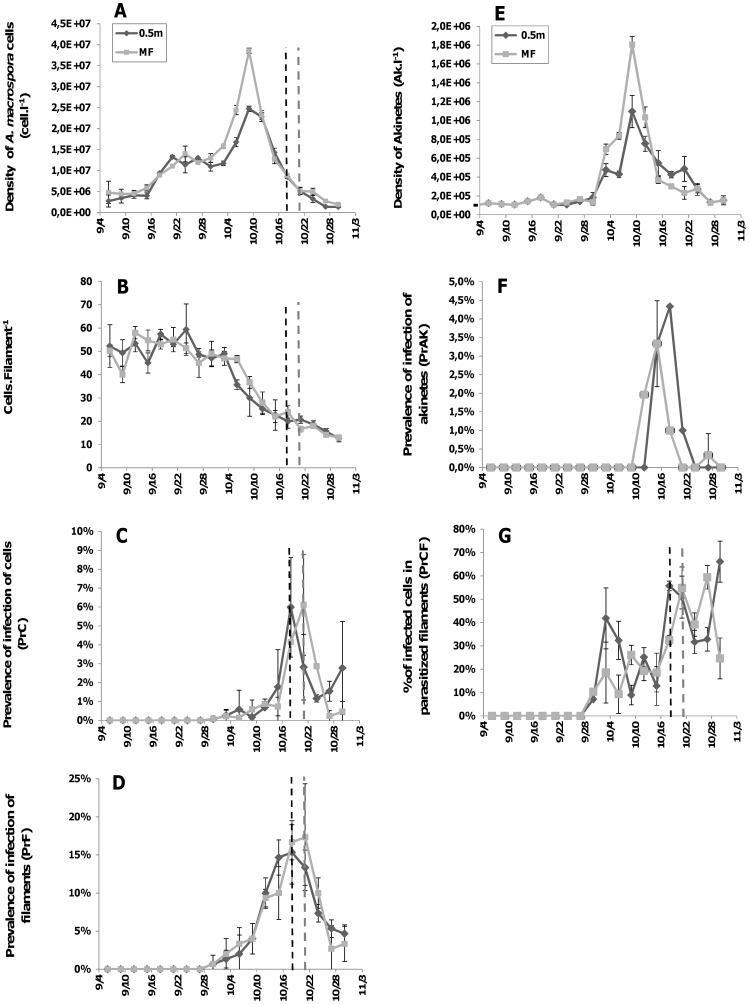
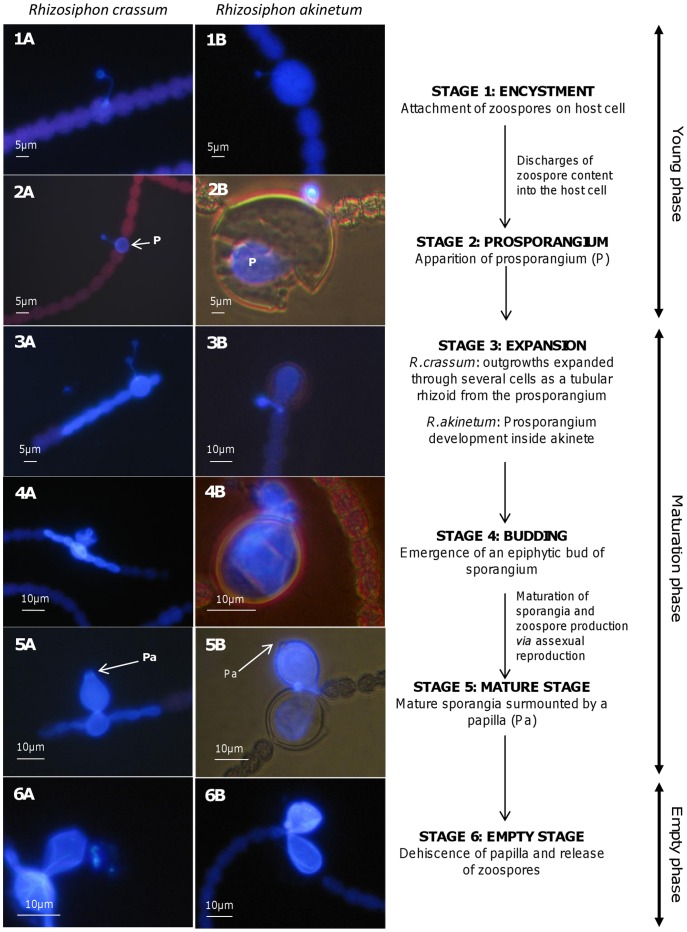
Many species of phytoplankton are susceptible to parasitism by fungi from the phylum Chytridiomycota (i.e. chytrids). However, few studies have reported the effects of fungal parasites on filamentous cyanobacterial blooms. To investigate the missing components of bloom ecosystems, we examined an entire field bloom of the cyanobacterium Anabaena macrospora for evidence of chytrid infection in a productive freshwater lake, using a high resolution sampling strategy. A. macrospora was infected by two species of the genus Rhizosiphon which have similar life cycles but differed in their infective regimes depending on the cellular niches offered by their host. R. crassum infected both vegetative cells and akinetes while R. akinetum infected only akinetes. A tentative reconstruction of the developmental stages suggested that the life cycle of R. crassum was completed in about 3 days. The infection affected 6% of total cells (and 4% of akinètes), spread over a maximum of 17% of the filaments of cyanobacteria, in which 60% of the cells could be parasitized. Furthermore, chytrids may reduce the length of filaments of Anabaena macrospora significantly by "mechanistic fragmentation" following infection. All these results suggest that chytrid parasitism is one of the driving factors involved in the decline of a cyanobacteria blooms, by direct mortality of parasitized cells and indirectly by the mechanistic fragmentation, which could weaken the resistance of A. macrospora to grazing.
许多浮游植物物种容易受到来自壶菌门(即壶菌)真菌的寄生。然而,很少有研究报道真菌寄生虫对丝状蓝藻水华的影响。为了研究水华生态系统中缺失的成分,我们使用高分辨率采样策略,检查了一个富营养化淡水湖中整个丝状蓝藻 Anabaena macrospora 的水华,以寻找壶菌感染的证据。A. macrospora 被两种 Rhizosiphon 属的真菌感染,这两种真菌具有相似的生命周期,但由于其宿主提供的细胞生态位不同,其感染方式也不同。R. crassum 感染营养细胞和静息孢子,而 R. akinetum 只感染静息孢子。对发育阶段的初步重建表明,R. crassum 的生命周期在大约 3 天内完成。感染影响了总细胞的 6%(静息孢子的 4%),分布在蓝藻丝状藻的最大 17%的范围内,其中 60%的细胞可以被寄生。此外,在感染后,壶菌可能通过“机械性破碎”显著缩短 Anabaena macrospora 的丝状体长度。所有这些结果表明,壶菌寄生是导致蓝藻水华衰退的驱动因素之一,通过寄生细胞的直接死亡和机械性破碎的间接作用,这可能削弱 A. macrospora 对放牧的抵抗力。