Ecology and Evolutionary Biology, Brown University, 80 Waterman Street, Providence, RI 02912, USA.
BMC Genomics. 2013 Apr 19;14:266. doi: 10.1186/1471-2164-14-266.
Nematostella vectensis, a burrowing sea anemone, has become a popular species for the study of cnidarian development. In previous studies, the expression of a variety of genes has been characterized during N. vectensis development with in situ mRNA hybridization. This has provided detailed spatial resolution and a qualitative perspective on changes in expression. However, little is known about broad transcriptome-level patterns of gene expression through time. Here we examine the expression of N. vectensis genes through the course of development with quantitative RNA-seq. We provide an overview of changes in the transcriptome through development, and examine the maternal to zygotic transition, which has been difficult to investigate with other tools.
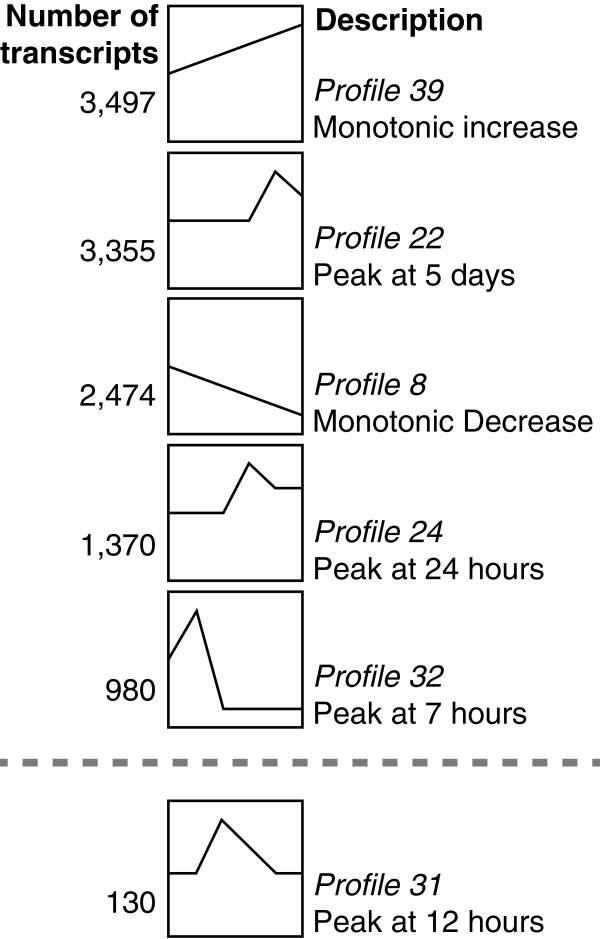
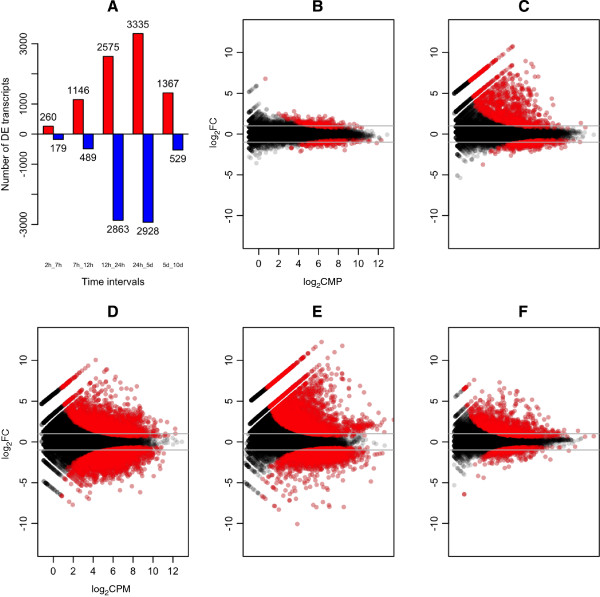
We measured transcript abundance in N. vectensis with RNA-seq at six time points in development: zygote (2 hours post fertilization (HPF)), early blastula (7 HPF), mid-blastula (12 HPF), gastrula (24 HPF), planula (5 days post fertilization (DPF)) and young polyp (10 DPF). The major wave of zygotic expression appears between 7-12 HPF, though some changes occur between 2-7 HPF. The most dynamic changes in transcript abundance occur between the late blastula and early gastrula stages. More transcripts are upregulated between the gastrula and planula than downregulated, and a comparatively lower number of transcripts significantly change between planula and polyp. Within the maternal to zygotic transition, we identified a subset of maternal factors that decrease early in development, and likely play a role in suppressing zygotic gene expression. Among the first genes to be expressed zygotically are genes whose proteins may be involved in the degradation of maternal RNA.
The approach presented here is highly complementary to prior studies on spatial patterns of gene expression, as it provides a quantitative perspective on a broad set of genes through time but lacks spatial resolution. In addition to addressing the problems identified above, our work provides an annotated matrix that other investigators can use to examine genes and developmental events that we do not examine in detail here.
穴居海葵(Nematostella vectensis)是一种研究腔肠动物发育的热门物种。在之前的研究中,通过原位 mRNA 杂交技术对 N. vectensis 发育过程中的多种基因进行了特征描述。这提供了详细的空间分辨率和定性的表达变化观点。然而,对于整个转录组水平的基因表达随时间的变化知之甚少。在这里,我们使用定量 RNA-seq 研究了 N. vectensis 发育过程中的基因表达。我们提供了一个通过发育过程中转录组变化的概述,并研究了母体到合子的转变,这是其他工具难以研究的。
我们通过 RNA-seq 在 N. vectensis 发育的六个时间点测量了转录丰度:合子(受精后 2 小时(HPF))、早期囊胚(7 HPF)、中期囊胚(12 HPF)、原肠胚(24 HPF)、浮游幼虫(受精后 5 天(DPF))和幼体息肉(10 DPF)。主要的合子表达波出现在 7-12 HPF 之间,尽管在 2-7 HPF 之间也发生了一些变化。转录丰度最动态的变化发生在晚期囊胚和早期原肠胚之间。在原肠胚和浮游幼虫之间上调的转录本多于下调的转录本,而在浮游幼虫和幼体息肉之间变化显著的转录本数量相对较少。在母体到合子的转变中,我们鉴定出一组早期减少的母体因子,它们可能在抑制合子基因表达中发挥作用。最早合子表达的基因是其蛋白质可能参与母体 RNA 降解的基因。
这里提出的方法与以前关于基因表达空间模式的研究高度互补,因为它提供了一个随时间变化的广泛基因的定量观点,但缺乏空间分辨率。除了解决上述问题外,我们的工作还提供了一个注释矩阵,其他研究人员可以使用该矩阵来研究我们在这里没有详细研究的基因和发育事件。