Gupta Asheesh, Dai Tianhong, Hamblin Michael R
BAR414, Wellman Center for Photomedicine, Massachusetts General Hospital, 40 Blossom Street, Boston, MA, 02114, USA.
Lasers Med Sci. 2014 Jan;29(1):257-65. doi: 10.1007/s10103-013-1319-0. Epub 2013 Apr 26.
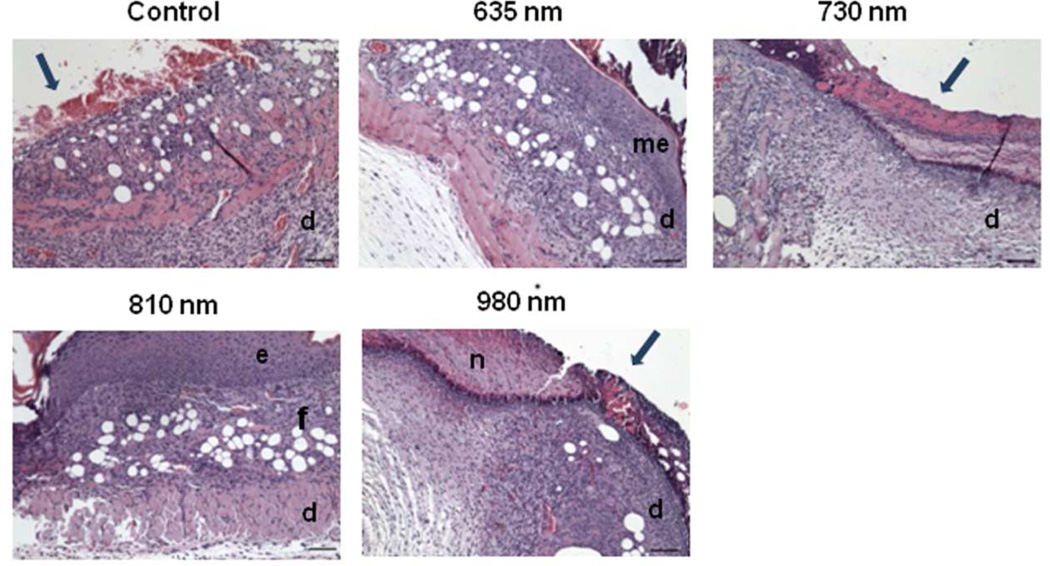
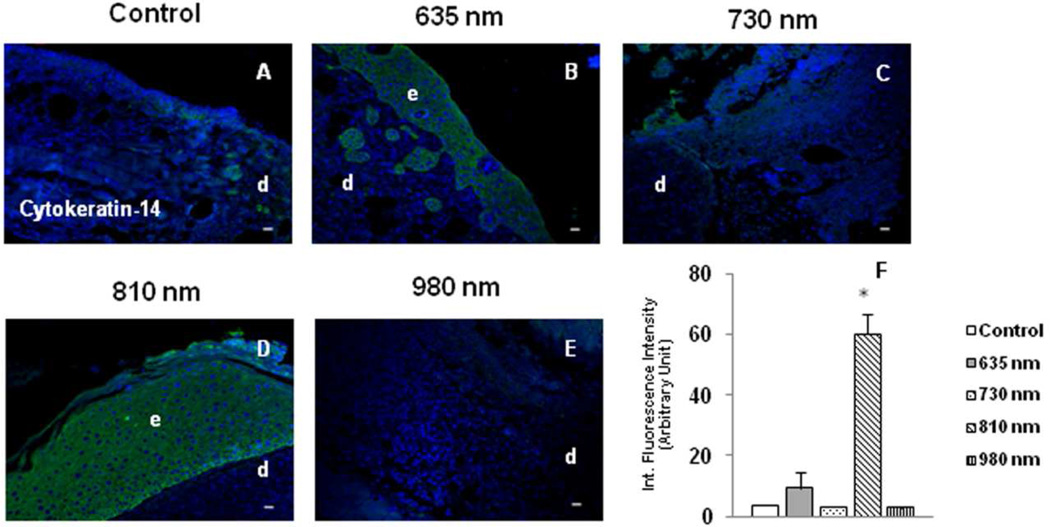
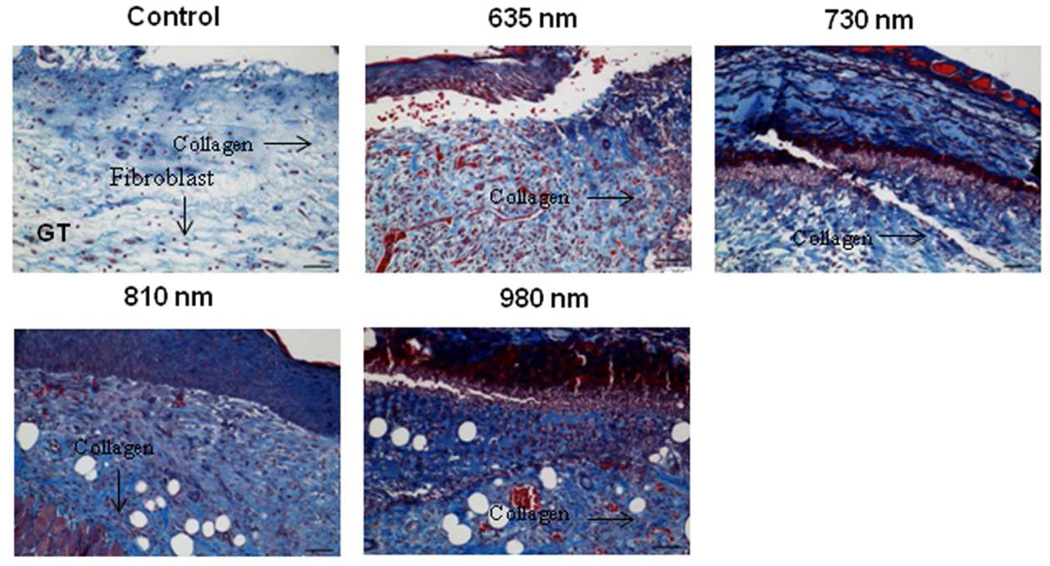
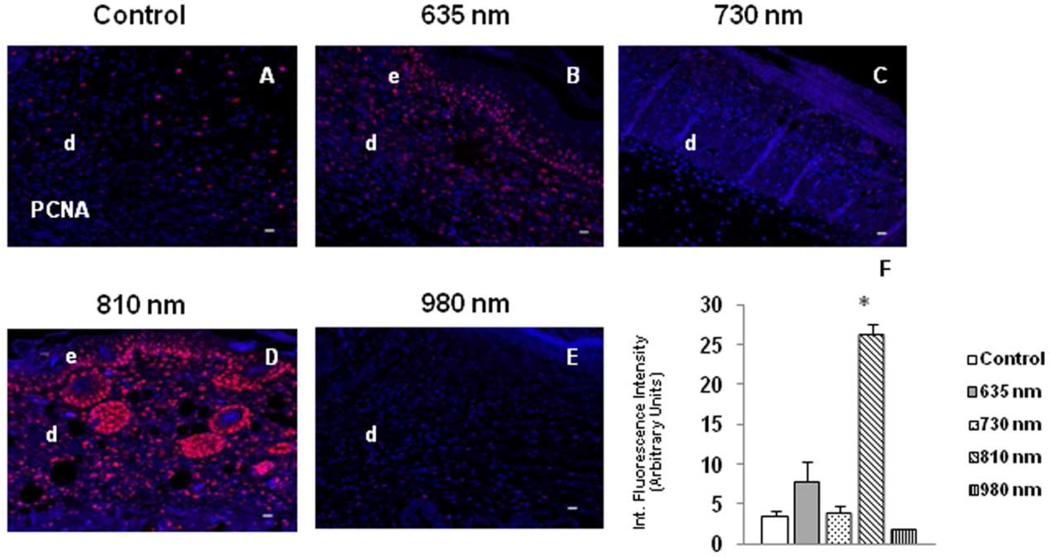
Low-level laser (light) therapy (LLLT) promotes wound healing, reduces pain and inflammation, and prevents tissue death. Studies have explored the effects of various radiant exposures on the effect of LLLT; however, studies of wavelength dependency in in vivo models are less common. In the present study, the healing effects of LLLT mediated by different wavelengths of light in the red and near-infrared (NIR) wavelength regions (635, 730, 810, and 980 nm) delivered at constant fluence (4 J/cm(2)) and fluence rate (10 mW/cm(2)) were evaluated in a mouse model of partial-thickness dermal abrasion. Wavelengths of 635 and 810 nm were found to be effective in promoting the healing of dermal abrasions. However, treatment using 730- and 980-nm wavelengths showed no sign of stimulated healing. Healing was maximally augmented in mice treated with an 810-nm wavelength, as evidenced by significant wound area reduction (p < 0.05), enhanced collagen accumulation, and complete re-epithelialization as compared to other wavelengths and non-illuminated controls. Significant acceleration of re-epithelialization and cellular proliferation revealed by immunofluorescence staining for cytokeratin-14 and proliferating cell nuclear antigen (p < 0.05) was evident in the 810-nm wavelength compared with other groups. Photobiomodulation mediated by red (635 nm) and NIR (810 nm) light suggests that the biological response of the wound tissue depends on the wavelength employed. The effectiveness of 810-nm wavelength agrees with previous publications and, together with the partial effectiveness of 635 nm and the ineffectiveness of 730 and 980 nm wavelengths, can be explained by the absorption spectrum of cytochrome c oxidase, the candidate mitochondrial chromophore in LLLT.
低强度激光(光)疗法(LLLT)可促进伤口愈合、减轻疼痛和炎症,并防止组织坏死。已有研究探讨了不同辐射暴露对LLLT效果的影响;然而,关于体内模型中波长依赖性的研究较为少见。在本研究中,在部分厚度皮肤擦伤的小鼠模型中,评估了在恒定能量密度(4 J/cm²)和能量密度率(10 mW/cm²)下,由红色和近红外(NIR)波长区域(635、730、810和980 nm)不同波长的光介导的LLLT的愈合效果。发现635和810 nm波长可有效促进皮肤擦伤的愈合。然而,使用730和980 nm波长的治疗未显示出刺激愈合的迹象。与其他波长和未照射的对照组相比,用810 nm波长治疗的小鼠愈合得到最大程度增强,表现为伤口面积显著减小(p < 0.05)、胶原积累增加以及完全重新上皮化。与其他组相比,810 nm波长组通过细胞角蛋白-14和增殖细胞核抗原免疫荧光染色显示的重新上皮化和细胞增殖显著加速(p < 0.05)。红色(635 nm)和近红外(810 nm)光介导的光生物调节表明,伤口组织的生物学反应取决于所采用的波长。810 nm波长的有效性与先前的出版物一致,并且635 nm的部分有效性以及730和980 nm波长的无效性可以通过细胞色素c氧化酶的吸收光谱来解释,细胞色素c氧化酶是LLLT中候选的线粒体发色团。