Department of Applied Physics, Stanford University, Stanford, California, USA.
Nat Struct Mol Biol. 2013 Jun;20(6):718-27. doi: 10.1038/nsmb.2567. Epub 2013 Apr 28.
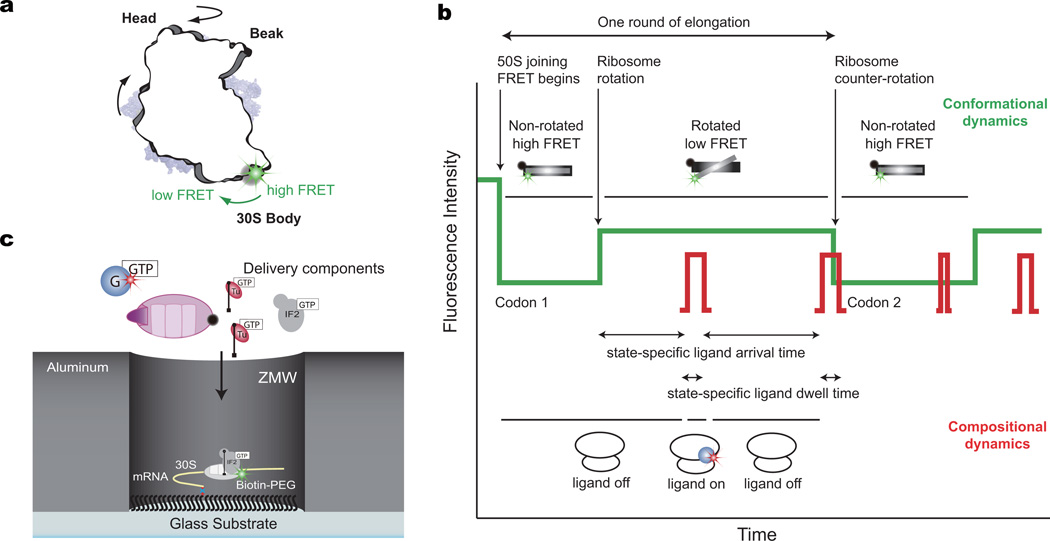
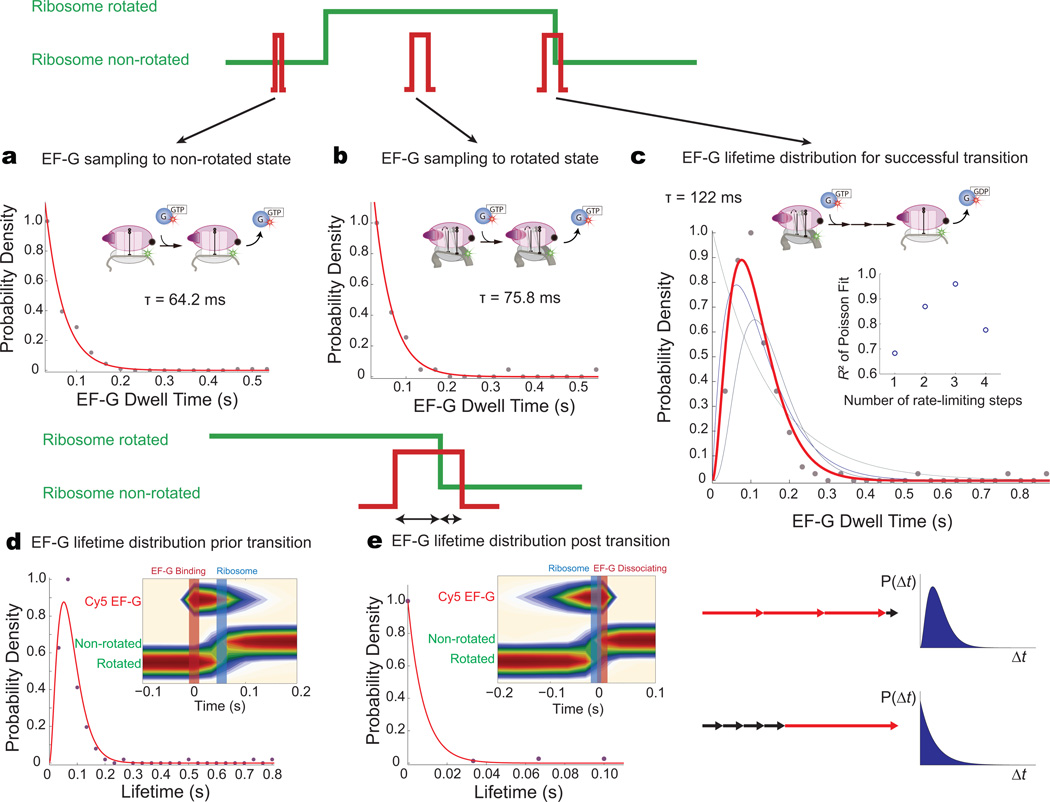
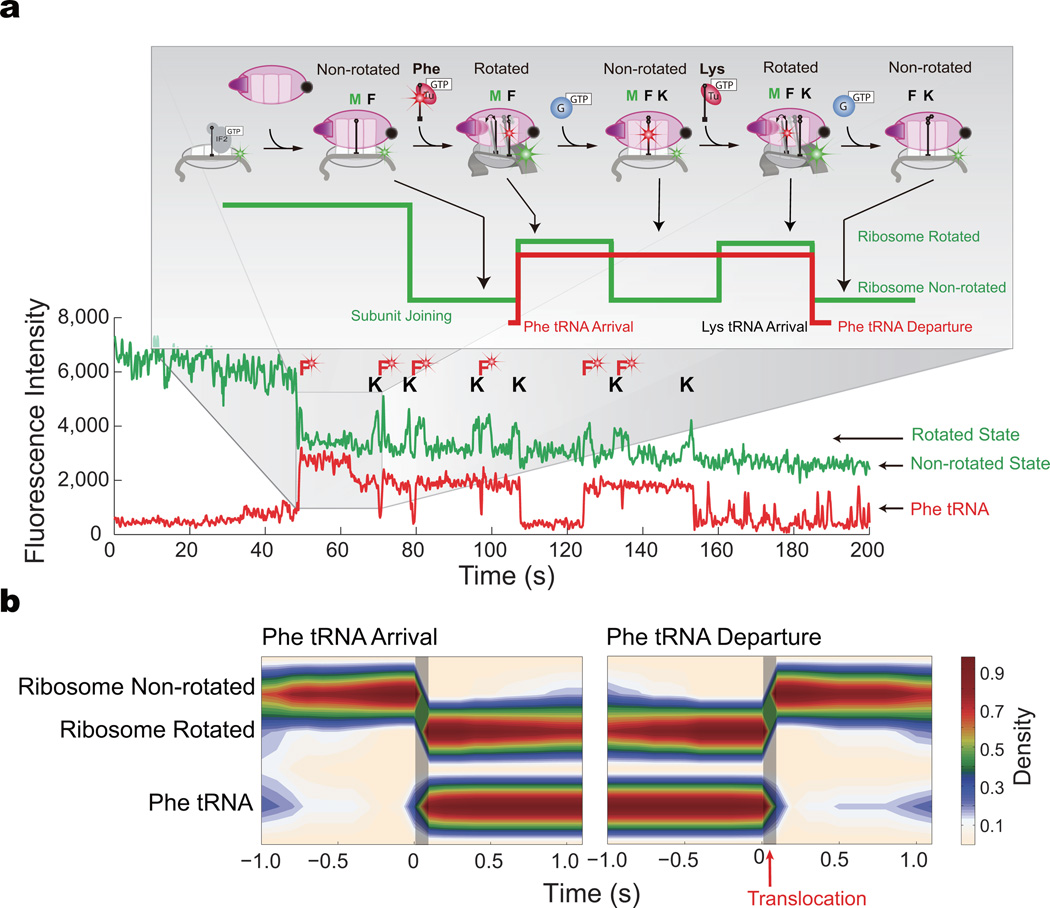
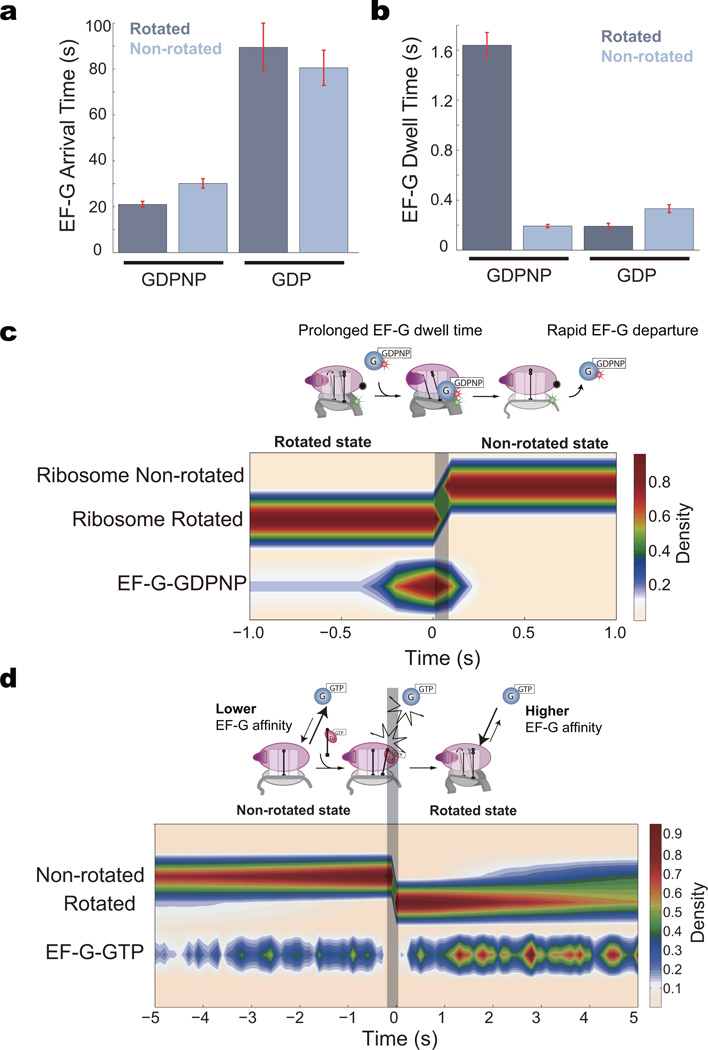
During translation elongation, the ribosome compositional factors elongation factor G (EF-G; encoded by fusA) and tRNA alternately bind to the ribosome to direct protein synthesis and regulate the conformation of the ribosome. Here, we use single-molecule fluorescence with zero-mode waveguides to directly correlate ribosome conformation and composition during multiple rounds of elongation at high factor concentrations in Escherichia coli. Our results show that EF-G bound to GTP (EF-G-GTP) continuously samples both rotational states of the ribosome, binding with higher affinity to the rotated state. Upon successful accommodation into the rotated ribosome, the EF-G-ribosome complex evolves through several rate-limiting conformational changes and the hydrolysis of GTP, which results in a transition back to the nonrotated state and in turn drives translocation and facilitates release of both EF-G-GDP and E-site tRNA. These experiments highlight the power of tracking single-molecule conformation and composition simultaneously in real time.
在翻译延伸过程中,核糖体组成因子延伸因子 G(EF-G;由 fusA 编码)和 tRNA 交替结合到核糖体上,以指导蛋白质合成并调节核糖体的构象。在这里,我们使用单分子荧光与零模波导,在高因子浓度下,直接关联大肠杆菌中多次延伸过程中的核糖体构象和组成。我们的结果表明,结合 GTP 的 EF-G(EF-G-GTP)连续地采样核糖体的两种旋转状态,与旋转状态的结合亲和力更高。在成功适应到旋转核糖体后,EF-G-核糖体复合物通过几个限速构象变化和 GTP 的水解进化,这导致回到非旋转状态,并依次驱动转位和促进 EF-G-GDP 和 E 位 tRNA 的释放。这些实验强调了实时同时跟踪单个分子构象和组成的能力。