Artificial Intelligence Laboratory, Department of Informatics, University of Zurich Zurich, Switzerland.
Front Comput Neurosci. 2013 Apr 19;7:43. doi: 10.3389/fncom.2013.00043. eCollection 2013.
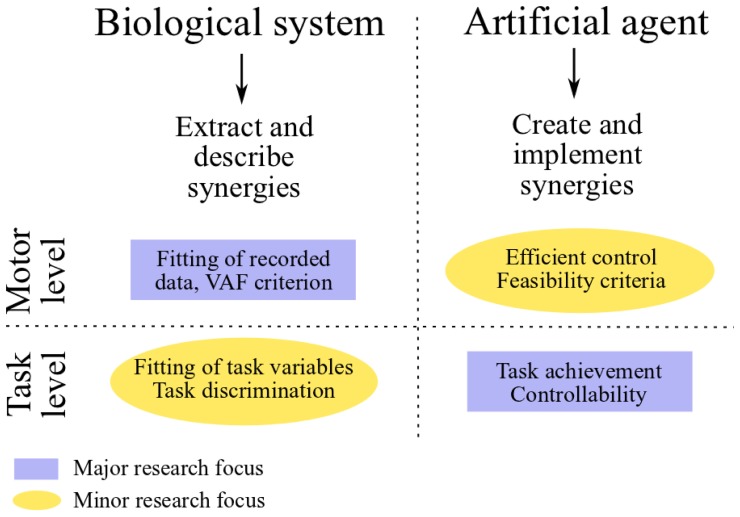
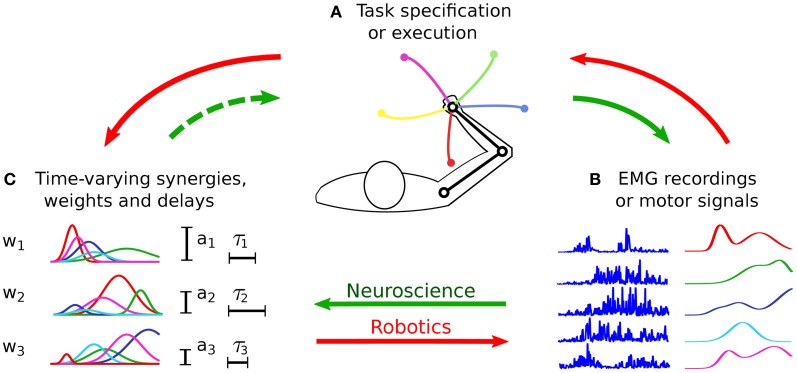
In this paper we review the works related to muscle synergies that have been carried-out in neuroscience and control engineering. In particular, we refer to the hypothesis that the central nervous system (CNS) generates desired muscle contractions by combining a small number of predefined modules, called muscle synergies. We provide an overview of the methods that have been employed to test the validity of this scheme, and we show how the concept of muscle synergy has been generalized for the control of artificial agents. The comparison between these two lines of research, in particular their different goals and approaches, is instrumental to explain the computational implications of the hypothesized modular organization. Moreover, it clarifies the importance of assessing the functional role of muscle synergies: although these basic modules are defined at the level of muscle activations (input-space), they should result in the effective accomplishment of the desired task. This requirement is not always explicitly considered in experimental neuroscience, as muscle synergies are often estimated solely by analyzing recorded muscle activities. We suggest that synergy extraction methods should explicitly take into account task execution variables, thus moving from a perspective purely based on input-space to one grounded on task-space as well.
本文综述了神经科学和控制工程领域中与肌肉协同作用相关的研究工作。特别是,我们提到了这样一种假设,即中枢神经系统(CNS)通过组合少量预定义的模块(称为肌肉协同作用)来产生所需的肌肉收缩。我们概述了已被用于检验该方案有效性的方法,并展示了如何将肌肉协同作用的概念推广到对人工代理的控制。这两条研究路线的比较,特别是它们不同的目标和方法,有助于解释所假设的模块化组织的计算意义。此外,它还阐明了评估肌肉协同作用的功能作用的重要性:尽管这些基本模块是在肌肉激活(输入空间)水平上定义的,但它们应该能够有效地完成预期的任务。在实验神经科学中,这一要求并不总是被明确考虑,因为肌肉协同作用通常仅通过分析记录的肌肉活动来估计。我们建议,协同作用提取方法应明确考虑任务执行变量,从而从纯粹基于输入空间的视角转变为基于任务空间的视角。