Department of Medicine, Radboud University Nijmegen Medical Centre and Nijmegen Institute for Infection, Inflammation, and Immunity (N4i), Nijmegen, The Netherlands.
EMBO Mol Med. 2013 Jun;5(6):805-13. doi: 10.1002/emmm.201201678. Epub 2013 Apr 30.
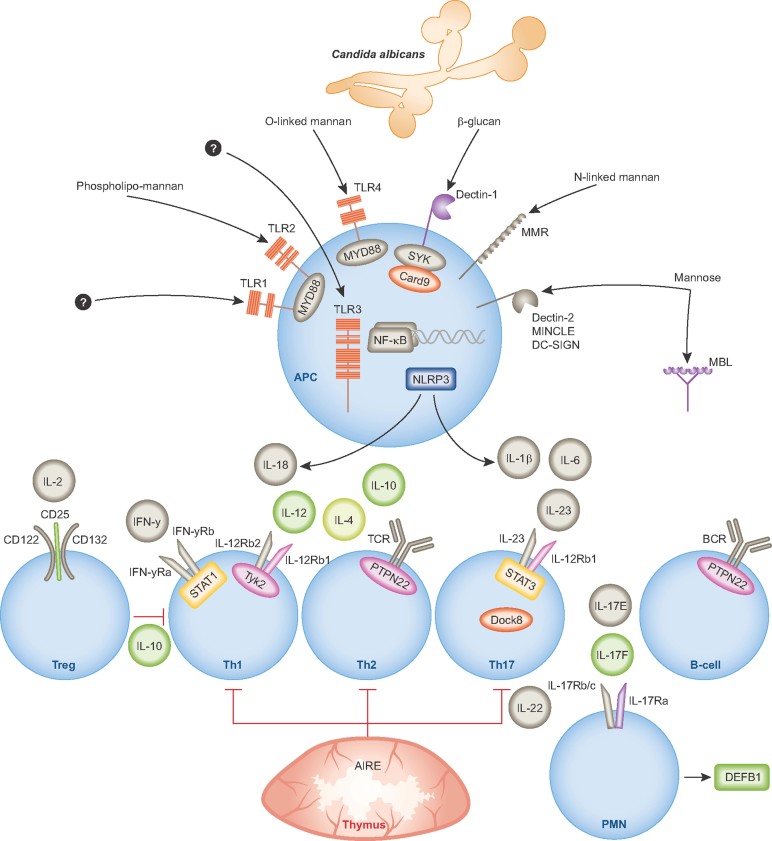
Candida spp. are medically important fungi causing severe mucosal and life-threatening invasive infections, especially in immunocompromised hosts. However, not all individuals at risk develop Candida infections, and it is believed that genetic variation plays an important role in host susceptibility. On the one hand, severe fungal infections are associated with monogenic primary immunodeficiencies such as defects in STAT1, STAT3 or CARD9, recently discovered as novel clinical entities. On the other hand, more common polymorphisms in genes of the immune system have also been associated with fungal infections such as recurrent vulvovaginal candidiasis and candidemia. The discovery of the genetic susceptibility to Candida infections can lead to a better understanding of the pathogenesis of the disease, as well as to the design of novel immunotherapeutic strategies. This review is part of the review series on host-pathogen interactions. See more reviews from this series.
念珠菌属是医学上重要的真菌,可引起严重的黏膜和危及生命的侵袭性感染,尤其在免疫功能低下的宿主中。然而,并非所有处于危险中的个体都会发生念珠菌感染,人们认为遗传变异在宿主易感性中起着重要作用。一方面,严重的真菌感染与单基因原发性免疫缺陷有关,例如 STAT1、STAT3 或 CARD9 缺陷,这些缺陷最近被发现是新的临床实体。另一方面,免疫系统基因中的常见多态性也与真菌感染有关,如复发性外阴阴道念珠菌病和念珠菌血症。对念珠菌感染遗传易感性的发现可以更好地了解疾病的发病机制,并设计新的免疫治疗策略。这篇综述是宿主-病原体相互作用综述系列的一部分。更多来自该系列的综述,请参见此处。