Quimby Jessica M, Webb Tracy L, Habenicht Lauren M, Dow Steven W
Stem Cell Res Ther. 2013 Apr 30;4(2):48. doi: 10.1186/scrt198.
Administration of mesenchymal stem cells (MSCs) has been shown to improve renal function in rodent models of chronic kidney disease (CKD), in part by reducing intrarenal inflammation and suppressing fibrosis. CKD in cats is characterized by tubulointerstitial inflammation and fibrosis, and thus treatment with MSCs might improve renal function and urinary markers of inflammation in this disease. Therefore, a series of pilot studies was conducted to assess the safety and efficacy of intravenous administration of allogeneic adipose-derived MSCs (aMSCs) in cats with naturally occurring CKD.
Cats enrolled in these studies received an intravenous infusion of allogeneic aMSCs every 2 weeks collected from healthy, young, specific pathogen-free cats. Cats in pilot study 1 (six cats) received 2 × 10⁶ cryopreserved aMSCs per infusion, cats in pilot study 2 (five cats) received 4 × 10⁶ cryopreserved aMSCs per infusion, and cats in pilot study 3 (five cats) received 4 × 10⁶ aMSCs cultured from cryopreserved adipose. Serum biochemistry, complete blood count, urinalysis, urine protein, glomerular filtration rate, and urinary cytokine concentrations were monitored during the treatment period. Changes in clinical parameters were compared statistically by means of repeated measures analysis of variance (ANOVA) followed by Bonferroni's correction.
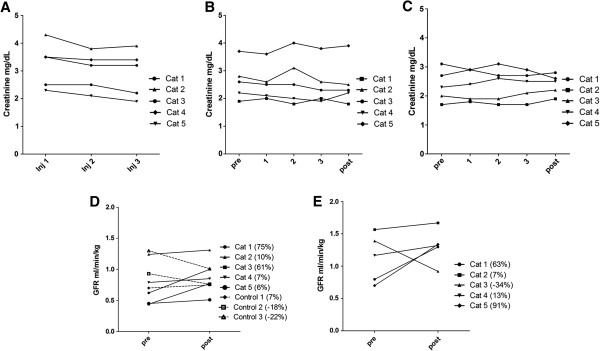
Cats in pilot study 1 had few adverse effects from the aMSC infusions and there was a statistically significant decrease in serum creatinine concentrations during the study period, however the degree of decrease seems unlikely to be clinically relevant. Adverse effects of the aMSC infusion in cats in pilot study 2 included vomiting (2/5 cats) during infusion and increased respiratory rate and effort (4/5 cats). Cats in pilot study 3 did not experience any adverse side effects. Serum creatinine concentrations and glomerular filtration rates did not change significantly in cats in pilot studies 2 and 3.
Administration of cryopreserved aMSCs was associated with significant adverse effects and no discernible clinically relevant improvement in renal functional parameters. Administration of aMSCs cultured from cryopreserved adipose was not associated with adverse effects, but was also not associated with improvement in renal functional parameters.
在慢性肾脏病(CKD)的啮齿动物模型中,间充质干细胞(MSCs)的给药已被证明可改善肾功能,部分原因是减少肾内炎症和抑制纤维化。猫的CKD以肾小管间质炎症和纤维化为特征,因此用MSCs治疗可能改善该疾病的肾功能和炎症的尿液标志物。因此,进行了一系列初步研究,以评估静脉注射同种异体脂肪来源的MSCs(aMSCs)对自然发生CKD的猫的安全性和有效性。
参与这些研究的猫每2周接受一次从健康、年轻、无特定病原体的猫收集的同种异体aMSCs静脉输注。初步研究1中的猫(6只猫)每次输注接受2×10⁶个冷冻保存的aMSCs,初步研究2中的猫(5只猫)每次输注接受4×10⁶个冷冻保存的aMSCs,初步研究3中的猫(5只猫)接受从冷冻保存的脂肪中培养的4×10⁶个aMSCs。在治疗期间监测血清生化、全血细胞计数、尿液分析、尿蛋白、肾小球滤过率和尿液细胞因子浓度。通过重复测量方差分析(ANOVA),然后进行Bonferroni校正,对临床参数的变化进行统计学比较。
初步研究1中的猫接受aMSCs输注的不良反应很少,并且在研究期间血清肌酐浓度有统计学意义的下降,然而下降程度似乎不太可能具有临床相关性。初步研究2中的猫接受aMSCs输注的不良反应包括输注期间呕吐(2/5只猫)以及呼吸频率和用力增加(4/5只猫)。初步研究3中的猫没有经历任何不良副作用。初步研究2和3中的猫的血清肌酐浓度和肾小球滤过率没有显著变化。
冷冻保存的aMSCs给药与显著的不良反应相关,并且在肾功能参数方面没有明显的临床相关改善。从冷冻保存的脂肪中培养的aMSCs给药与不良反应无关,但也与肾功能参数的改善无关。