BMC Geriatr. 2013 May 1;13:41. doi: 10.1186/1471-2318-13-41.
Omega-3 (n-3) fatty acid supplementation is becoming increasingly popular. However given its antithrombotic properties the potential for severe adverse events (SAE) such as bleeding has safety implications, particularly in an older adult population. A systematic review of randomized control trials (RCT) was conducted to explore the potential for SAE and non-severe adverse events (non-SAE) associated with n-3 supplementation in older adults.
A comprehensive search strategy using Medline and a variety of other electronic sources was conducted. Studies investigating the oral administration of n-3 fish oil containing eicosapentaenoic acid (EPA), docosahexaenoic acid (DHA) or both against a placebo were sourced. The primary outcome of interest included reported SAE associated with n-3 supplementation. Chi-square analyses were conducted on the pooled aggregate of AEs.
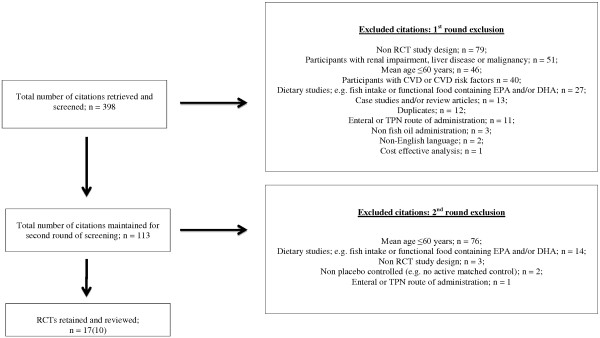
Of the 398 citations initially retrieved, a total of 10 studies involving 994 older adults aged ≥60 years were included in the review. Daily fish oil doses ranged from 0.03 g to 1.86 g EPA and/or DHA with study durations ranging from 6 to 52 weeks. No SAE were reported and there were no significant differences in the total AE rate between groups (n-3 intervention group: 53/540; 9.8%; placebo group: 28/454; 6.2%; p = 0.07). Non-SAE relating to gastrointestinal (GI) disturbances were the most commonly reported however there was no significant increase in the proportion of GI disturbances reported in participants randomized to the n-3 intervention (n-3 intervention group: 42/540 (7.8%); placebo group: 24/454 (5.3%); p = 0.18).
The potential for AEs appear mild-moderate at worst and are unlikely to be of clinical significance. The use of n-3 fatty acids and the potential for SAE should however be further researched to investigate whether this evidence is consistent at higher doses and in other populations. These results also highlight that well-documented data outlining the potential for SAE following n-3 supplementation are limited nor adequately reported to draw definitive conclusions concerning the safety associated with n-3 supplementation. A more rigorous and systematic approach for monitoring and recording AE data in clinical settings that involve n-3 supplementation is required.
ω-3(n-3)脂肪酸补充剂越来越受欢迎。然而,由于其抗血栓特性,可能会发生严重不良事件(SAE),如出血,这具有安全性影响,特别是在老年人群中。系统评价了随机对照试验(RCT),以探讨 n-3 补充剂与老年人相关的 SAE 和非严重不良事件(非 SAE)的潜在风险。
使用 Medline 和各种其他电子资源进行了全面的搜索策略。研究了口服含二十碳五烯酸(EPA)、二十二碳六烯酸(DHA)或两者的 n-3 鱼油与安慰剂相比的安全性。主要观察指标为与 n-3 补充剂相关的报告 SAE。对 AE 的汇总数据进行了卡方分析。
在最初检索到的 398 篇引文 中,共有 10 项研究纳入了 994 名年龄≥60 岁的老年人,共计 10 项研究。每日鱼油剂量范围为 0.03g 至 1.86g EPA 和/或 DHA,研究持续时间为 6 至 52 周。未报告 SAE,两组的总 AE 发生率无显著差异(n-3 干预组:53/540;9.8%;安慰剂组:28/454;6.2%;p=0.07)。与胃肠道(GI)紊乱相关的非 SAE 是最常报告的,但随机分配到 n-3 干预组的参与者中报告的 GI 紊乱比例没有显著增加(n-3 干预组:42/540(7.8%);安慰剂组:24/454(5.3%);p=0.18)。
AE 的可能性似乎是温和至中度的,不太可能具有临床意义。然而,应该进一步研究 n-3 脂肪酸的使用和 SAE 的可能性,以调查在更高剂量和其他人群中这一证据是否一致。这些结果还表明,关于 n-3 补充剂后 SAE 潜在风险的记录数据有限,也没有充分报告,无法就 n-3 补充剂的安全性得出明确结论。需要在涉及 n-3 补充剂的临床环境中采取更严格和系统的方法来监测和记录 AE 数据。