Dementia Research Centre, UCL Institute of Neurology, University College London, London, UK.
Neurodegener Dis. 2013;12(4):165-76. doi: 10.1159/000350060. Epub 2013 Apr 26.
Understanding the pathophysiology of Alzheimer's disease (AD) is of fundamental importance for improved diagnosis, monitoring and ultimately, treatment.
A role for the sleep-wake cycle in the pathogenesis of AD has been proposed, but remains to be worked out in detail.
Here we draw together several lines of previous work to outline a 'hypnic hypothesis' of AD.
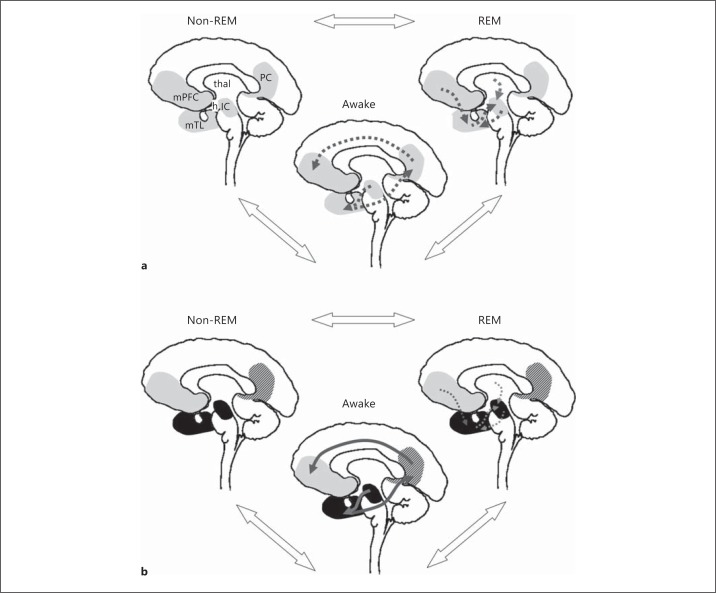
We propose that altered function of brainstem neurotransmitter pathways associated with sleep, promotes regionally specific disintegration of a cortico-subcortical 'default mode' brain network that is selectively vulnerable in AD.
The formation of a dynamic toxic state within this vulnerable network linked to sleep-wake disruption, would in turn lead to failure of synaptic repair, increased transmission of pathogenic misfolded proteins and a self-amplifying neurodegenerative process. We consider the evidence for this hypnic hypothesis and the implications that follow on from it.
了解阿尔茨海默病(AD)的病理生理学对于改善诊断、监测,最终治疗具有重要意义。
有人提出,睡眠-觉醒周期在 AD 的发病机制中起作用,但仍需详细研究。
在这里,我们综合了之前的几项研究结果,概述了 AD 的“催眠假说”。
我们提出,与睡眠相关的脑干神经递质通路功能改变,会促进皮质-皮质下“默认模式”神经网络的区域性特异性瓦解,而这种网络在 AD 中是选择性脆弱的。
在与睡眠-觉醒中断相关的易损网络内形成动态毒性状态,反过来会导致突触修复失败、致病性错误折叠蛋白的过度传递以及自我放大的神经退行性过程。我们考虑了这种催眠假说的证据及其后续影响。