Blöte Anke W, Miers Anne C, Heyne David A, Clark David M, Westenberg P Michiel
Leiden University,The Netherlands.
University of Oxford,UK.
Behav Cogn Psychother. 2014 Sep;42(5):555-67. doi: 10.1017/S1352465813000271. Epub 2013 May 1.
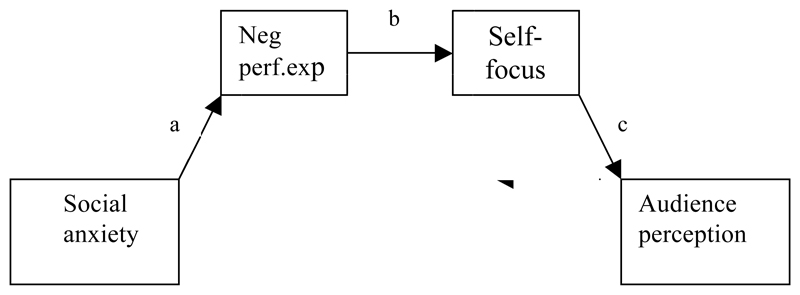
Clark and Wells' cognitive model of social anxiety proposes that socially anxious individuals have negative expectations of performance prior to a social event, focus their attention predominantly on themselves and on their negative self-evaluations during an event, and use this negative self-processing to infer that other people are judging them harshly.
The present study tested these propositions.
The study used a community sample of 161 adolescents aged 14-18 years. The participants gave a speech in front of a pre-recorded audience acting neutrally, and participants were aware that the projected audience was pre-recorded.
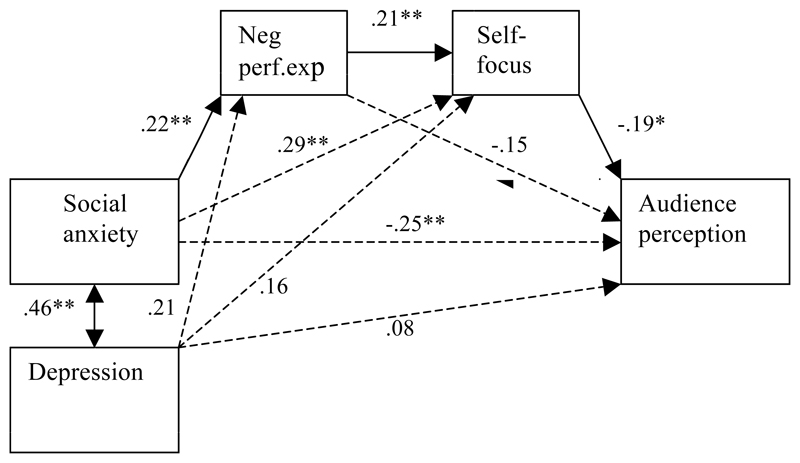
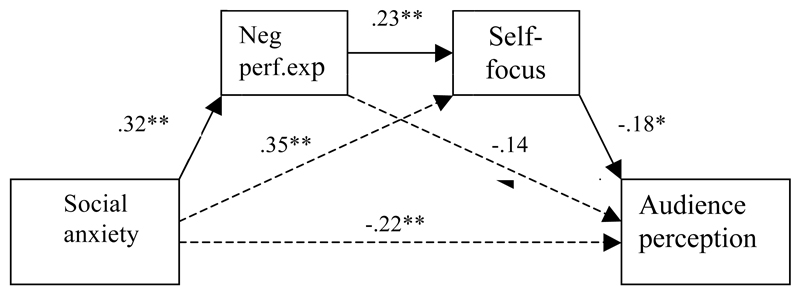
As expected, participants with higher levels of social anxiety had more negative performance expectations, higher self-focused attention, and more negative perceptions of the audience. Negative performance expectations and self-focused attention were found to mediate the relationship between social anxiety and audience perception.
The findings support Clark and Wells' cognitive model of social anxiety, which poses that socially anxious individuals have distorted perceptions of the responses of other people because their perceptions are coloured by their negative thoughts and feelings.
克拉克和韦尔斯的社交焦虑认知模型提出,社交焦虑个体在社交活动前对表现有负面预期,在活动期间将注意力主要集中在自己和负面自我评价上,并利用这种负面自我加工推断他人在严厉评判自己。
本研究对这些观点进行了测试。
该研究使用了一个由161名14至18岁青少年组成的社区样本。参与者在预先录制的表现中立的观众面前发表演讲,且参与者知晓投射出的观众是预先录制的。
正如预期的那样,社交焦虑水平较高的参与者有更多负面表现预期、更高的自我关注以及对观众更负面的看法。研究发现负面表现预期和自我关注在社交焦虑与对观众的看法之间起中介作用。
研究结果支持克拉克和韦尔斯的社交焦虑认知模型,该模型认为社交焦虑个体对他人反应的认知存在扭曲,因为他们的认知被负面思想和感受所影响。