Gondhalekar Gauri Arun, Deo Medha Vasant
Department of Musculoskeletal Physiotherapy, Terna Physiotherapy College, Navi-Mumbai, Maharashtra, India.
N Am J Med Sci. 2013 Feb;5(2):108-12. doi: 10.4103/1947-2714.107527.
Increased external knee adduction moment during walking alters the joint biomechanics; which causes symptoms in chronic knee osteoarthritis patients.
To assess additional effects of Retro-walking over conventional treatment on pain and disability in patients with acute exacerbation of chronic knee osteoarthritis.
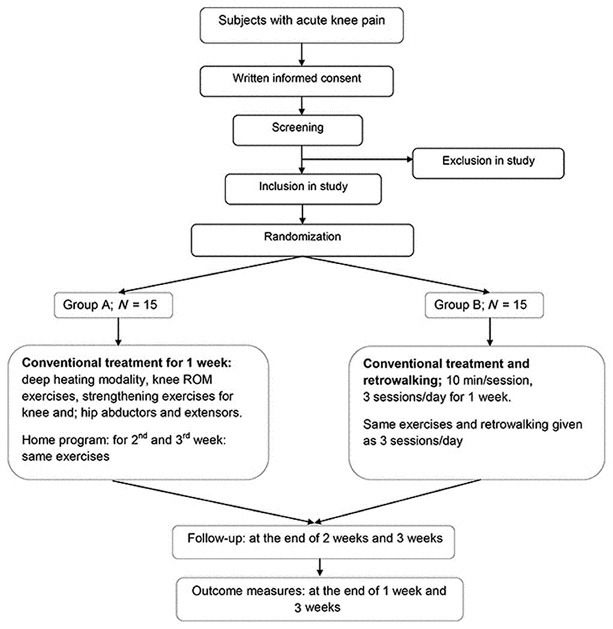
Thirty chronic knee osteoarthritis patients were randomly assigned into 2 groups. Group 'A' (7 men, 8 women) received conventional treatment. Group 'B' (8 men, 7 women) received conventional treatment and Retro-walking. Pain, assessed through visual analogue scale (VAS), and Western Ontario and McMaster Universities Arthritis Index (WOMAC) were the primary outcomes and knee range of motion (ROM), hip abductor and extensor strength were secondary outcomes; measured pre-intervention, after 1 week and after 3 weeks of intervention.
Two factors analysis of variance for repeated measures was used for all outcomes. At the end of 3 weeks; WOMAC score showed highly significant difference within (P < 0.0001) and significant difference between groups (P = 0.040) also by Time × group interaction (P = 0.024), VAS showed highly significant difference within groups (P < 0.0001). Knee ROM showed significant difference within groups. Hip abductor and extensor strength showed significant difference by Time × group interaction (P < 0.05).
Retrowalking is an effective adjunct to conventional treatment in decreasing disability in patients with knee osteoarthritis.
步行过程中外侧膝关节内收力矩增加会改变关节生物力学,这会导致慢性膝关节骨关节炎患者出现症状。
评估倒走相对于传统治疗对慢性膝关节骨关节炎急性加重患者疼痛和功能障碍的额外影响。
30例慢性膝关节骨关节炎患者被随机分为2组。A组(7名男性,8名女性)接受传统治疗。B组(8名男性,7名女性)接受传统治疗和倒走。通过视觉模拟量表(VAS)评估的疼痛以及西安大略和麦克马斯特大学骨关节炎指数(WOMAC)为主要结局指标,膝关节活动范围(ROM)、髋外展肌和伸肌力量为次要结局指标;在干预前、干预1周后和干预3周后进行测量。
所有结局指标均采用重复测量的双因素方差分析。在3周结束时;WOMAC评分在组内显示出高度显著差异(P < 0.0001),组间也有显著差异(P = 0.040),且通过时间×组间交互作用也有显著差异(P = 0.024),VAS在组内显示出高度显著差异(P < 0.0001)。膝关节ROM在组内显示出显著差异。髋外展肌和伸肌力量通过时间×组间交互作用显示出显著差异(P < 0.05)。
倒走是传统治疗的有效辅助手段,可减少膝关节骨关节炎患者的功能障碍。