Department of Molecular Biology and Genetics, Aarhus University, Aarhus, Denmark.
mBio. 2013 May 7;4(3):e00270-13. doi: 10.1128/mBio.00270-13.
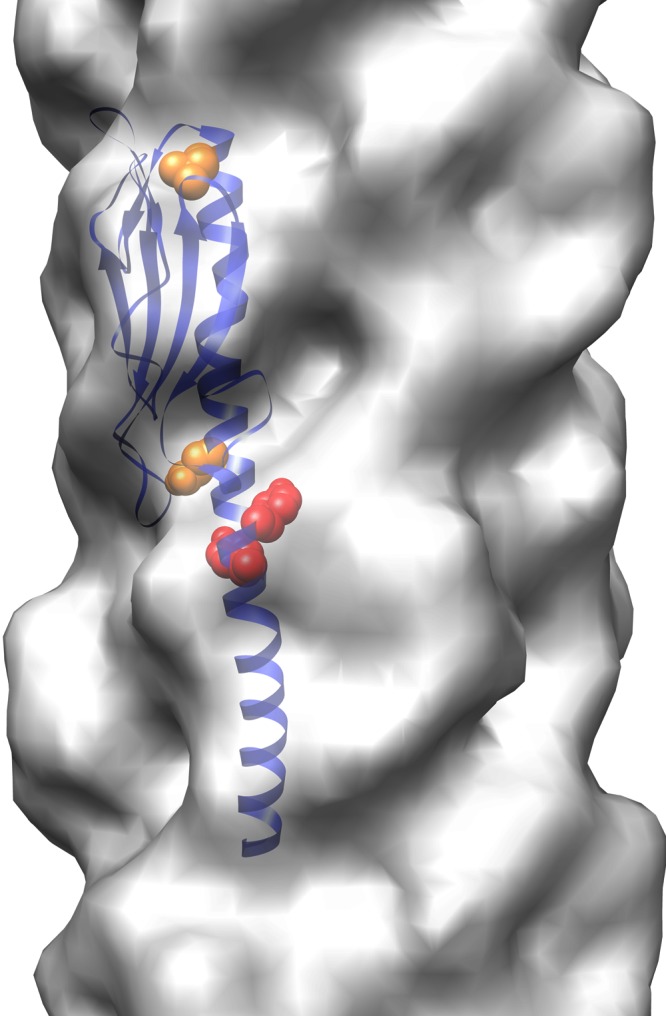
The discovery of bacterial conductive structures, termed nanowires, has intrigued scientists for almost a decade. Nanowires enable bacteria to transfer electrons over micrometer distances to extracellular electron acceptors such as insoluble metal oxides or electrodes. Nanowires are pilus based and in Geobacter sulfurreducens are composed of the type IV pilin subunit PilA. Multiheme c-type cytochromes have been shown to attach to nanowire pili. Two hypotheses have been proposed for electron conduction in nanowires. The first (termed the metal-like conductivity or MLC hypothesis) claims that the pilus itself has the electron-conductive properties and the attached cytochromes mediate transfer to the final electron acceptor, whereas the second hypothesis (termed the superexchange conductivity or SEC hypothesis) suggests that electrons are "hopping" between heme groups in cytochromes closely aligned with the pilus as a scaffold. In their recent article in mBio, Vargas et al. [M. Vargas, N. S. Malvankar, P.-L. Tremblay, C. Leang, J. A. Smith, P. Patel, O. Snoeyenbos-West, K. P. Nevin, and D. R. Lovley, mBio 4(2):e00210-13, 2013] address this ambiguity through an analysis of strain Aro-5, a G. sulfurreducens PilA mutant lacking aromatic residues in the nonconserved portion of PilA. These residues were suspected of involvement in electron transport according to the MLC hypothesis. The G. sulfurreducens mutant had reduced conductive properties, lending important support to the MLC hypothesis. The data also highlight the need for further and more conclusive evidence for one or the other hypothesis.
细菌导电结构(称为纳米线)的发现引起了科学家近十年的兴趣。纳米线使细菌能够将电子转移到微米距离的细胞外电子受体,如不溶性金属氧化物或电极。纳米线基于菌毛,在脱硫弧菌中由 IV 型菌毛亚基 PilA 组成。多血红素 c 型细胞色素已被证明附着在纳米线菌毛上。已经提出了两种关于纳米线中电子传导的假说。第一个假说(称为金属样导电性或 MLC 假说)声称菌毛本身具有导电性,并且附着的细胞色素介导向最终电子受体的转移,而第二个假说(称为超交换导电性或 SEC 假说)表明电子在与菌毛紧密排列的细胞色素中的血红素基团之间“跳跃”作为支架。在他们最近在 mBio 上的文章中,Vargas 等人 [M. Vargas, N. S. Malvankar, P.-L. Tremblay, C. Leang, J. A. Smith, P. Patel, O. Snoeyenbos-West, K. P. Nevin, and D. R. Lovley, mBio 4(2):e00210-13, 2013] 通过分析 G. sulfurreducens PilA 突变体 Aro-5 解决了这种歧义,该突变体缺乏 PilA 中非保守部分的芳香族残基。根据 MLC 假说,这些残基被怀疑参与电子传递。G. sulfurreducens 突变体的导电性能降低,为 MLC 假说提供了重要支持。该数据还强调需要进一步和更具决定性的证据来支持一个或另一个假说。