University of Washington-Harborview Center for Prehospital Emergency Care, Seattle, WA, USA.
Scand J Trauma Resusc Emerg Med. 2013 May 10;21:36. doi: 10.1186/1757-7241-21-36.
Cardiopulmonary resuscitation (CPR) improves outcomes after cardiac arrest. Much of the lay public is untrained in CPR skills. We evaluated the effectiveness of a compression-only CPR video self-instruction (VSI) with a personal manikin in the lay public.
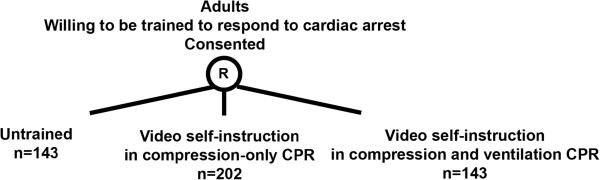
Adults without prior CPR training in the past year or responsibility to provide medical care were randomized into one of three groups: 1) Untrained before testing, 2) 10-minute VSI in compressions-only CPR (CPR Anytime, American Heart Association, Dallas, TX), or 3) 22-minute VSI in compressions and ventilations (CPR Anytime). CPR proficiency was assessed using a sensored manikin. The primary outcome was composite skill competence of 90% during five minutes of skill demonstration. Evaluated were alternative cut-points for skill competence and individual components of CPR. 488 subjects (143 in untrained group, 202 in compressions-only group and 143 in compressions and ventilation group) were required to detect 21% competency with compressions-only versus 7% with untrained and 34% with compressions and ventilations.
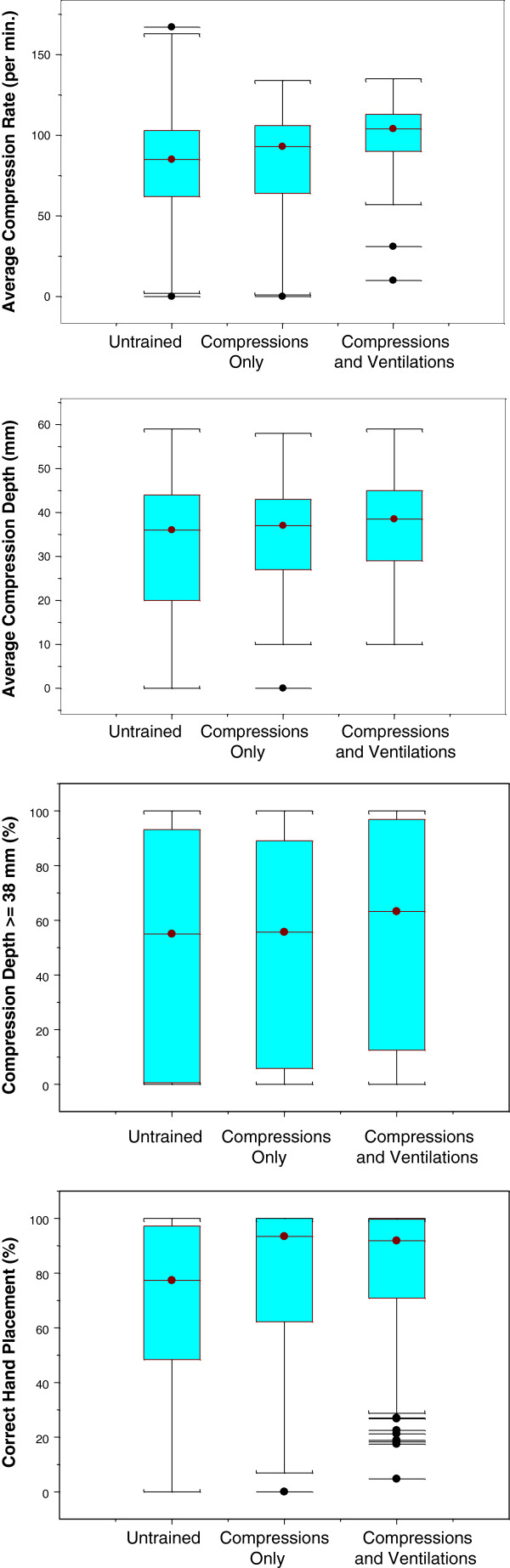
Analyzable data were available for the untrained group (n = 135), compressions-only group (n = 185) and the compressions and ventilation group (n = 119). Four (3%) achieved competency in the untrained group (p-value = 0.57 versus compressions-only), nine (4.9%) in the compressions-only group, and 12 (10.1%) in the compressions and ventilations group (p-value 0.13 vs. compressions-only). The compressions-only group had a greater proportion of correct compressions (p-value = 0.028) and compressions with correct hand placement (p-value = 0.0004) compared to the untrained group.
VSI in compressions-only CPR did not achieve greater overall competency but did achieve some CPR skills better than without training.
心肺复苏(CPR)可改善心搏骤停后的预后。大多数非专业人员并未接受过 CPR 技能培训。我们评估了在非专业人员中使用仅按压式 CPR 视频自我指导(VSI)与个人模型的效果。
过去一年中未接受过 CPR 培训或无提供医疗护理责任的成年人被随机分为三组:1)测试前未经培训,2)仅接受 10 分钟的 VSI 培训(CPR Anytime,美国心脏协会,达拉斯,TX),或 3)仅接受 22 分钟的 VSI 培训(CPR Anytime),包括按压和通气。使用带传感器的模型评估 CPR 熟练度。主要结局是在五分钟技能演示中达到 90%的综合技能合格标准。评估了技能合格的替代切点和 CPR 的各个组成部分。需要 488 名受试者(未经培训组 143 名,仅按压组 202 名,按压和通气组 143 名)来检测仅按压组的 21%与未经培训组的 7%和按压和通气组的 34%的合格水平。
可分析数据可用于未经培训组(n = 135)、仅按压组(n = 185)和按压和通气组(n = 119)。未经培训组中有 4 名(3%)达到合格标准(p 值= 0.57 与仅按压组相比),仅按压组中有 9 名(4.9%),按压和通气组中有 12 名(10.1%)(p 值= 0.13 与仅按压组相比)。与未经培训组相比,仅按压组的正确按压比例更大(p 值= 0.028),正确手部放置的按压比例更大(p 值= 0.0004)。
仅按压式 CPR 的 VSI 培训并未提高整体合格率,但在某些 CPR 技能方面要好于未经培训。