Gamper Marianne, Viereck Volker, Eberhard Jakob, Binder Jochen, Moll Carlo, Welter Joellen, Moser René
IKBT, Institut für Klinische Biomedizinische Forschung Thurgau, Lauchefeld 31, 9548, Matzingen, Switzerland,
Int Urogynecol J. 2013 Dec;24(12):2049-57. doi: 10.1007/s00192-013-2112-0. Epub 2013 May 14.
Bladder pain syndrome/interstitial cystitis (BPS/IC) is identified based on subjective symptoms which lead to heterogeneous patient populations. Previous studies using gene expression arrays for BPS/IC with Hunner's lesions [European Society for the Study of Interstitial Cystitis (ESSIC) type 3C], a subtype of the condition discernible by cystoscopy, have revealed characteristic immune responses and urothelial abnormalities. This current study aimed to further characterize this subtype using a gene expression panel. We hypothesized that B-cell activation with high levels of urinary antibody concentration would be found.
Cold-cup bladder biopsies, catheterized urine and blood were collected from 15 BPS/IC ESSIC type 3C patients, 11 non-inflammatory overactive bladder (OAB) patients and eight healthy controls. Gene expression in biopsies was quantified by real-time quantitative polymerase chain reaction (RT-qPCR), immunohistochemistry was performed on bladder tissue and urinary immunoglobulins G and A were quantified by enzyme-linked immunosorbent assay. Statistical analyses included the Kruskal-Wallis test for non-parametric data and post hoc tests identified differences between groups.
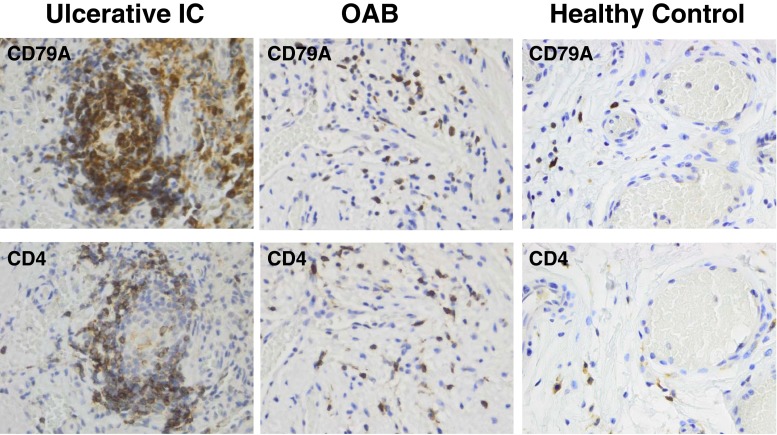
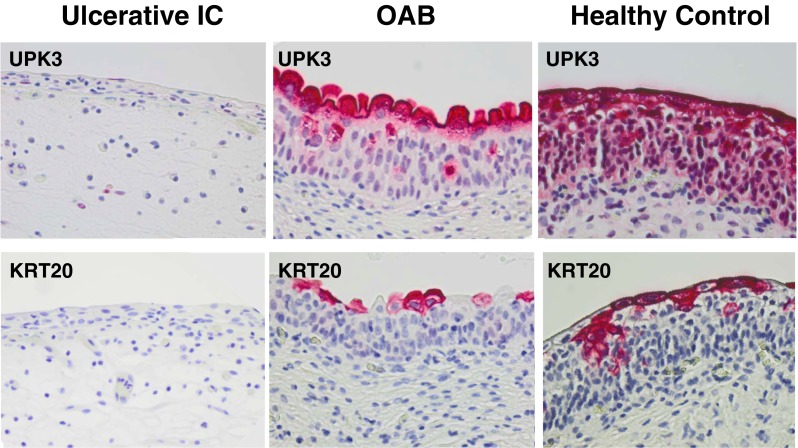
High expression of T- and B-cell markers (CTLA4, CD20, CD79A, IGH@), low expression of urothelial markers (KRT20, UPK1B, UPK3A), focal lymphoid aggregates in the submucosa and high immunoglobulin concentration in urine were found exclusively in BPS/IC ESSIC type 3C patients. Results for OAB were in intermediate ranges between the other two groups and UPK1B even reached significantly lower expression when compared to healthy controls.
BPS/IC ESSIC type 3C is characterized by a local adaptive immune response with elevated urinary antibody concentrations. Quantification of urinary immunoglobulin levels could be used for a non-invasive diagnosis of BPS/IC ESSIC type 3C.
膀胱疼痛综合征/间质性膀胱炎(BPS/IC)是根据主观症状来确定的,这导致了患者群体的异质性。先前使用基因表达阵列对患有Hunner病变的BPS/IC(欧洲间质性膀胱炎研究学会(ESSIC)3C型)进行研究,该亚型可通过膀胱镜检查辨别,研究揭示了其特征性免疫反应和尿路上皮异常。本研究旨在使用基因表达谱进一步表征该亚型。我们假设会发现高水平尿抗体浓度导致的B细胞活化。
收集了15例BPS/IC ESSIC 3C型患者、11例非炎性膀胱过度活动症(OAB)患者和8名健康对照者的冷杯膀胱活检组织、导尿尿液和血液。通过实时定量聚合酶链反应(RT-qPCR)对活检组织中的基因表达进行定量,对膀胱组织进行免疫组织化学检测,并通过酶联免疫吸附测定法定量尿液中的免疫球蛋白G和A。统计分析包括对非参数数据的Kruskal-Wallis检验,并通过事后检验确定组间差异。
仅在BPS/IC ESSIC 3C型患者中发现T细胞和B细胞标志物(CTLA4、CD20、CD79A、IGH@)高表达、尿路上皮标志物(KRT20、UPK1B,、UPK3A)低表达、黏膜下局灶性淋巴聚集以及尿液中免疫球蛋白浓度高。OAB患者的结果介于其他两组之间,与健康对照相比,UPK1B的表达甚至显著降低。
BPS/IC ESSIC 3C型的特征是局部适应性免疫反应以及尿抗体浓度升高。尿免疫球蛋白水平的定量可用于BPS/IC ESSIC 3C型的无创诊断。