Faculty of Health Sciences, University of Southampton, Highfield Campus, Southampton SO17 1BJ, UK.
BMJ. 2013 May 13;346:f2882. doi: 10.1136/bmj.f2882.
To determine the effectiveness of an intervention to enhance self management support for patients with chronic conditions in UK primary care.
Pragmatic, two arm, cluster randomised controlled trial.
General practices, serving a population in northwest England with high levels of deprivation.
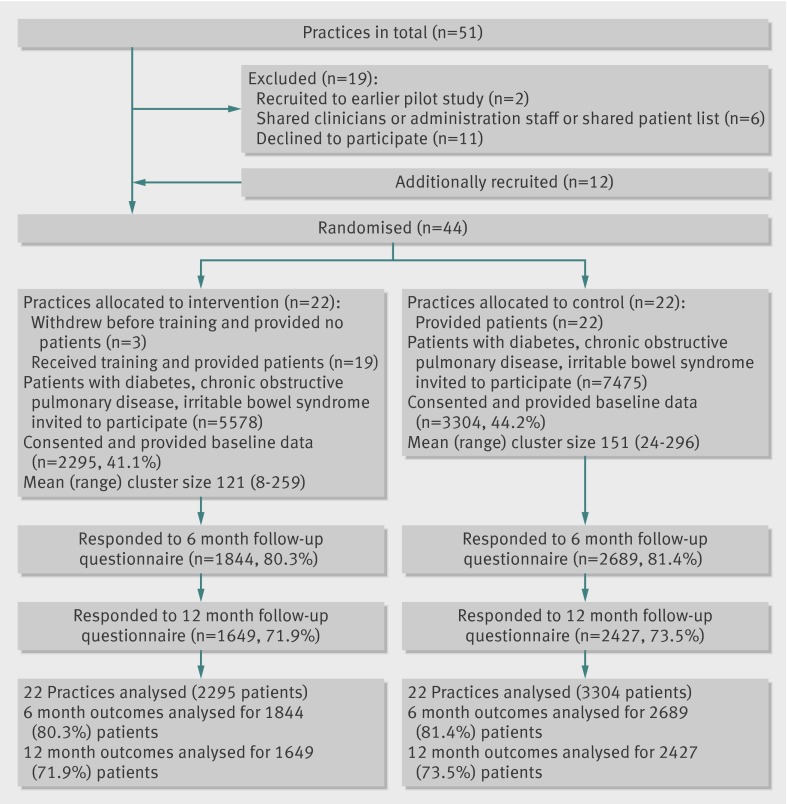
5599 patients with a diagnosis of diabetes (n=2546), chronic obstructive pulmonary disease (n=1634), and irritable bowel syndrome (n=1419) from 43 practices (19 intervention and 22 control practices).
Practice level training in a whole systems approach to self management support. Practices were trained to use a range of resources: a tool to assess the support needs of patients, guidebooks on self management, and a web based directory of local self management resources. Training facilitators were employed by the health management organisation.
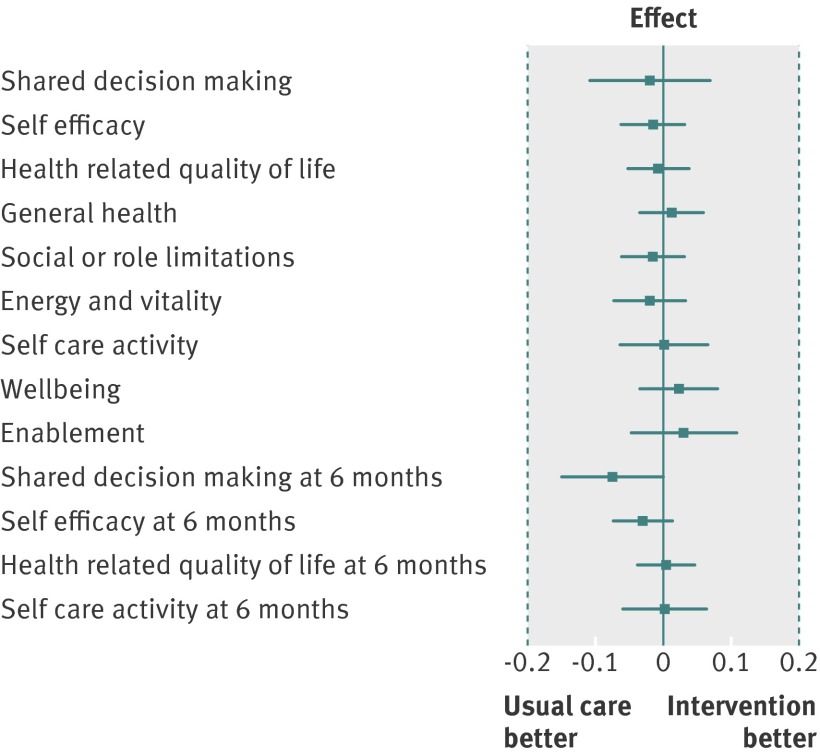
Primary outcomes were shared decision making, self efficacy, and generic health related quality of life measured at 12 months. Secondary outcomes were general health, social or role limitations, energy and vitality, psychological wellbeing, self care activity, and enablement.
We randomised 44 practices and recruited 5599 patients, representing 43% of the eligible population on the practice lists. 4533 patients (81.0%) completed the six month follow-up and 4076 (72.8%) the 12 month follow-up. No statistically significant differences were found between patients attending trained practices and those attending control practices on any of the primary or secondary outcomes. All effect size estimates were well below the prespecified threshold of clinically important difference.
An intervention to enhance self management support in routine primary care did not add noticeable value to existing care for long term conditions. The active components required for effective self management support need to be better understood, both within primary care and in patients' everyday lives.
Current Controlled Trials ISRCTN90940049.
确定在英国初级保健中增强对慢性病患者自我管理支持的干预措施的效果。
实用的、双臂、整群随机对照试验。
服务于英格兰西北部一个人口高度贫困地区的全科医生诊所。
43 家诊所(19 家干预诊所和 22 家对照诊所)的 5599 名患有糖尿病(n=2546)、慢性阻塞性肺疾病(n=1634)和肠易激综合征(n=1419)的患者。
针对自我管理支持的全系统方法进行实践层面的培训。培训使实践能够使用一系列资源:一种评估患者支持需求的工具、自我管理指南和基于网络的本地自我管理资源目录。培训协调员由健康管理组织雇用。
12 个月时的主要结果是共同决策、自我效能和一般健康相关生活质量。次要结果是一般健康、社会或角色限制、能量和活力、心理健康、自我护理活动和赋权。
我们随机分配了 44 家诊所,并招募了 5599 名患者,占实践名单上合格人群的 43%。4533 名患者(81.0%)完成了 6 个月的随访,4076 名患者(72.8%)完成了 12 个月的随访。在任何主要或次要结果上,接受培训实践治疗的患者与接受对照实践治疗的患者之间没有发现统计学上的显著差异。所有效果大小估计都远低于预定的临床重要差异阈值。
增强常规初级保健中自我管理支持的干预措施并没有为长期疾病护理增加明显的价值。需要更好地了解有效自我管理支持的积极组成部分,包括在初级保健和患者的日常生活中。
当前对照试验 ISRCTN90940049。