Ong ChiWei, Dokos Socrates, Chan BeeTing, Lim Einly, Al Abed Amr, Bin Abu Osman Noor Azuan, Kadiman Suhaini, Lovell Nigel H
Faculty of Biomedical Engineering, University of Malaya, Malaysia University of Malaya, 50603 Kuala Lumpur, Malaysia.
Theor Biol Med Model. 2013 May 16;10:35. doi: 10.1186/1742-4682-10-35.
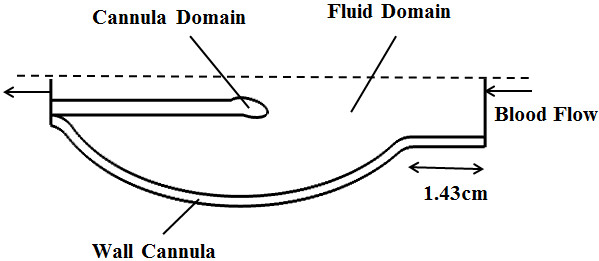
Despite the rapid advancement of left ventricular assist devices (LVADs), adverse events leading to deaths have been frequently reported in patients implanted with LVADs, including bleeding, infection, thromboembolism, neurological dysfunction and hemolysis. Cannulation forms an important component with regards to thrombus formation in assisted patients by varying the intraventricular flow distribution in the left ventricle (LV). To investigate the correlation between LVAD cannula placement and potential for thrombus formation, detailed analysis of the intraventricular flow field was carried out in the present study using a two way fluid structure interaction (FSI), axisymmetric model of a passive LV incorporating an inflow cannula. Three different cannula placements were simulated, with device insertion near the LV apex, penetrating one-fourth and mid-way into the LV long axis. The risk of thrombus formation is assessed by analyzing the intraventricular vorticity distribution and its associated vortex intensity, amount of stagnation flow in the ventricle as well as the level of wall shear stress. Our results show that the one-fourth placement of the cannula into the LV achieves the best performance in reducing the risk of thrombus formation. Compared to cannula placement near the apex, higher vortex intensity is achieved at the one-fourth placement, thus increasing wash out of platelets at the ventricular wall. One-fourth LV penetration produced negligible stagnation flow region near the apical wall region, helping to reduce platelet deposition on the surface of the cannula and the ventricular wall.
尽管左心室辅助装置(LVADs)迅速发展,但植入LVADs的患者中导致死亡的不良事件仍屡有报道,包括出血、感染、血栓栓塞、神经功能障碍和溶血。插管通过改变左心室(LV)内的室内心脏血流分布,在辅助患者血栓形成方面构成一个重要因素。为了研究LVAD插管位置与血栓形成可能性之间的相关性,本研究使用双向流固耦合(FSI)对包含流入插管的被动左心室轴对称模型进行了详细的室内流场分析。模拟了三种不同的插管位置,即装置插入左心室心尖附近、穿透左心室长轴的四分之一处和中途位置。通过分析室内涡度分布及其相关的涡旋强度、心室内的停滞流数量以及壁面剪应力水平来评估血栓形成的风险。我们的结果表明,将插管四分之一处插入左心室在降低血栓形成风险方面表现最佳。与插管位于心尖附近相比,四分之一处插管位置实现了更高的涡旋强度,从而增加了心室壁处血小板的清除。左心室四分之一处的穿透在靠近心尖壁区域产生的停滞流区域可忽略不计,有助于减少血小板在插管表面和心室壁上的沉积。